How bridges get built · Bored piles and deep foundations · Tremie concreting of piles
Also called: underwater concrete placement, tremie method, tremie pipe
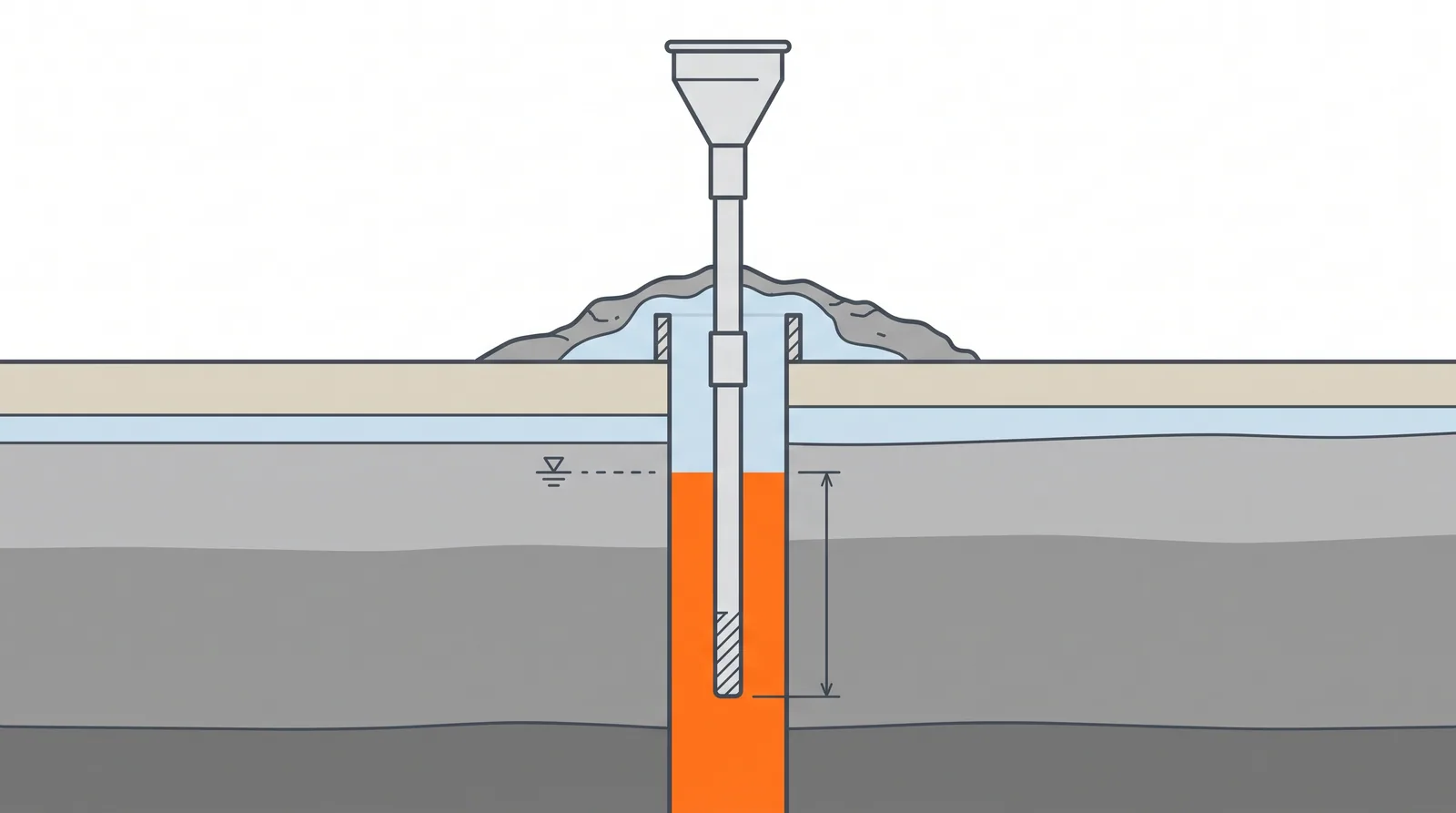
How it is done
- Design the mix for flow and stability rather than strength alone: slump 180–220 mm or slump flow 500–600 mm, high fines, rounded aggregate where available, and retarder so it stays workable for the whole pour plus a margin.
- Plan supply for the full volume with backup plant or trucks, and check that the tremie pipes (about 200–300 mm bore, watertight joints) and hopper are clean and complete before the hole is released.
- Lower the tremie to the base, fit a plug or closed end so the first concrete does not mix with the slurry, and charge the hopper so the first batch fills the base and buries the tip.
- Raise the tremie in steps without ever lifting its tip out of the concrete; keep the embedment at or above the specified minimum (typically 2–3 m) and measure the concrete level by weighted tape after every truck.
- Plot actual against theoretical volume as the pour proceeds: a deficit warns of necking or collapse, a large excess of overbreak or loss into the ground.
- Extract temporary casing only with enough concrete above its toe and a concrete head greater than the external water pressure; watch for cage uplift.
- Overpour above cut-off (more under deep slurry) so contaminated concrete is removed at break-down, and test integrity once the concrete has gained strength.
Key numbers
- Workabilityslump 180–220 mm or slump flow 500–600 mm, retained for the full pour plus a margin
- Tremie boreabout 200–300 mm
- Tip embedmentspecified minimum typically 2–3 m; very deep embedment slows flow
- Placement rate30–80 m³/h; a 60 m³ pile in 1–3 h
- Overpourcommonly 0.5–1.0 m or more above cut-off
Where it fits
- All bored piles and barrettes under slurry or water.
Where it does not
- Mixes that stiffen before the pour ends; interrupted supply.
Choosing it
- Use a tremie whenever the hole holds water or slurry; free fall is acceptable only in dry holes with negligible inflow and a cage that will not deflect the concrete.
- Choose self-consolidating or highly flowable mixes over conventional 200 mm slump mixes for congested cages and long pours; the Huey P. Long shafts used SCC with 35 % slag.
- Prefer a pumped, sealed-line placement where loading a hopper over the hole is slow or unsafe; the embedment rules still apply.
- Order retarder for the real pour duration with margin: in a documented over-water pour the concrete lost workability about 5½ hours after batching, the tremie jammed and costly repairs followed.
Plant, pace and money
PlantTremie pipes and hoppers, pump or crane and skip, concrete supply of 30-80 m3 per hour.
ProductivityA 60 m3 pile is poured in one to three hours.
CostConcrete at USD 150-250 per m3 plus placement.
Risks and controls
What goes wrong
- Tip pulled out of the concrete, cold joints, slurry inclusions, cage floating.
Quality assurance
Pour log with level and volume per truck, slump tests every truck, CSL after 7 days.
Origins
Tremie placement of concrete under water dates from 19th-century harbour and bridge-pier work; it became the standard for bored piles under slurry in the 1960s, and the joint EFFC/DFI tremie concrete guide of the late 2010s moved practice towards rheology-based mix design.
Examples
Every bored pile in the game's marine sites.
Case studies
Huey P. Long Bridge wideningUSA · 20092.8 m shafts about 61 m deep concreted by tremie with self-consolidating concrete in which 35 % of the cement was replaced by slag; a downhole camera was used to confirm a clean, level base before concreting.
Sutong BridgeChina · 2008Piles of 2.8/2.5 m and 114–117 m each needed several hundred cubic metres placed continuously under slurry, so supply and retarder had to cover very long pours.
Related methods
Drilled shafts (bored piles) with casing or slurryBentonite and polymer slurry stabilisationTremie concrete sealPile integrity testing (sonic echo and cross-hole sonic logging)Secant-pile and diaphragm-wall cofferdamsBase and shaft post-grouting of bored piles
Further reading
EFFC/DFI Guide to Tremie Concrete for Deep Foundations · EN 1536 · ACI 304R Guide for Measuring, Mixing, Transporting and Placing Concrete