How bridges get built · Site investigation and testing · Pile integrity testing (sonic echo and cross-hole sonic logging)
Also called: low-strain test, PIT, CSL, thermal integrity profiling
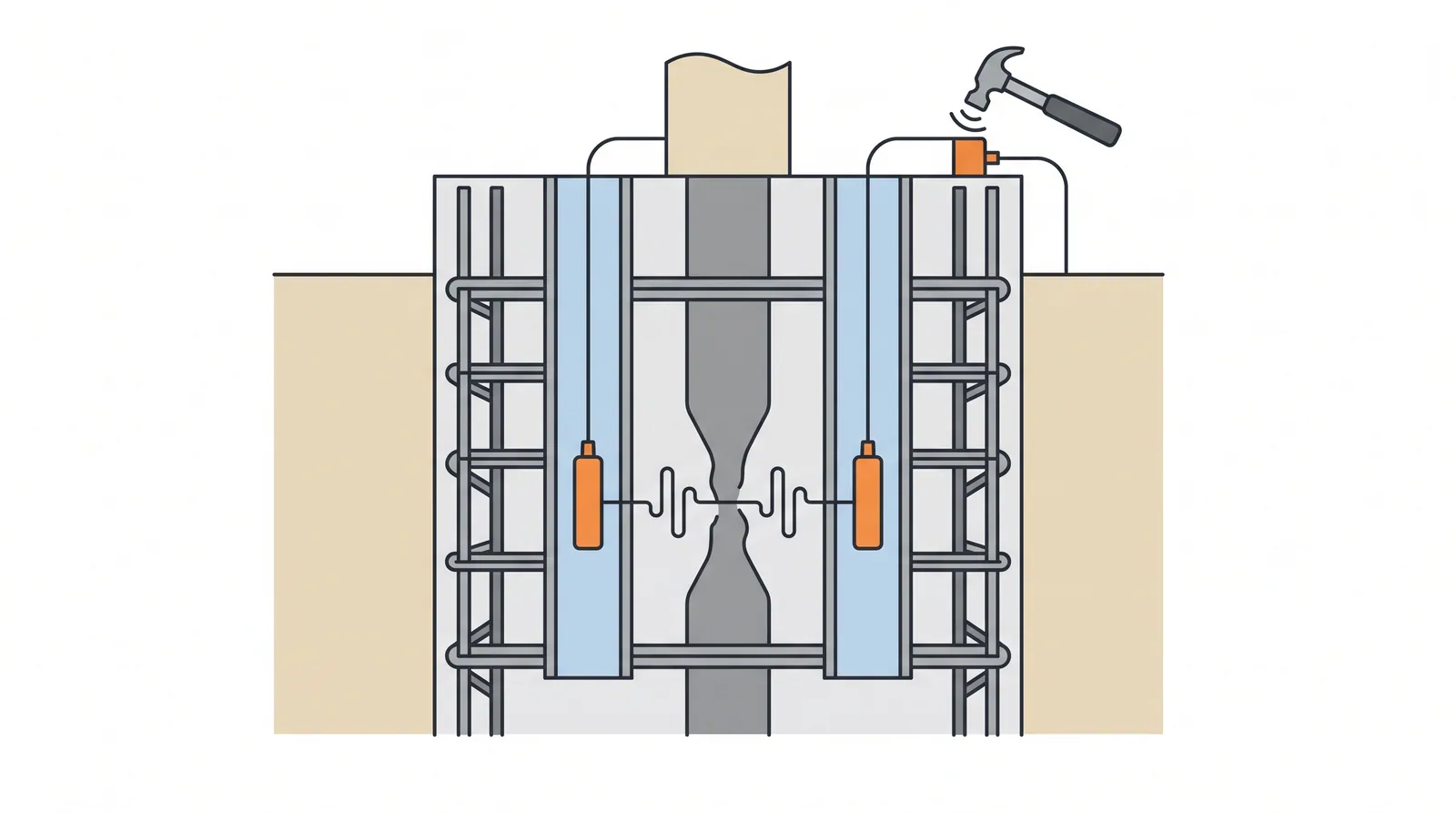
How it is done
- Specify the method for each pile type before construction: CSL tubes or thermal wires in large bored piles, sonic echo for small piles, with acceptance and rating criteria agreed in advance.
- Fix steel access tubes (about one per 0.3 m of diameter, at least four on bridge shafts) to the cage from head to toe, capped and filled with water immediately after concreting to limit debonding.
- For thermal integrity profiling, read the embedded sensors through hydration, typically 12–48 hours after concreting, and convert temperature to effective radius and cover.
- For CSL, test when the concrete allows (commonly 3–7 days), pulling transmitter and receiver together in each tube pair and reading every 50 mm; run tomography on anomalies.
- For sonic echo, trim the head to sound concrete, prepare small flat spots, tap with a hand hammer and read the velocity record against the expected length and wave speed.
- Rate anomalies by the agreed criteria; confirm suspect zones by coring and concrete testing, then accept, repair by grouting through cores, or replace or supplement the pile.
- Report each pile with plots and set every anomaly against the construction record (tremie breaks, slurry condition, delays, cage problems).
Key numbers
- CSL tubesabout one per 0.3 m of shaft diameter, minimum four on bridge shafts; steel tubes 38–50 mm inside diameter.
- CSL rating by first-arrival delay0–10 % good, 10–20 % questionable, above 20 % poor or defect, with matching energy loss.
- Sonic echouseful to a length-to-diameter ratio of about 20–30; concrete wave speed about 3,500–4,200 m/s.
- Thermal profilingreadings 12–48 hours after concreting; results available before the concrete would allow CSL.
- Coveragemany owners test every drilled shaft on bridges by CSL or thermal methods.
Where it fits
- All bored piles on bridges; CSL is standard on shafts above 1 m.
- Driven concrete piles suspected of driving damage (sonic echo).
Where it does not
- Sonic echo on long slender piles or piles with many joints; the signal is lost.
Choosing it
- Use CSL or thermal profiling on every large bridge shaft: they inspect the whole length and section, which sonic echo cannot.
- Prefer thermal profiling when early results or cover and cage alignment matter; prefer CSL when the quality of concrete between tubes matters most.
- Use sonic echo as cheap screening on large numbers of small piles (CFA, precast) and to estimate the length of existing piles.
- Core and test before declaring a defect: integrity tests flag anomalies, they do not measure strength or capacity.
Plant, pace and money
PlantCSL logger and probes, PIT hammer and accelerometer, thermal wires and readout.
ProductivityFour to ten piles per day.
CostUSD 500-2,000 per pile for CSL; a few hundred for sonic echo.
Risks and controls
What goes wrong
- Tubes debonding from the concrete give false anomalies.
- Anomalies near the toe are hard to distinguish from base debris.
Quality assurance
Anomaly rating criteria agreed before testing; coring or grouting protocol for confirmed defects.
Origins
Sonic logging between access tubes and low-strain echo testing developed in France and the Netherlands in the late 1960s and 1970s; thermal integrity profiling came from the University of South Florida in the 2000s and became ASTM D7949 in 2014.
Examples
Every large-diameter shaft on modern sea bridge pylons carries CSL tubes.
Case studies
Golden Ears Bridge test shaftCanada · 2006The 2.5 m test shaft carried CSL tubes, yet the bi-directional test showed toe resistance at 37 % of expected because of base debris: a condition integrity tests of the shaft body do not detect, which is why base cleanliness is inspected separately.
Hong Kong public housing short pilesHong Kong, China · 1999–2000At sites in Tin Shui Wai and Sha Tin, coring and testing showed piles far shorter than recorded; blocks were demolished or strengthened and supervision and pile testing requirements were tightened.
Related methods
Drilled shafts (bored piles) with casing or slurryTremie concreting of pilesDynamic load testing (PDA) and signal matchingBase and shaft post-grouting of bored piles
Further reading
ASTM D6760 (CSL) · ASTM D5882 (sonic echo) · ASTM D7949 (thermal) · FHWA GEC 10 Drilled Shafts: Construction Procedures and Design Methods (integrity testing chapter) · ACI 228.2R Nondestructive Test Methods for Evaluation of Concrete in Structures