How bridges get built · Shallow foundations, cofferdams and dewatering · Tremie concrete seal
Also called: underwater concrete plug, cofferdam seal, tremie plug
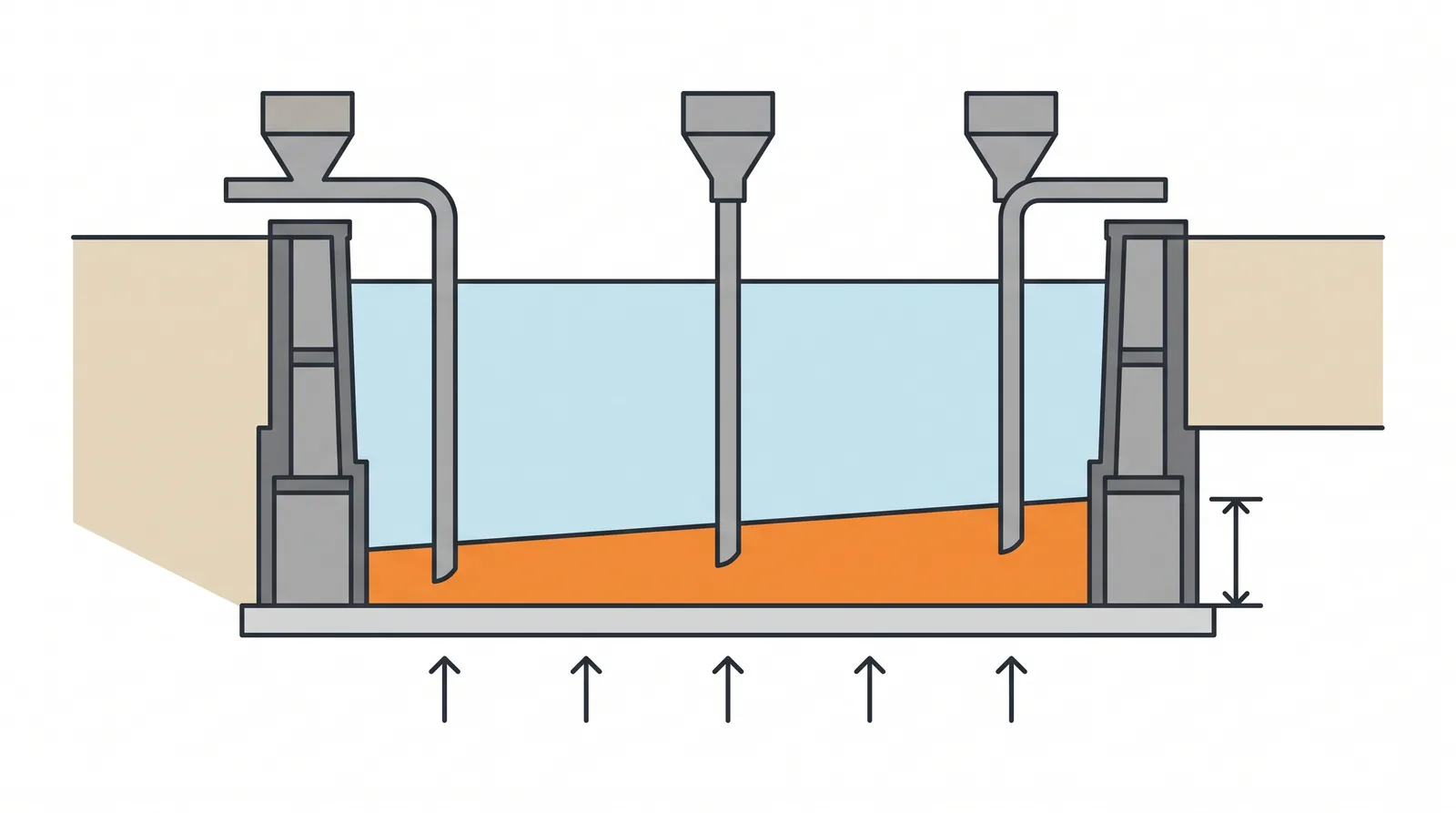
How it is done
- Design the seal for uplift (its weight plus bond to piles and sheets), for bending between piles, and for the construction stage; specify a cohesive, highly workable mix with retarder and, for long flow distances, an anti-washout admixture.
- Excavate to grade and clean the base and the pile and sheet surfaces by airlift, jetting or divers with brushes, since bond to the piles carries much of the uplift; sound the base on a grid to confirm level.
- Set tremie pipes of 200-300 mm with watertight flanged joints on a gantry at 3-6 m spacing, marked for depth, with hoppers above water.
- Start each pipe with its tip on the base and a plug or go-devil separating concrete from water; lift slightly to release the charge and keep the tip at least 1-1.5 m inside fresh concrete from then on.
- Pour continuously, raising the surface evenly and moving pipes in a planned sequence; sound the surface regularly. If a pipe loses its seal, withdraw, re-plug and restart; never let concrete fall through water.
- Leave the seal to gain strength for 3-7 days, then dewater in stages, watching for leaks at pile and sheet interfaces and repairing them before going lower.
- Remove laitance and high spots down to sound concrete before casting the footing; core the seal where quality is in doubt.
Key numbers
- Seal thickness1-3 m typical; a seal relying on its weight alone needs about 0.45-0.5 times the water head at its underside.
- Tremie pipes200-300 mm diameter at 3-6 m spacing; tip embedment at least 1-1.5 m.
- Mixslump about 150-230 mm (ACI 304R), maximum aggregate usually 20 mm.
- Placing rateabout 50-150 m3/h on large seals; the pour must be continuous.
- Wait before dewatering3-7 days.
Where it fits
- Sheet-pile and double-wall cofferdams in sand and gravel where the base would boil; pile caps in water built inside cofferdams.
Where it does not
- Thin seals in deep water: the seal thickness is often 1-3 m and can exceed the footing itself.
Choosing it
- Choose a seal over pumped dewatering when the base is in permeable sand or gravel and the sheets cannot reach an impermeable layer, so pumping would cause boiling or very large inflows.
- Omit the seal when the sheets toe into clay or rock that cuts off seepage and the base passes the heave check: the seal concrete, often thicker than the footing, is otherwise wasted.
- Prefer a precast or steel box with a sealed floor when a seal would stand above the bed in a navigation channel or scour zone, or where divers cannot clean the base.
- Where foundation piles pass through the seal, a thinner seal anchored by bond to the piles is cheaper than a gravity seal; check bond and punching.
Plant, pace and money
PlantTremie pipes and hoppers, concrete pump or crane and skips, divers.
Productivity300-1,000 m3 per day per pour.
CostUSD 200-350 per m3, plus a lot of concrete you never see.
Risks and controls
What goes wrong
- Pipe tip lifting out of the concrete and washing the mix; cold joints from an interrupted pour; seal cracking and leaking under uplift.
Quality assurance
Continuous pour log, soundings during placement, diver inspection of the surface, cube tests on the mix.
Origins
Placing concrete underwater through a tremie (French for hopper) dates from the 19th century; anti-washout admixtures, in use since the 1970s and 1980s, made wide, thin and self-levelling underwater placements reliable.
Examples
Standard under river pier cofferdams worldwide; also used to plug pile caps of the game's water piers when the cap is low.
Case studies
Sikorsky BridgeUSA · 2003A tremie seal was considered and rejected because it would have stood above the mudline in the navigation channel and needed later removal; a precast 'bathtub' inside the cofferdam replaced it.
Kabinakagami River Bridge replacementCanada · 2008The geotechnical report recommended a tremie plug or mud mat at the base of the abutment cofferdam; none was placed and the soft base heaved.
Akashi Kaikyo Bridge (main tower foundations)Japan · 1998Steel caissons about 80 m in diameter were set on the excavated seabed and filled with anti-washout underwater concrete in the strong tidal currents of the strait.
Related methods
Further reading
ACI 304R · FHWA guidance on underwater concrete · Gerwick, Construction of Marine and Offshore Structures · Caltrans Trenching and Shoring Manual (cofferdams and seal courses)