How bridges get built · Bored piles and deep foundations · Bentonite and polymer slurry stabilisation
Also called: drilling fluid, bentonite support, polymer slurry
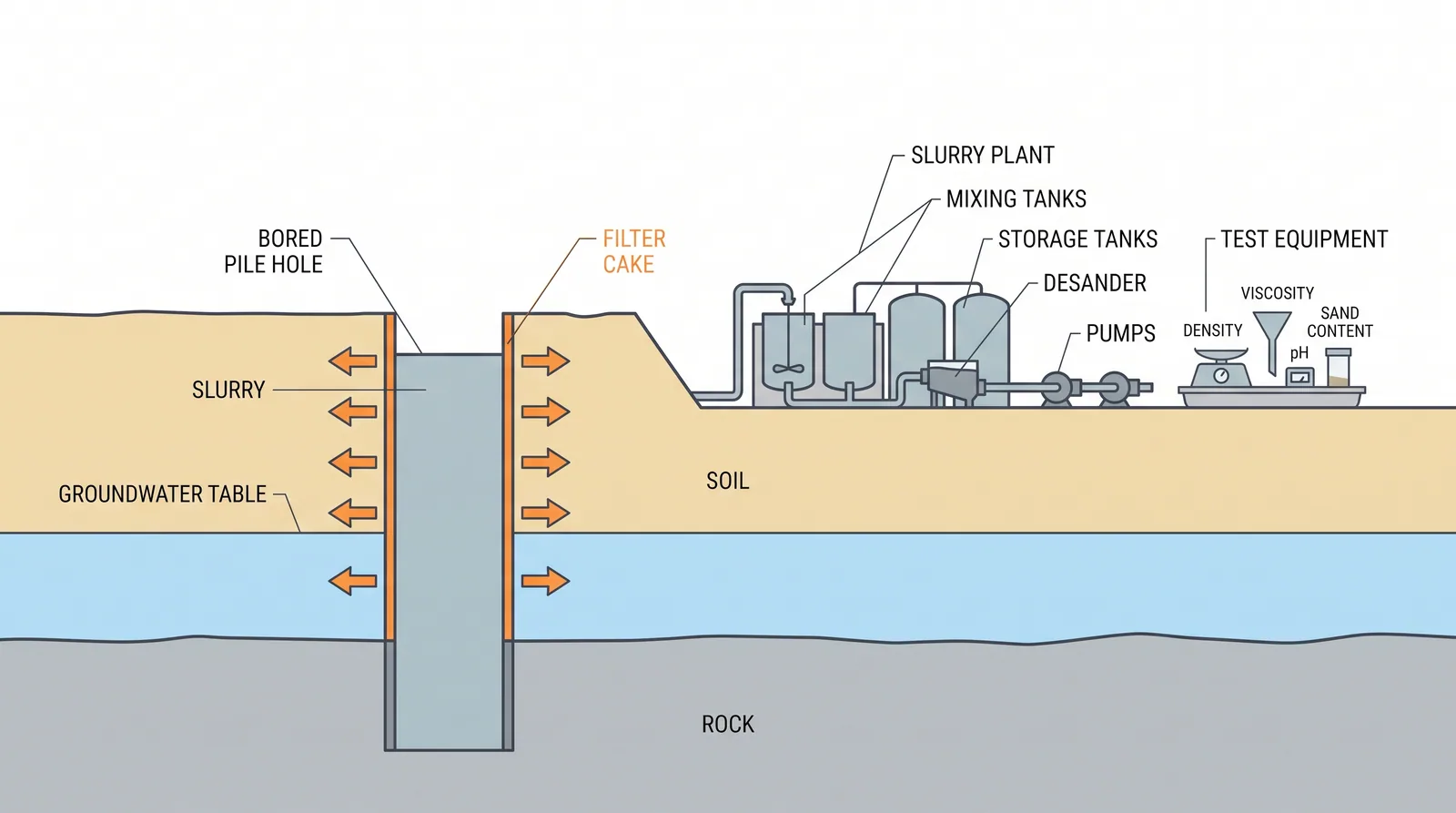
How it is done
- Choose the fluid for the ground and groundwater: bentonite for most soils, polymer where disposal is restricted or the water is saline; test the make-up water and agree acceptance limits with the designer.
- Mix bentonite at about 3–6 % (or polymer at 0.1–0.3 %) in a high-shear mixer, and let bentonite hydrate for the time the supplier specifies before use.
- Fill the hole before the tool passes below the water table and keep the fluid level at least 1.5–2 m above the groundwater or tide level at all times, allowing for tide and waves at sea.
- Test density, Marsh viscosity, sand content, pH and (for bentonite) filtrate and cake at the start of each shift, during drilling and from the base before concreting.
- Desand or exchange the fluid at the base until it meets the pre-concreting limits. Hold point before the cage and tremie.
- Recover and recycle the fluid displaced by the concrete; treat spent fluid and dispose of it through licensed routes.
Key numbers
- Bentonite dosageabout 3–6 %; polymer 0.1–0.3 %
- Bentonite before concreting (EN 1536/1538 type limits): density < 1.15 t/m³, Marsh viscosity 32–50 s, sand < 4 %, pH 7–11
- Polymer before concretingdensity about 1.00–1.03 t/m³, sand ≤ 1 %, viscosity within the supplier's range
- Headat least 1.5–2 m above groundwater or tide
- Plantone slurry plant typically serves 2–4 rigs
Where it fits
- All uncased bored piles and barrettes below the water table; polymer in urban sites with disposal limits.
Where it does not
- Bentonite in saline groundwater without conditioning; polymer in very loose gravels.
Choosing it
- Choose polymer over bentonite where groundwater is saline or contaminated (bentonite flocculates), disposal is costly, or shaft friction matters: comparative tests by Brown found shafts drilled under bentonite had markedly lower side resistance than those under polymer or casing.
- Choose bentonite in coarse, permeable soils where a filter cake is needed to hold the head.
- Prefer full-length casing where fluid loss, fractured rock or cavities make the head impossible to hold (Benicia–Martinez).
- Prefer dry drilling with short casing in stiff clays above the water table; no fluid is cheaper than any fluid.
Plant, pace and money
PlantMixers, tanks, desanders, pumps, testing kit.
ProductivityA slurry plant serves two to four rigs.
CostUSD 20-60 per m3 of slurry; disposal can exceed mixing.
Risks and controls
What goes wrong
- Hole collapse from a dropped head, thick filter cake reducing shaft friction, slurry inclusions in the concrete.
Quality assurance
Slurry tests before concreting recorded per pile, level watch, sand content below 4 % (bentonite) or 1 % (polymer).
Origins
Christian Veder pioneered bentonite support for diaphragm walls in Italy in the early 1950s, and the same fluid was soon used for bored piles; synthetic polymer fluids came into piling from the 1980s–90s, and EFFC and DFI issued a joint support-fluid guide in the late 2010s.
Examples
Standard on bored piles worldwide; polymers dominate in Hong Kong and Singapore.
Case studies
Burj KhalifaUAE · 2010A building, but a regional reference: the tower's 1.5 m piles, about 47 m long, were drilled under polymer slurry in highly saline groundwater, and the foundation was given cathodic protection.
New Benicia–Martinez BridgeUSA · 2007Slurry-supported reverse-circulation sockets caved in fractured rock, and the contractor changed to full-depth casing: a case of a fluid that could not hold the ground.
Related methods
Drilled shafts (bored piles) with casing or slurryBarrettes and diaphragm-wall foundationsTremie concreting of pilesSecant-pile and diaphragm-wall cofferdams
Further reading
FHWA GEC 10 Chapter 7 · FPS (UK) slurry guidance · EFFC/DFI Guide to Support Fluids for Deep Foundations · Lam and Jefferis, Polymer Support Fluids in Civil Engineering