Also called: group efficiency, pile spacing, pile group settlement
How it is done
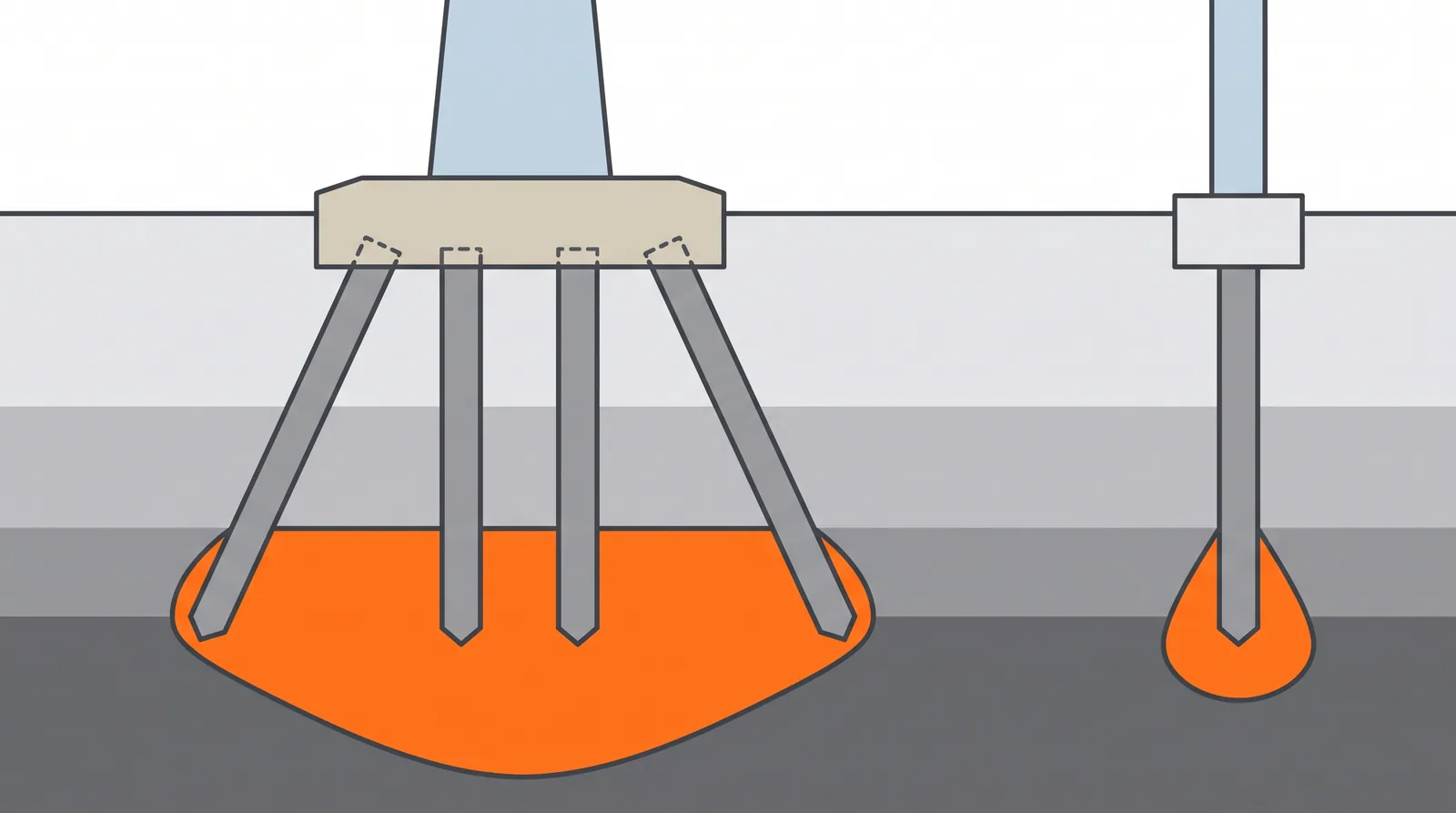
- Establish the design actions at each pier (axial, lateral, moment, ship impact, seismic) and the ground model; decide on vertical or raked piles and the cap level relative to water and scour.
- Choose diameter and layout: spacing 2.5–3 diameters or more, rows arranged to resist moment about both axes, and edge cover beyond the outer piles.
- Analyse the group with a 3D model and pile–soil springs: load sharing, group efficiency and block failure in clay, group settlement (equivalent raft or numerical), and lateral response with p-y curves reduced by p-multipliers for trailing rows.
- Design the free length for the scoured bed, including local scour around the cap and group.
- Design the cap for punching, shear and tie forces (strut-and-tie for deep caps), and plan thermal control for thick caps.
- Survey as-built pile positions, levels and rakes before the cap and re-check the design for piles out of tolerance.
- Build the cap with piles trimmed to sound concrete and bars anchored as designed; monitor settlement of large groups during and after loading.
Key numbers
- Spacing2.5–3 D centre to centre; friction groups lose efficiency below about 3 D
- Lateral p-multipliers at 3 D spacingabout 0.8, 0.4 and 0.3 for the first, second and later rows (AASHTO)
- Rake1:4 to 1:8 for lateral loads
- Group efficiency in frictionabout 0.7–1.0; Sutong's 131-pile group was designed with 0.82
- Pile numbersriver piers 4–20 piles; pylons 20–150 large piles (Sutong 131)
- Position tolerance±75–150 mm in plan before the cap
Where it fits
- Every pier on piles; the sizing routine in the game does this with the pile calculator for the real ground under each pier.
Where it does not
- Very large groups (more than 30-40 piles) where a few large shafts or a caisson would be cleaner.
Choosing it
- Choose a few large shafts over many small piles when the cap is in water: fewer piles mean a smaller cap and cofferdam, and each shaft can be socketed and tested.
- Choose a piled raft (cap and piles sharing load) on stiff clay where settlement rather than capacity governs, as under the Rędziński Bridge pylon.
- Choose raked piles for ship, ice or arch thrust; prefer vertical large-diameter piles in high seismic zones, where raked piles attract large forces.
- Compare a caisson or barrettes once a group would exceed about 30–40 piles in deep water or severe scour; Sutong kept a 131-pile group because bedrock lay about 300 m down.
Plant, pace and money
Risks and controls
What goes wrong
- Group settlement under-estimated on layered ground, cap punching shear, corner piles overloaded by moment.
Quality assurance
Group analysis reviewed, pile positions surveyed before the cap, cap reinforcement inspected.
Origins
Group behaviour was formalised in stages: the Converse–Labarre efficiency formula in the 1940s, elastic interaction methods by Poulos and Davis (1980), and full-scale lateral group tests by Brown, Reese and others in the 1980s that produced the p-multipliers now in AASHTO.
Examples
River piers on 6-20 piles, pylons on 20-40 large shafts.
Case studies
Related methods
Further reading
Poulos and Davis, Pile Foundation Analysis and Design · AASHTO LRFD 10.7.2 · Brown, Morrison and Reese (1988), lateral load behavior of a pile group in sand · Randolph (1994), design methods for pile groups and piled rafts · Fleming, Weltman, Randolph and Elson, Piling Engineering