How bridges get built · Bored piles and deep foundations · Reverse circulation drilling (RCD)
Also called: RCD pile, reverse circulation bored pile, large-diameter marine bored pile
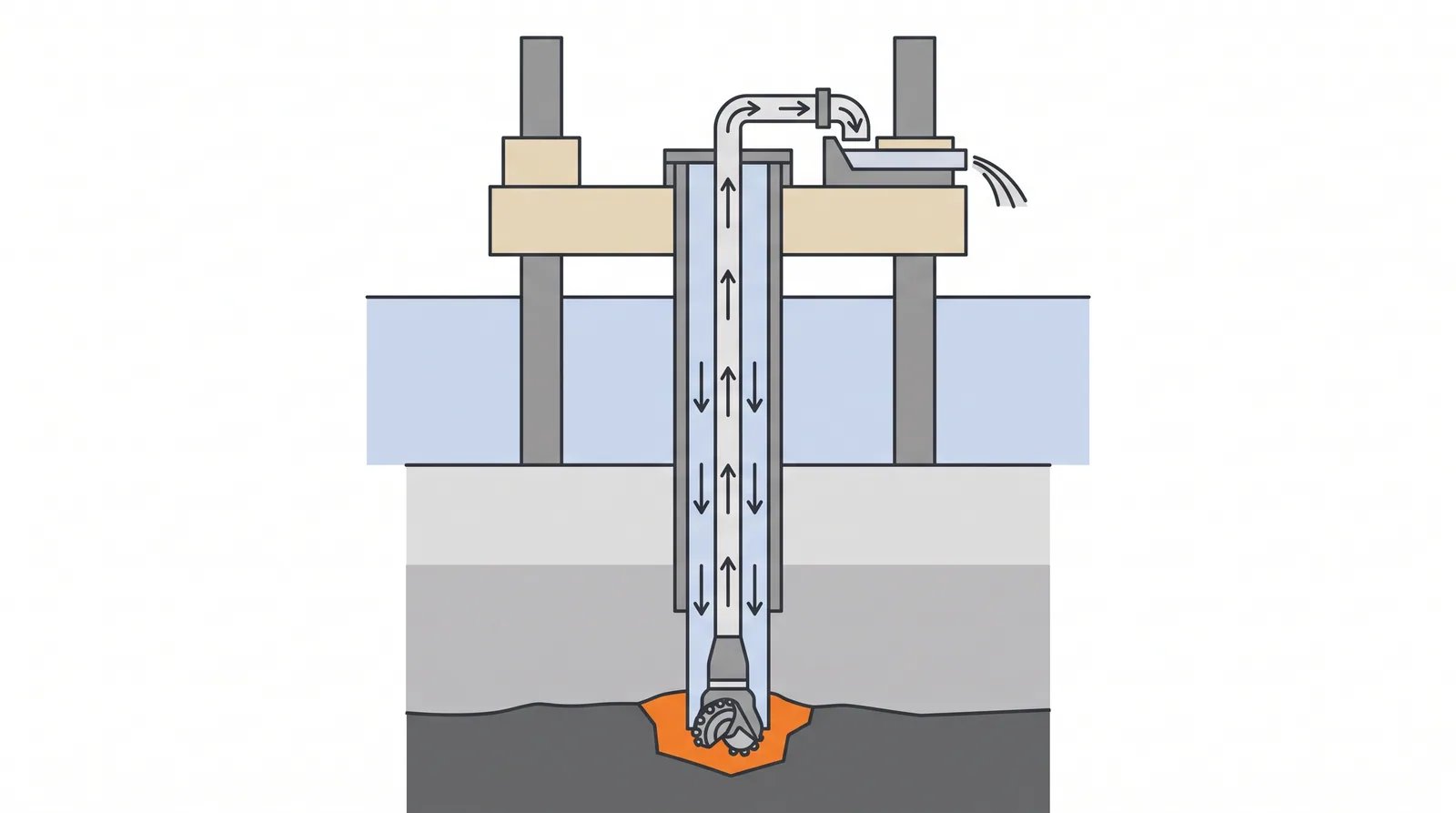
How it is done
- Provide a stable platform (jack-up, piled platform or the permanent casings themselves) and drive or vibrate a steel standpipe through the water and soft bed into a competent layer.
- Fill the standpipe with water or slurry and keep the internal head at least about 2 m above the external water or tide level throughout drilling.
- Assemble the flanged drill string with a roller, tricone or drag bit and stabiliser; rotate slowly and lift the cuttings up the string by air-lift or suction pump to a settling tank or desander, returning the cleaned fluid to the hole.
- Drill through soil and into rock to the socket level, controlling weight on bit and rotation to hold verticality; sample the returns every metre to confirm the founding stratum.
- Clean the base by circulating with the bit just off the bottom until the returns are clear, then measure depth, verticality (ultrasonic profiling) and base sediment. Hold point.
- Lower the cage in sections with couplers or welded splices over the standpipe, fit CSL tubes and any base-grouting circuits, and tremie the concrete continuously.
- Remove or leave the standpipe as designed; test integrity on every pile and load test samples, usually with bi-directional cells at sea.
Key numbers
- Diameter1.5–3.5 m common
- Depthto 100–120 m (Sutong 114–117 m)
- Fluid headat least about 2 m above the external water level
- Drill-string boreabout 150–300 mm; returns by air-lift or suction pump
- Cyclea 2.5 m pile of 60–80 m in about a week including the socket
- Verticality1:200–1:400 achievable with stabilised strings and guided casings
Where it fits
- Sea and river pylon foundations, deep piles through soft sediments into rock, 2-3 m diameters, heavy loads.
Where it does not
- Small piles where a Kelly rig is far cheaper; loose gravel that keeps flowing into the hole.
Choosing it
- Choose it over Kelly (bucket) drilling for diameters above about 2.5 m and depths beyond 60–80 m, where Kelly bars run out and every bucket trip costs time.
- Choose it for marine pylon foundations where the rig sits on a platform and the hole is already lined through the water column.
- Prefer full-length casing (oscillator or rotator) where fractured rock or fluid loss means the head cannot be held; Benicia–Martinez switched from RCD under slurry to full-depth casing after caving.
- Prefer driven large-diameter steel piles where no rock is within reach and hammers can drive them; RCD earns its cost where sockets or very large diameters are needed.
Plant, pace and money
PlantRCD rig on a platform or jack-up, standpipes, high-capacity pumps, settling tanks, cranes, tremie plant.
ProductivityA 2.5 m pile of 60-80 m in a week including socketing; several rigs work in parallel at a pylon.
CostUSD 1,500-4,000 per metre from marine platforms.
Risks and controls
What goes wrong
- Loss of circulation in fissured rock, hole collapse if the head is lost, long cage lifts in weather.
Quality assurance
Slurry head kept above sea level, base cleanliness by sounding and sediment measurement, CSL and O-cell tests.
Origins
Reverse circulation came from water-well and mining drilling; Japanese contractors adapted it to large bored piles in the 1960s, and it became the standard way to drill deep, large-diameter marine piles in East Asia.
Examples
Sutong, Stonecutters, Incheon, Russky and most modern sea cable-stayed pylons; the game assigns RCD to pylons in deep water.
Case studies
Sutong BridgeChina · 2008131 piles per pylon of 2.8/2.5 m and 114–117 m, drilled under slurry from a 117 × 55 m platform carried on the permanent casings; the deep, large-diameter marine piles that reverse-circulation rigs are built for.
New Benicia–Martinez BridgeUSA · 20072.2 m sockets planned with reverse circulation under slurry suffered caving and were completed with full-depth casing; a cautionary case for RCD in fractured rock.
Related methods
Drilled shafts (bored piles) with casing or slurryBi-directional (Osterberg cell) load testJack-up platformsRock sockets and base treatmentBase and shaft post-grouting of bored piles
Further reading
JGS 1531 · project papers on Sutong and Incheon Bridge foundations · Japan Road Association, Specifications for Highway Bridges, Part IV (Substructures) · Gerwick, Construction of Marine and Offshore Structures