How bridges get built · Bored piles and deep foundations · Continuous flight auger (CFA) piles
Also called: auger cast piles, ACIP, CFA pile
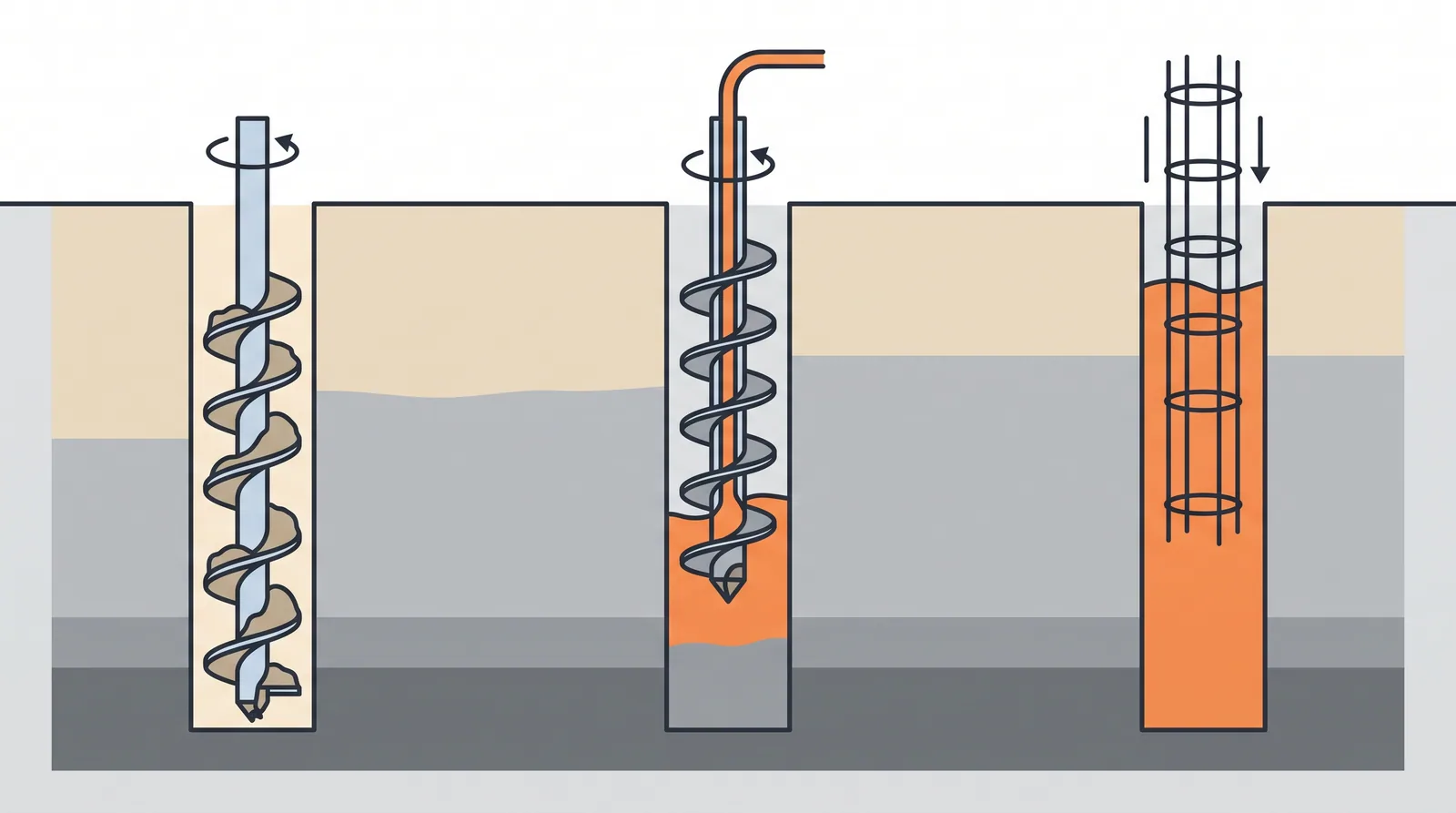
How it is done
- Calibrate the rig instrumentation (depth, rotation, torque, concrete pressure and volume) and agree the pile record format and acceptance criteria before work starts.
- Screw the auger to depth in one continuous pass with a high penetration per revolution, so the flights stay full and the ground is not mined; stop and review if torque or penetration indicate an obstruction.
- At depth, pump concrete or grout through the hollow stem, lift the auger slightly to blow the plug, and build a concrete head before withdrawal begins.
- Withdraw the auger at a controlled rate while pumping at positive pressure, so the volume placed per metre stays at or above the specified ratio to theoretical.
- Clear spoil from the pile head, then push the reinforcement cage into the fresh concrete by its own weight or with a vibrator; long cages need stiffening and a fluid mix.
- Trim to cut-off, review every instrumentation record against the criteria (hold point before the cap), and test integrity and load on a sample.
Key numbers
- Diameter0.3–1.2 m; length usually 10–30 m
- Working load0.5–3 MN per pile, to about 5 MN for large diameters
- Concrete volumenever below 100 % of theoretical; commonly specified at 110–120 % per increment
- Reinforcementfull-length cages to about 15–20 m; often only the top 6–12 m is caged where moments are low
- Output10–25 piles per rig per shift; about 15–30 minutes of drilling and concreting per pile
Where it fits
- Soft to firm clays, sands above and below the water table, viaduct approaches, 450-1,200 mm diameter, 10-30 m deep, loads to about 3-5 MN.
Where it does not
- Rock sockets, boulders, very loose sands (flighting removes soil and loosens the ground), deep cages.
Choosing it
- Choose it over bored piles for land viaducts on soil with moderate loads: no casing, no slurry, low vibration and very high output.
- Choose it over driven piles beside sensitive buildings and railways where vibration and noise are limits and the soil stands up to the auger.
- Prefer bored piles (cased or under slurry) for rock sockets, boulders, heavy cages or loads beyond about 3–5 MN.
- Prefer driven or displacement piles in very loose sands and soft silts, where flighting loosens the ground and over-augering cuts capacity.
Plant, pace and money
PlantCFA rig with instrumented head, concrete pump, cage vibrator.
Productivity10-25 piles of 15-20 m per rig per shift.
CostUSD 90-180 per metre for 750 mm.
Risks and controls
What goes wrong
- Over-augering in loose sand, necking where the concrete pressure drops, cage not reaching depth.
Quality assurance
Instrumentation record (depth, concrete volume and pressure per metre) for every pile, integrity tests, load tests.
Origins
Augered cast-in-place piles were developed in the United States after the Second World War and spread to Europe in the 1960s–70s; automated recording of depth, pressure and volume from the 1980s made them acceptable for bridges.
Examples
UK motorway widening, US highway viaducts on alluvium, urban viaducts in Europe.
Case studies
Krenek Road bridge over US 90, Crosby, TexasUSA · 2004 (reported)64 ACIP piles of 0.46 m, 17–19 m long; an instrumented test pile failed at about 215 t against a 90 t design load, each pile took about 15 minutes, settlements stayed under 3 mm over six months, and the study found ACIP cheaper than the driven square piles on an adjacent bridge.
Related methods
Drilled shafts (bored piles) with casing or slurryDriven cast-in-situ pilesPile integrity testing (sonic echo and cross-hole sonic logging)
Further reading
EN 1536 · FHWA GEC 8 (CFA piles) · DFI Augered Cast-in-Place Pile Manual · O'Neill, Kim and Vipulanandan, TxDOT research on ACIP piles (Project 5-3940, University of Houston, 2004)