How bridges get built · Caissons and marine foundations · Jack-up platforms
Also called: self-elevating platform, jack-up barge, SEP
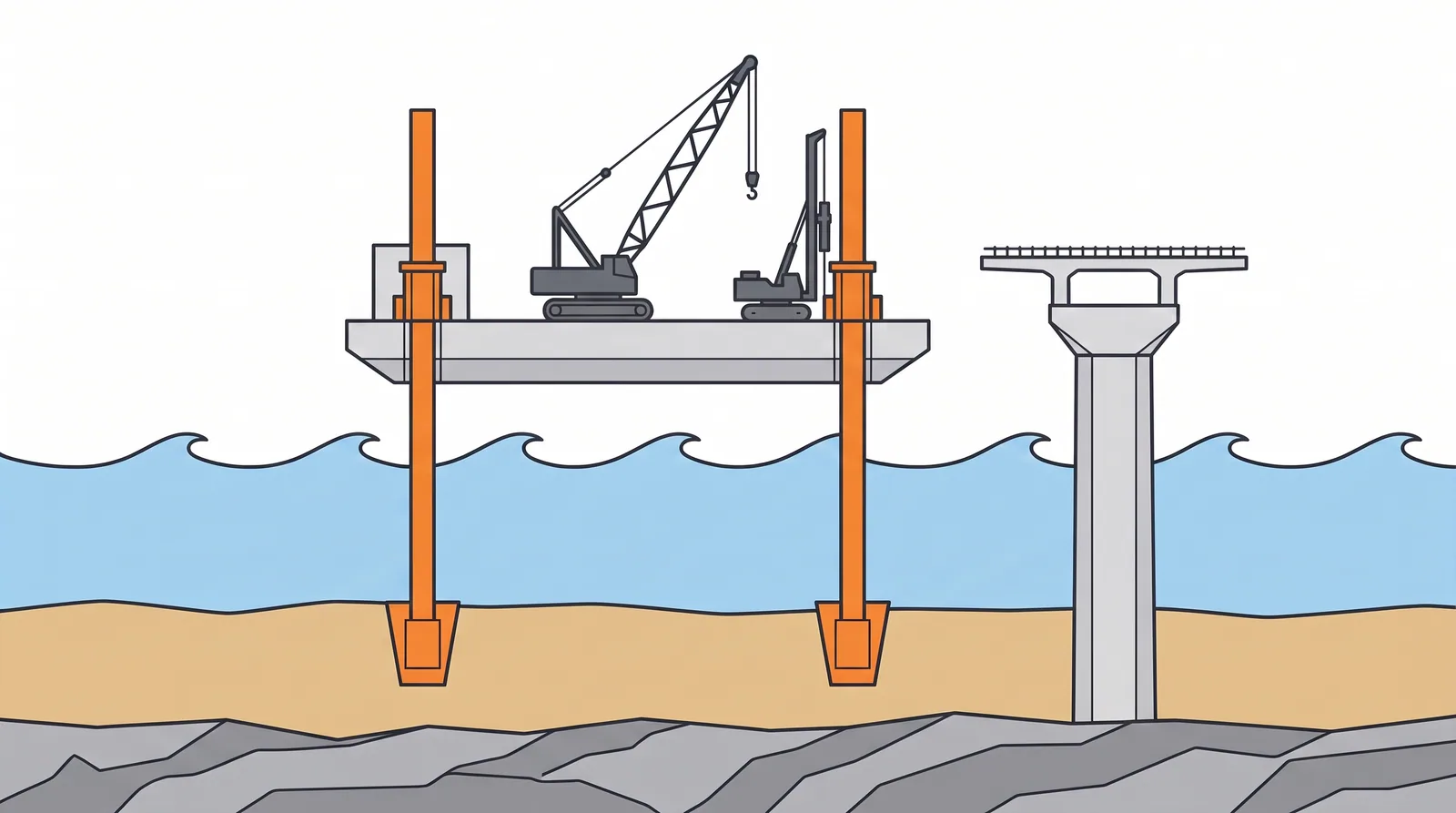
How it is done
- Carry out a site-specific assessment (ISO 19905-1): leg penetration and punch-through risk from CPTs or borings at each location, seabed obstructions, scour, and metocean limits for moving and for the elevated condition.
- Tow or self-propel to location in a weather window and position with GNSS, anchors or tugs.
- Lower the legs to touchdown and pre-load each footing, by ballast water or leg by leg, to at least the largest reaction expected in the design storm, watching for sudden penetration. Hold point.
- Jack the hull to the working air gap above the design wave crest.
- Work from the deck (drilling, piling, cap formwork) within the deck-load and crane charts; re-check leg penetration and scour around the footings periodically.
- Jack down, extract the legs (jetting where they are deep in clay) and move to the next pier.
Key numbers
- Water depthabout 5–40 m for construction jack-ups; larger units to 60 m or more
- Pre-loadat least the maximum footing reaction expected in the design storm
- Air gaphull above the design wave crest with a margin, commonly at least about 1.5 m
- Leg penetrationfrom under 1 m in dense sand to over 20 m in soft clay
- Movesabout one day between piers in good weather
Where it fits
- Bored piles, drilling investigation, pile caps and pier construction at sea and in estuaries; water 5-40 m.
Where it does not
- Very soft seabeds with punch-through risk, rock outcrops, strong currents beyond the leg capacity.
Choosing it
- Choose a jack-up over a floating barge for bored piling, caps and pier work at sea: drilling and concreting need a steady platform for days at a time.
- Prefer a temporary trestle in water up to about 5–6 m along long viaducts, where land plant can work from it continuously.
- Prefer floating plant for short tasks, for water deeper than the legs allow, or on soft seabeds with high punch-through risk.
- For long campaigns at one large pylon, compare a fixed platform carried on the permanent casings, as at Sutong, which frees the jack-up for other piers.
Plant, pace and money
PlantJack-up 30-90 m with 100-300 t crane, legs to 60 m.
ProductivityMoves take a day; the deck then works around the clock.
CostUSD 20,000-80,000 per day; the game's jack-up rate.
Risks and controls
What goes wrong
- Punch-through of a leg during preload (the major jack-up accident), leg damage, collision.
Quality assurance
Site-specific leg penetration assessment, preload records, weather limits enforced.
Origins
Self-elevating platforms were developed for offshore drilling in the Gulf of Mexico in the 1950s; construction jack-ups derived from them became the standard platform for marine piling and, later, offshore wind installation.
Examples
All Gulf sea bridges, Hong Kong-Zhuhai-Macau, Incheon; the game assigns jack-ups to water piers deeper than 6 m.
Related methods
Reverse circulation drilling (RCD)Drilled shafts (bored piles) with casing or slurryTemporary trestles and access bridgesFloating barges and spud bargesOver-water site investigation from jack-ups, barges and vessels
Further reading
ISO 19905-1 · SNAME Technical Bulletin 5-5A · Noble Denton 0009/ND, Self-elevating platforms: guidelines for elevated operations