Also called: monopile foundation, single large pile pier
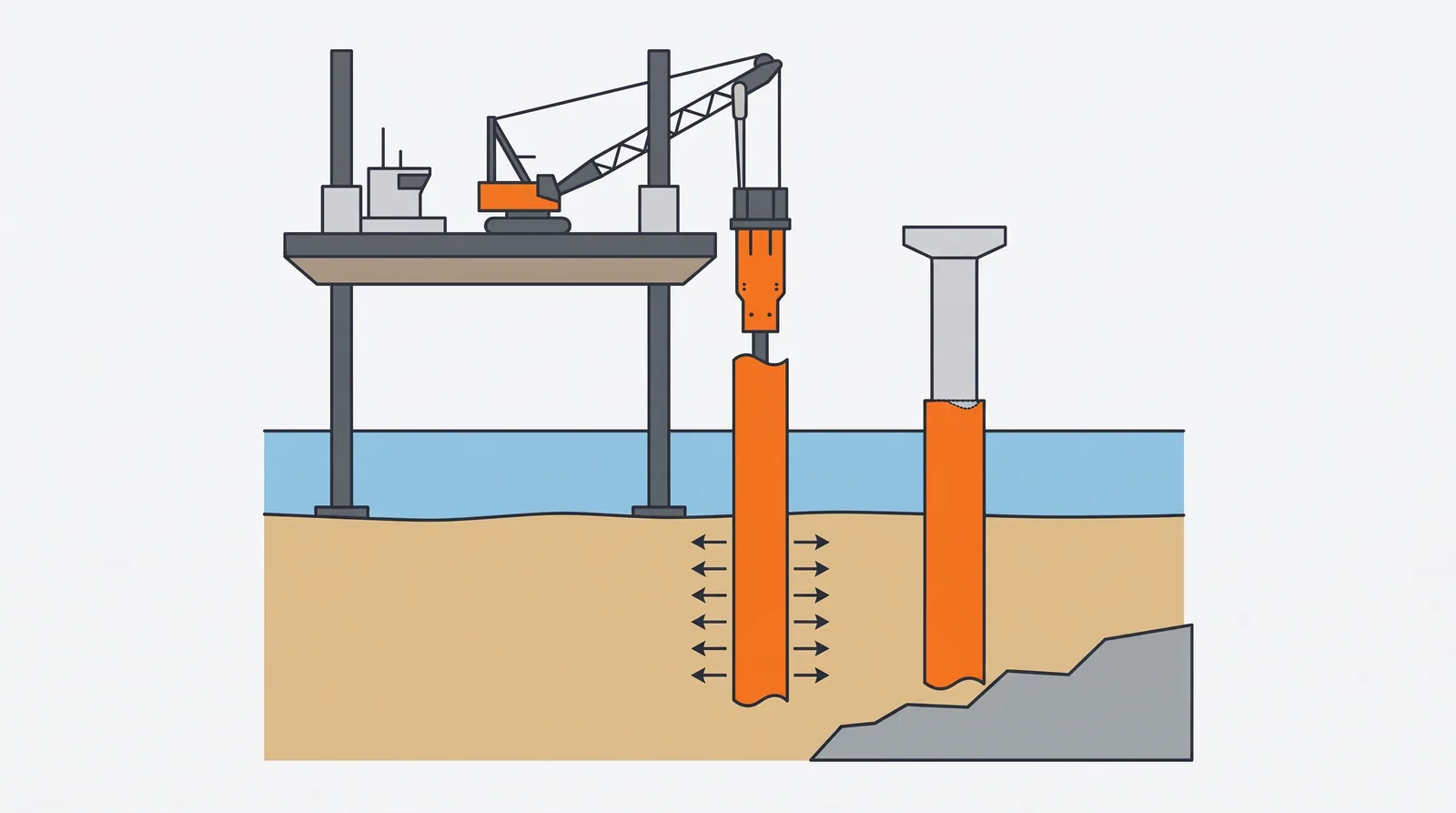
How it is done
- Assess drivability and refusal risk (boulders, dense sands, rock) and size the wall for driving fatigue and tip buckling; plan a drilling contingency (drive, drill out, drive).
- Fabricate the pile from rolled and welded cans in a yard with full NDT; load out and transport by barge, or seal and float it.
- Position a jack-up or heavy-lift vessel; upend the pile with an upending tool and set it in a gripper or pile frame that holds verticality.
- Drive with a large hydraulic hammer, measuring inclination continuously and correcting early; monitor blow counts against predictions.
- If refusal occurs above design depth, drill out the plug or relieve the tip and resume driving; where rock is shallow, drill a socket and grout an insert pile.
- Install the transition piece or cast the pier head (bolted flange or grouted connection), correcting residual inclination, and place scour protection.
- Where hammers are unsuitable, use the same one-pile, one-column layout with a single large bored pile under each column, without a cap.
Key numbers
- Diameter3–6 m in bridge-scale use; offshore wind monopiles have reached about 10 m
- Embedded lengthabout 3–6 diameters in sand for modern rigid monopiles
- Hammer energyabout 1,000–4,000 kJ
- Verticalitywithin about 0.25–0.5 degrees
- Minimum wall (API)6.35 mm + D/100, with thicker cans at the mudline
- Installationone pile per one to three days
Where it fits
- Sea viaducts in 5-25 m of water with sand beds, repetitive piers, sites where marine crane time is the constraint.
Where it does not
- Boulders and rock without drilling, very soft clay to depth, ship-impact piers where a group is stiffer.
Choosing it
- Choose a monopile over a pile group and cap when piers are repetitive, water is 5–25 m deep over sand or stiff clay, and marine plant time dominates cost.
- Prefer a group with a cap where ship impact or large seismic moments demand redundancy; a single pile has no reserve if it is damaged.
- Prefer drilled or bored piles where boulders or rock lie within the penetration; driving risks tip buckling.
- On land or in shallow water, a single large bored pile per column (New Bridgewater Bridge) gives the same saving in caps without a hammer.
Plant, pace and money
Risks and controls
What goes wrong
- Pile run in soft layers, refusal, buckling of the tip on boulders, fatigue in the transition piece.
Quality assurance
Driving records, verticality (within 0.25 degrees), weld inspection.
Origins
Large steel monopiles became the standard offshore wind foundation after projects such as Horns Rev 1 in Denmark (2002), with diameters growing from about 4 m to about 10 m; bridge engineers use the idea for repetitive sea piers and, more often, as single large bored piles under columns.
Examples
Offshore wind farms since Horns Rev 1 (2002). In bridges the one-pile, one-column concept appears mostly as single large bored piles under columns, as on the New Bridgewater Bridge in Tasmania; driven steel monopiles under bridge piers remain rare.
Case studies
Related methods
Further reading
DNV-ST-0126 · API RP 2GEO · API RP 2A-WSD · Byrne et al., PISA design methods for offshore wind monopiles