Also called: hydraulic hammer, diesel hammer, drop hammer, piling hammer selection
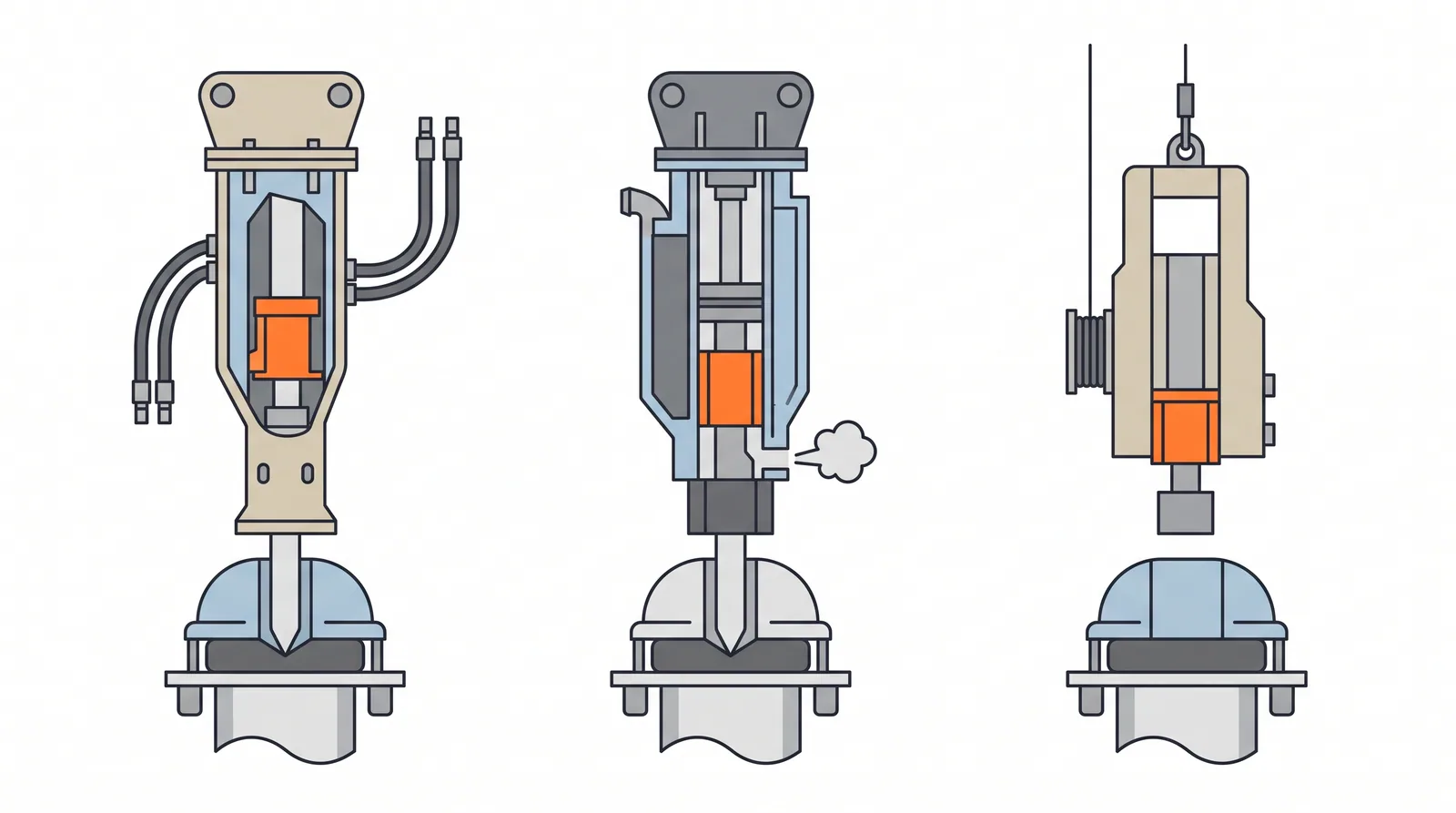
How it is done
- Run a wave equation analysis (GRLWEAP or equivalent) for the pile, soil and candidate hammers: the hammer must reach the required resistance at a blow count well below refusal without exceeding the driving stress limits.
- Submit hammer data (rated energy, ram weight), helmet and cushions for approval; match the cushion to the pile, plywood for concrete and aluminium-micarta or similar for steel.
- Mount the hammer in fixed or swinging leads, or free-hanging with a pile gate offshore, aligned with the pile axis and rake.
- Start at low energy until the pile is stable, then increase; record blows per 250 mm, stroke or energy and cushion condition.
- Reduce energy in soft layers (tension in concrete piles) and raise it approaching the bearing layer; measure transferred energy and stresses with dynamic testing on early piles.
- Stop at the driving criterion or at refusal; replace worn cushions and re-check the criterion after any change of hammer or cushion.
- Control noise with shrouds, cushions and working hours; underwater, use bubble curtains where marine life is protected.
Key numbers
- Hydraulic hammers for bridge pilesrams of 3-40 t, rated energies of about 30-700 kJ; offshore units exceed 3,000 kJ.
- Blow rateabout 30-60 blows per minute for hydraulic and diesel hammers.
- Driving stress limits (AASHTO)0.9 fy for steel; 0.85 f'c minus effective prestress in compression for prestressed concrete.
- Practical refusalabout 10 blows per 25 mm.
- Noiseoften above 100 dB(A) at 10 m without shrouds.
Where it fits
- Every driven pile; hydraulic for concrete and pipe piles, diesel for steel where emissions are tolerated, vibro for sheet piles and easy soils.
Where it does not
- Undersized hammers that cannot mobilise the toe; oversized hammers that break the pile.
Choosing it
- Choose a hydraulic hammer over diesel where energy control, emissions or driving stresses matter, especially for concrete piles.
- Diesel hammers remain economical for steel piles in hard driving on remote sites, but run poorly in soft soil where the ram does not rebound enough to fire.
- Prefer a vibro-hammer for sheet piles, casings and the upper length of steel piles in sand; switch to impact for the final set.
- Size by wave equation, not by rule of thumb: a larger hammer at reduced stroke is usually safer than a small one at full stroke.
Plant, pace and money
Risks and controls
What goes wrong
- Overstressing the pile, hammer bounce and cushion failure, noise above 100 dB at 10 m without shrouds.
Quality assurance
Wave equation report before driving, energy monitoring, cushion replacement schedule.
Origins
James Nasmyth's steam pile driver, first used at Devonport Dockyard in 1845, replaced the hand-hoisted drop hammer; diesel hammers appeared in Germany in the 1930s, and hydraulic hammers, developed for offshore piling in the 1960s and 1970s, became the modern default for their controllable energy and lower emissions.
Examples
Hydraulic hammers are the standard for bridge piling worldwide; diesel hammers persist on smaller jobs; drop hammers remain in driven cast-in-situ systems and for light piles.
Case studies
Related methods
Further reading
FHWA GEC 12 · Hannigan et al., Design and Construction of Driven Pile Foundations · ASTM D4945 High-strain dynamic testing of deep foundations