Also called: SPSP foundation, steel pipe sheet pile cofferdam foundation, koukan yaita
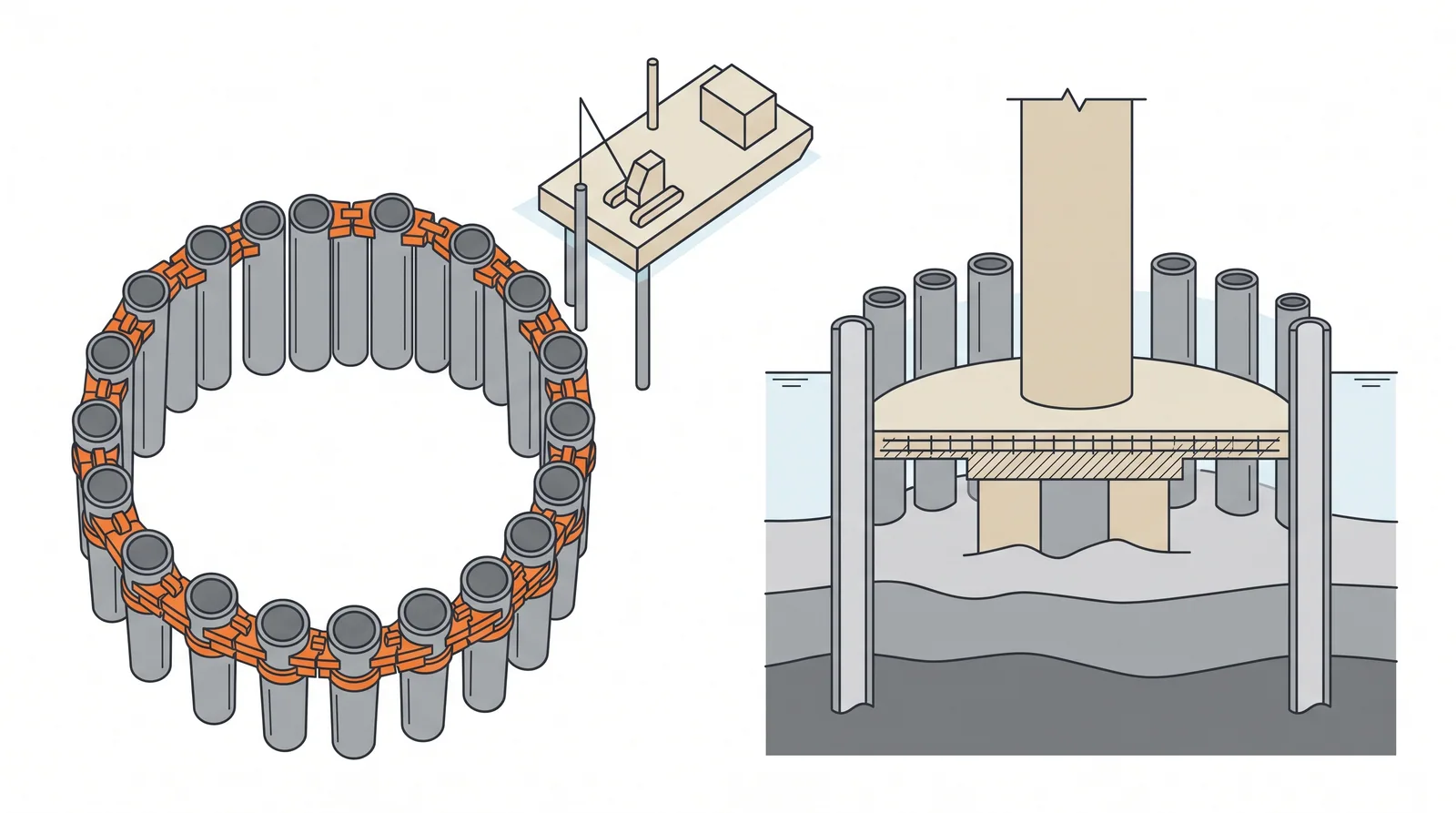
How it is done
- Set a guide frame or template on temporary piles and pitch the first steel pipe sheet piles (typically 800–1,500 mm) with welded joint pipes that interlock with the next pile.
- Drive the ring with vibratory and hydraulic hammers into the bearing layer, closing the ring carefully and checking verticality and joint engagement as each pile goes down.
- Flush the joint pipes and fill them with mortar so that the ring acts as a closed well, transferring shear between piles.
- Use the upper part of the ring as a cofferdam: excavate inside, place a tremie concrete seal, install walings and struts, and dewater.
- Cast the top slab rigidly connecting all pile heads, with shear connectors on the inside faces of the piles.
- Build the pier on the slab, then cut off the temporary upper part of the ring below the bed or low water, or leave it as protection.
Key numbers
- Pipe diameter800–1,500 mm
- Ring sizeabout 10–30 m across, circular, oval or rectangular
- Water depthabout 5–20 m
- Piles per ringabout 40–100 or more
- Programmea ring of 60–100 piles in one to two months, then slab and pier
Where it fits
- River and coastal piers in 5-20 m of water with sandy or clayey beds, high lateral loads (ships, earthquakes), sites where a separate cofferdam would double the time.
Where it does not
- Rock at shallow depth (piles cannot embed), very small piers (uneconomic).
Choosing it
- Choose it over a sheet-pile cofferdam plus a pile group in 5–20 m of water: one set of steel serves as cofferdam and foundation, saving months on river and estuary piers.
- Choose it where lateral loads (earthquake, ship, ice) are high and soft upper soils would make an ordinary pile group flexible.
- Prefer an open caisson or bored piles where rock or boulders lie close below the bed; the pipes must be driven well into the bearing layer.
- Prefer bored piles in a cofferdam for small piers or where impact driving is not permitted for noise reasons.
Plant, pace and money
Risks and controls
What goes wrong
- Interlock leakage and grout quality, driving refusal on obstructions, corrosion.
Quality assurance
Interlock grout tests, ring verticality, dewatering watch.
Origins
Developed in Japan from 1961 from a German box-pile wall concept of the 1930s, the steel pipe sheet pile foundation was first used for a blast-furnace foundation in 1967 and for a bridge at the Ishikari Kakō Bridge in 1969; the Japan Road Association now publishes a dedicated design and construction handbook.
Examples
Japanese river and coastal bridges since 1969; the Nhat Tan and Lach Huyen bridges in Vietnam; steel pipe sheet piles with mechanical joints were also used in the Haneda Airport D Runway works.
Case studies
Related methods
Further reading
Japanese Steel Pipe Sheet Pile Foundation design guidelines · Japan Road Association specifications · Japan Road Association, Handbook for Design and Construction of Steel Pipe Sheet Pile Foundations