How bridges get built · Caissons and marine foundations · Suction caissons
Also called: suction buckets, suction anchors
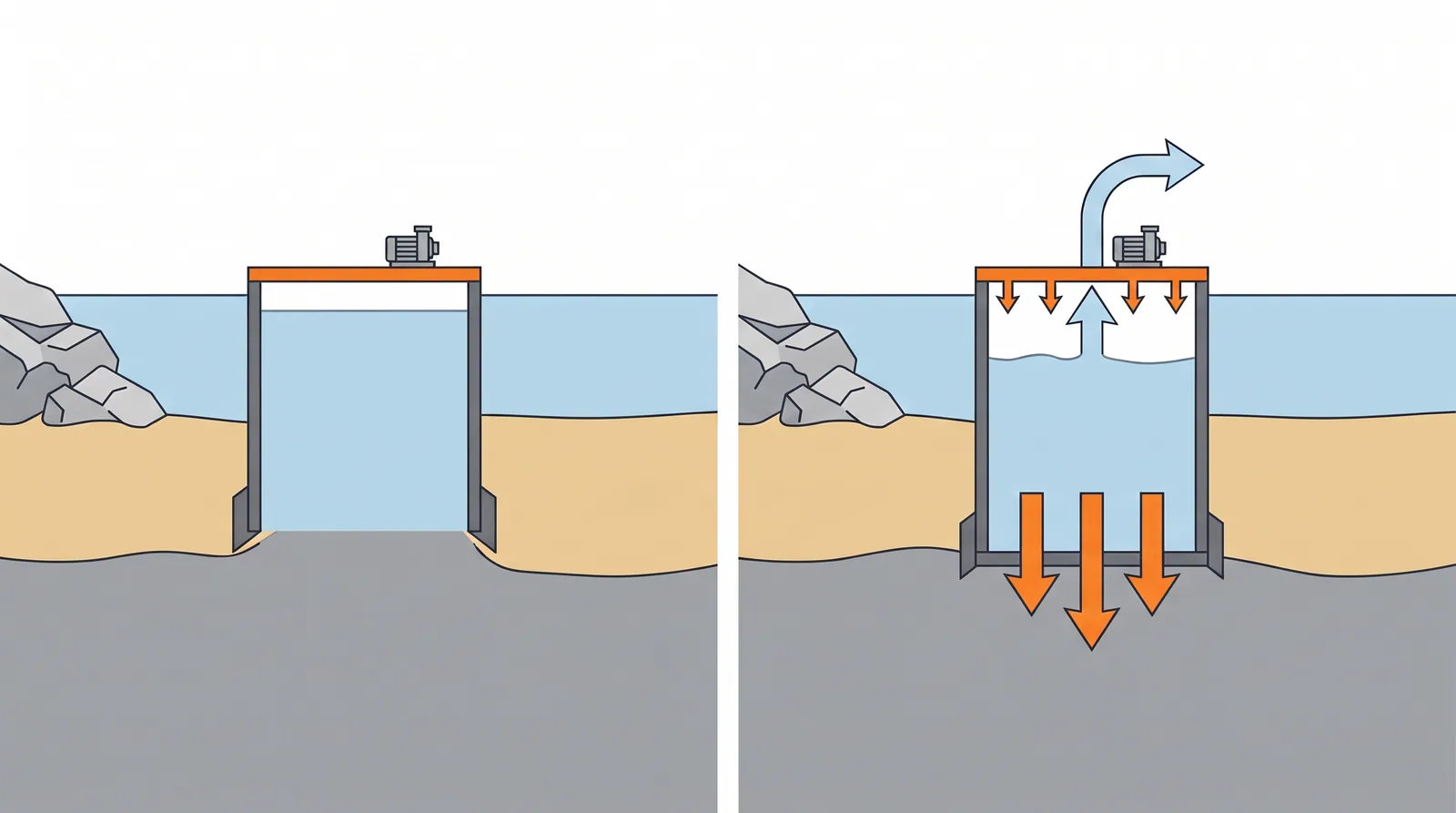
How it is done
- Confirm the soil profile to beyond skirt depth with CPTs; look for layers that would block penetration (dense sand, gravel) or allow piping (sand over clay).
- Lower the bucket by crane to touchdown with the vent open; self-weight pushes the skirt in and seals the rim.
- Close the vent and pump water out at a controlled rate; the underpressure drives the skirt down, and in sand the induced seepage loosens the soil at the tip and eases penetration.
- Monitor underpressure, penetration and tilt continuously, keeping underpressure below the critical value for piping or plug heave; correct tilt by adjusting pumping between the buckets of a multi-bucket jacket.
- Stop at target depth, seal the vent, and grout the gap under the lid where full contact is needed.
- Install the structure; to remove the bucket, pump water in so the overpressure pushes it out.
Key numbers
- Diameterabout 4–15 m
- Skirt length to diameterabout 0.5–1 in sand; up to about 3–6 for anchors in soft clay
- Underpressuretens to a few hundred kPa, limited by piping in sand and plug failure in clay
- Installationhours per bucket
Where it fits
- Soft clay and fine sand seabeds, temporary works platforms, anchors for floating cranes and moorings, small piers in calm water.
Where it does not
- Gravel, boulders and layered soils with sand over clay (piping), high-scour sites.
Choosing it
- Choose buckets over driven piles where the seabed is soft clay or uniform fine sand, piling noise is restricted, and the foundation may later be removed.
- Prefer driven piles in layered, gravelly or bouldery seabeds or where scour is severe; buckets are shallow and depend on the near-surface soil.
- For temporary works platforms and anchors for floating plant, re-use of the buckets offsets their steel cost.
Plant, pace and money
PlantBucket, pumps and control, crane vessel.
ProductivityHours per bucket.
CostLow installation cost; steel dominates.
Risks and controls
What goes wrong
- Piping failure in sand, tilt during penetration, scour around the rim.
Quality assurance
Penetration versus pressure logs, tilt monitoring.
Origins
Suction anchors were first used for floating systems in the North Sea around 1980; the Draupner E (Europipe 16/11E) jacket of 1994 was the first platform installed on suction buckets, and offshore wind adopted suction-bucket jackets in the 2010s.
Examples
North Sea platforms since Draupner E (1994), suction-bucket jackets for offshore wind (Aberdeen Bay, 2018), and anchors for floating plant and moorings.
Case studies
Draupner E (Europipe 16/11E)Norway (North Sea) · 1994First steel jacket installed on suction buckets instead of piles.
European Offshore Wind Deployment Centre, Aberdeen BayUK · 201811 turbines installed on jackets with suction buckets.
Related methods
Further reading
Andersen et al., suction anchors for deepwater · DNV-RP-E303 · Houlsby and Byrne (2005), design procedures for installation of suction caissons in clay and sand