Also called: probe holes, cavity investigation, grouting investigation
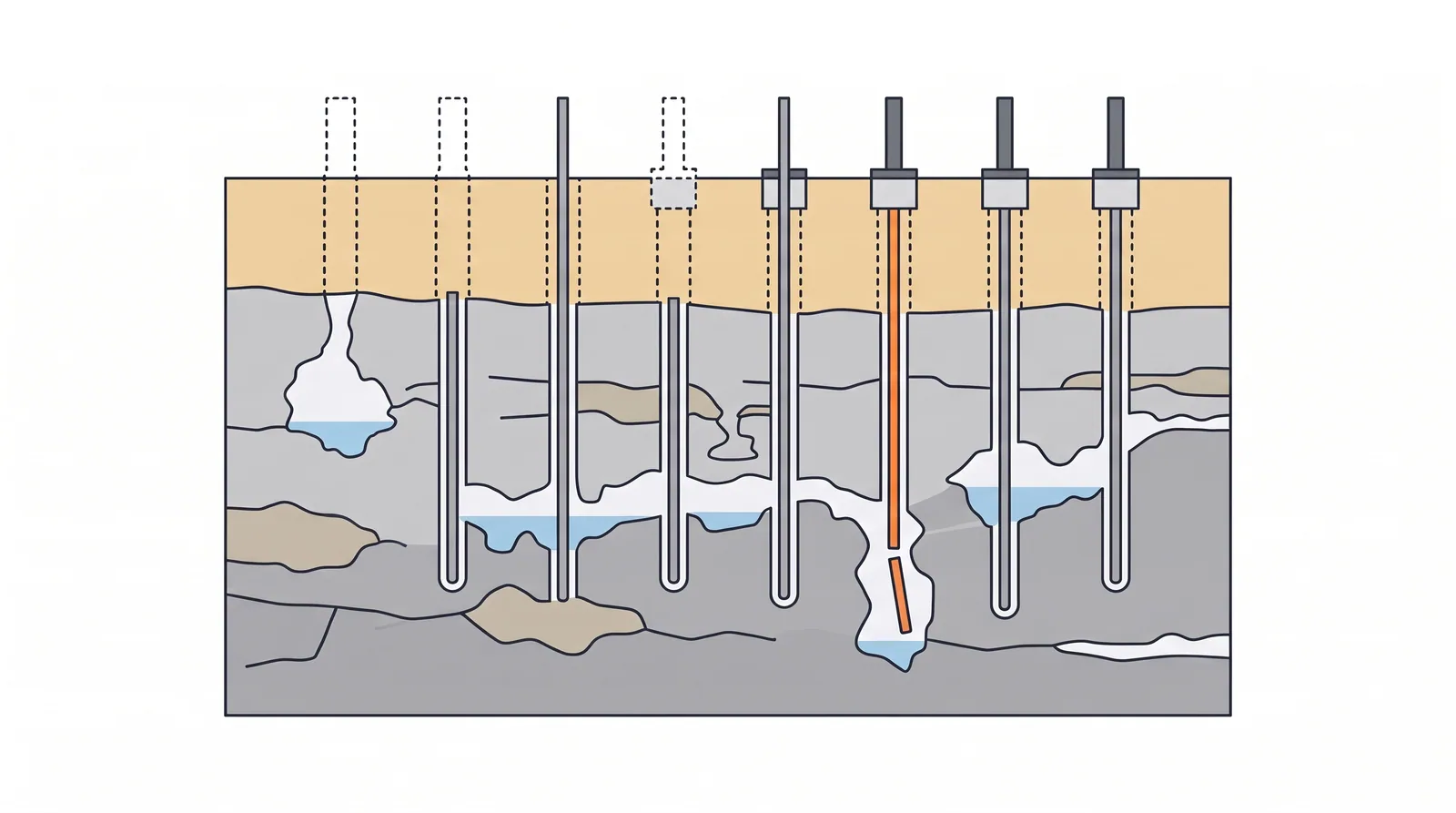
How it is done
- Zone the site by karst hazard from the desk study, geological mapping, earlier boreholes and geophysics (resistivity, microgravity) before planning probes.
- At each foundation drill probe holes with drilling-parameter recording to at least 3–5 m, or three pile diameters, below the design toe; for large shafts drill one probe per pile and add perimeter probes in high-hazard zones.
- Record penetration rate, rod drops, flush loss, thrust and torque; core selected probes to tell open voids from clay-filled fissures and pinnacles.
- Plot voids and the pinnacled rock head across each footprint; where spacing leaves gaps, add crosshole tomography or resistivity between probes.
- Decide pile by pile: deepen to sound rock, move or add the pile, enlarge the socket, or fill the void by grouting and re-probe.
- During production, probe again from the base of each excavated shaft before concreting and file the result against the pile number.
Key numbers
- Probe depthat least three pile diameters or 3–5 m below the design toe, whichever is greater.
- Densityone probe per pile in high-hazard karst (Hong Kong practice in its marble areas is pre-drilling at every pile); one or two per foundation in low-hazard zones.
- Drilling parameters recorded every 10–50 mm of advance: rate, thrust, torque and flush pressure.
- Added costtypically 5–15 % of piling cost in karst.
Where it fits
- Limestone, dolomite, gypsum and coral rock; any site flagged as karst in the desk study.
Where it does not
- Sizing sockets on a single borehole in karst.
Choosing it
- Probe every pile when the desk study or first boreholes show voids or pinnacled rock: probing costs far less than one lost shaft.
- Prefer friction piles or barrettes in the overburden, or a raft on grouted ground, when the rock head is deep and pinnacled.
- Use geophysics to zone the site, never in place of probing at the pile.
- Prefer fewer, larger shafts when each must be proven: the number of probes scales with the number of piles.
Plant, pace and money
Risks and controls
What goes wrong
- Voids between probe positions; sudden drill drops during production piling.
Quality assurance
Drill logs with rate and water loss for every probe; a void register tied to pile numbers.
Origins
Probing practice grew out of repeated pile and footing losses in limestone and marble regions such as Florida, Pennsylvania, Kuala Lumpur and Hong Kong; Hong Kong now designates its marble areas as Scheduled Areas, where additional investigation is mandatory before foundations are built.
Examples
Kuala Lumpur limestone, Florida, parts of the Gulf coast; the game's karst sites trigger the karst void event when bored piles are used without probing.
Case studies
Related methods
Further reading
Waltham, Bell and Culshaw, Sinkholes and Subsidence · Hong Kong GEO, Foundation design and construction (GEO Publication No. 1/2006) · Sowers, Building on Sinkholes: Design and Construction of Foundations in Karst Terrain