Also called: soil-cement columns, deep soil mixing, CDM, jet grout columns
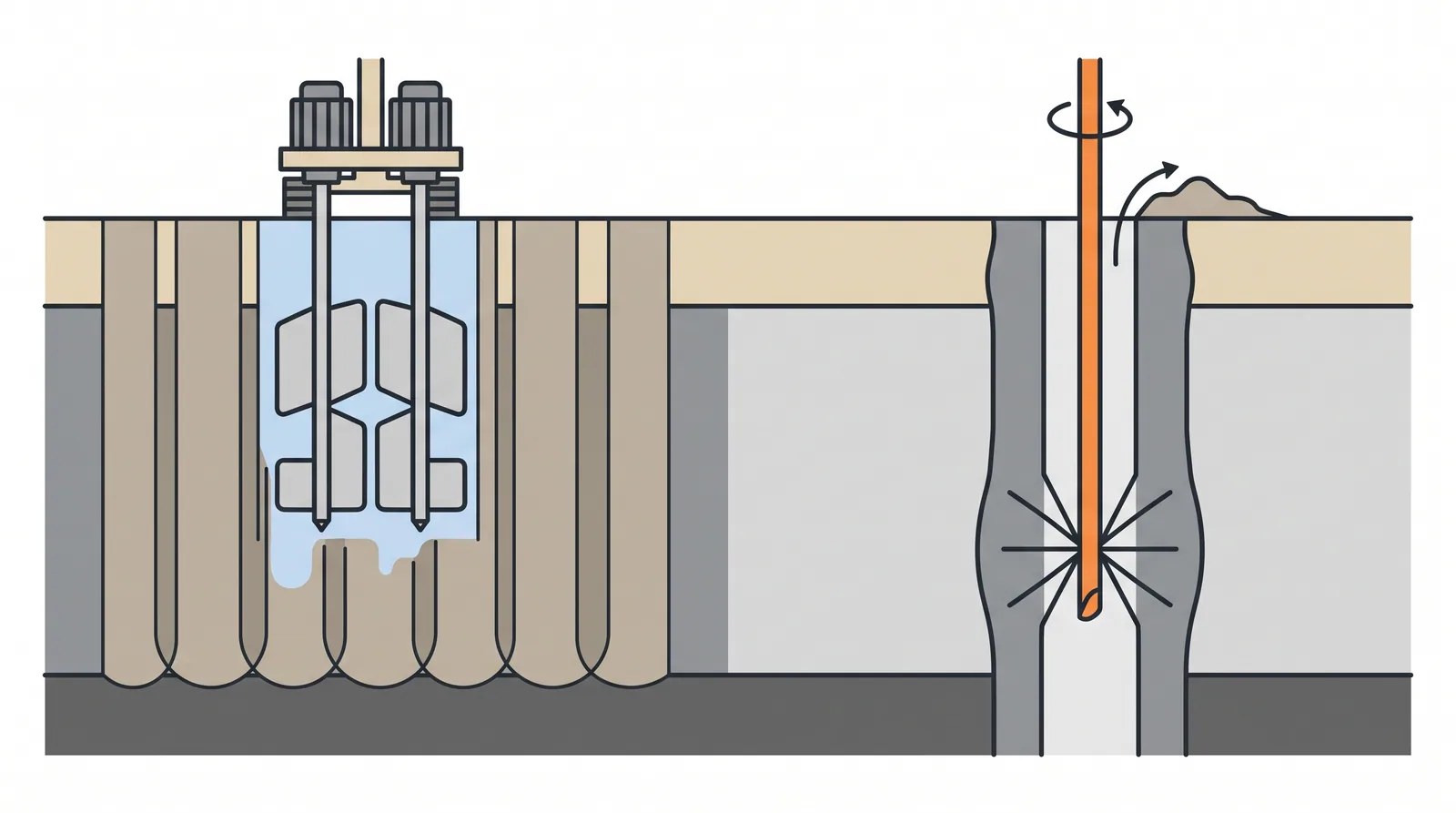
How it is done
- Run laboratory mix trials on the site soils (binder type and dosage, water-cement ratio) for the target strength, allowing for field strength being lower than laboratory strength.
- Choose the pattern for the function: isolated columns for settlement, overlapping walls or grids across the slip surface for stability, blocks for heavily loaded areas, overlapping panels for cut-offs and base plugs.
- Install trial columns, core and test them at 28 days, and expose their tops to check diameter and overlap; fix the rig parameters (penetration and withdrawal speed, rotation, binder flow) from the results.
- DCM production: drive the mixing tool down, injecting slurry or dry binder on penetration or withdrawal, and keep the specified blade rotation per metre so the soil is fully mixed.
- Jet grouting production: drill to depth, then rotate and lift the monitor while grout, alone or shrouded by air and water, jets from the nozzles at very high pressure; manage the spoil returning at the collar.
- Record depth, rotation, lift speed and binder flow automatically; for jet grouting, watch spoil return and monitor heave of nearby structures, stopping if the return is blocked.
- Verify by wet-grab samples during mixing and by full-depth coring at 28 days for recovery and strength; test walls and plugs for permeability, then add columns where results fall short.
Key numbers
- DCM columns 0.6–2.0 m diameter, to about 30–40 m on land; marine rigs with several shafts treat larger areas and greater depths.
- Bindercommonly about 100–350 kg of cement per m³ of soil; unconfined strength 0.5–3 MPa in clays.
- Field strength typically 0.2–1.0 times laboratory strength (lowest on land); Japanese wet-method practice calls for at least about 350 blade rotations per metre.
- Jet groutingnozzle pressures about 20–60 MPa; column diameters about 0.5–1.0 m single fluid, 1.0–2.0 m double, 1.5–3.0 m triple, smaller in clay.
- Jet grout strengthroughly 2–10 MPa in sands and gravels, 0.5–3 MPa in clays.
- OutputDCM 100–300 m of column per rig per shift; jet grouting 30–80 m per shift.
Where it fits
- Soft clay under abutments and approach fills when there is no time for PVDs.
- Cofferdam base plugs, cut-off walls, treatment around existing foundations, karst voids (jet grouting).
Where it does not
- Highly organic soils (cement does not set well).
- Cobbles and boulders for DCM; jet grouting handles them better.
Choosing it
- Choose DCM over PVD and surcharge when there is no time for consolidation, or when stability rather than settlement governs (high abutment fills, deep excavations).
- Choose jet grouting over DCM to treat around and beneath existing structures, through obstructions, in limited headroom, or to form plugs at depth; accept its higher cost per m³ and large spoil volume.
- Prefer piles or piled embankments in peat and highly organic soil, where binder sets poorly, unless trials prove a mix.
- Prefer walls or blocks across the slip surface to isolated columns where embankment stability is the problem: isolated columns fail in bending.
Plant, pace and money
Risks and controls
What goes wrong
- Uneven mixing and low-strength zones; ground heave near structures under jet grouting; spoil disposal.
Quality assurance
Wet-grab samples during mixing, cores at 28 days, unconfined tests, column diameter checks by excavation in a trial.
Origins
Deep mixing developed in parallel in Sweden (lime columns, late 1960s) and in Japan, where Port and Harbour Research Institute work led to wet cement deep mixing for marine works in the mid-1970s; jet grouting was developed in Japan around 1970 and reached Europe later that decade.
Examples
Japanese CDM for port and bridge approaches; jet grouting to seal river cofferdam bases in Europe.
Case studies
Related methods
Further reading
EN 14679 (deep mixing) · EN 12716 (jet grouting) · Kitazume and Terashi, The Deep Mixing Method · Bruce, An Introduction to the Deep Soil Mixing Methods as Used in Geotechnical Applications (FHWA-RD-99-138) · Croce, Flora and Modoni, Jet Grouting: Technology, Design and Control