How bridges get built · Caissons and marine foundations · Floating barges and spud barges
Also called: work barge, spud barge, crane barge
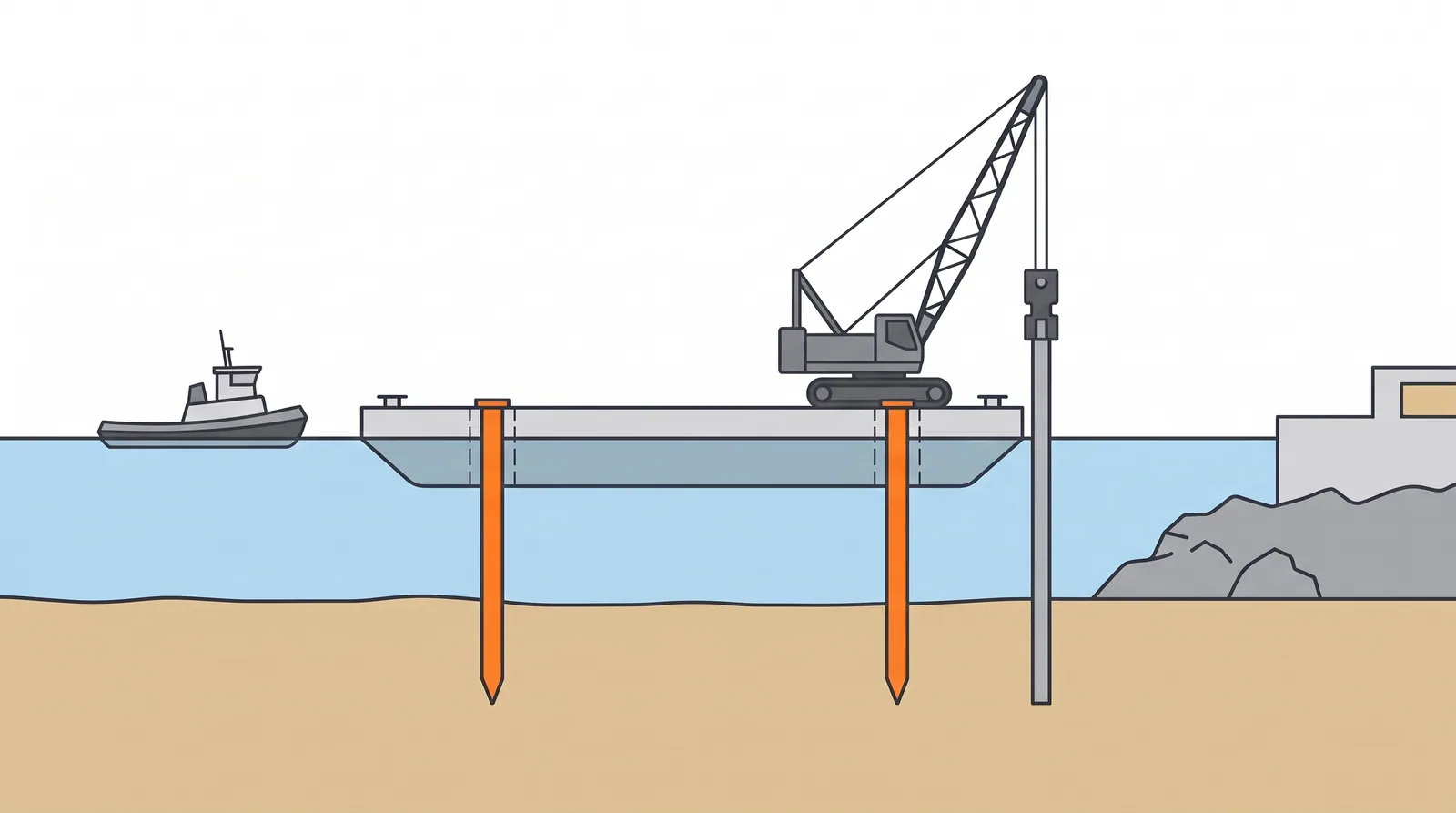
How it is done
- Check barge stability and deck strength for each crane configuration and radius, and plan the spud or mooring arrangement for current, tide and wind.
- Tow or push to site; drop spuds in shallow water or lay an anchor spread, with anchor positions agreed with the harbour authority.
- Set the crane on mats with tie-downs, and fix the piling template or pile gate to the barge or, for better accuracy, to piles already driven.
- Work within the barge-motion limits, adjusting for tide with the spuds or winches, and stop lifts when wind, waves or current exceed the limits.
- Move between pile positions by spud walking or anchor handling, keeping a navigation watch and lights for passing traffic.
- Demobilise by recovering anchors and spuds, and survey the bed for dropped objects.
Key numbers
- Barge size30–80 m long
- Crane100–300 t crawler on deck, on charts derated for list and motion
- List and trim during liftswithin the crane maker's limits, typically 1–3 degrees
- Crane work typically stops above about 0.5–1.0 m significant wave height
- Day rateUSD 5,000–25,000
Where it fits
- Sheet-pile cofferdams, driven piles in rivers and sheltered water, pier construction in calm estuaries, service of jack-ups.
Where it does not
- Open sea, strong currents, bored piling that needs a fixed platform, tolerances tighter than the barge motion.
Choosing it
- Choose barges for driven piles, sheet-pile cofferdams and pier works in rivers and sheltered water, where mobilisation is cheap and moves are frequent.
- Prefer a jack-up for bored piling and precision work in exposed water; prefer a trestle where water is so shallow that barges ground at low tide.
- Fix templates to driven piles rather than to the barge when position tolerance matters; the barge moves, the piles do not.
Plant, pace and money
PlantFlat-top barge 30-80 m, 100-300 t crawler crane, spuds, tugs.
ProductivityCheap to move, slow to hold position; downtime in weather.
CostUSD 5,000-25,000 per day.
Risks and controls
What goes wrong
- Capsizing under an over-swung crane, spud failure in current, collision, crew falls.
Quality assurance
Stability calculation for each crane radius, mooring plan, weather limits.
Origins
Crane and pile-driving barges have been the basic floating plant of river and harbour work since steam piling in the 19th century; the spud barge, pinned to the bed by its legs, is the simplest step towards the jack-up.
Examples
River pier cofferdams worldwide; the game's default access for water piers under 6 m.
Related methods
Jack-up platformsTemporary trestles and access bridgesSheet-pile cofferdamFloating crane erectionOver-water site investigation from jack-ups, barges and vesselsFloating (pontoon) bridge construction and towing
Further reading
USACE floating plant safety · IMCA marine guidance · USACE EM 385-1-1 Safety and Health Requirements Manual (floating plant)