How bridges get built · Caissons and marine foundations · Gravity base foundations
Also called: gravity caisson, GBS, spread footing at sea
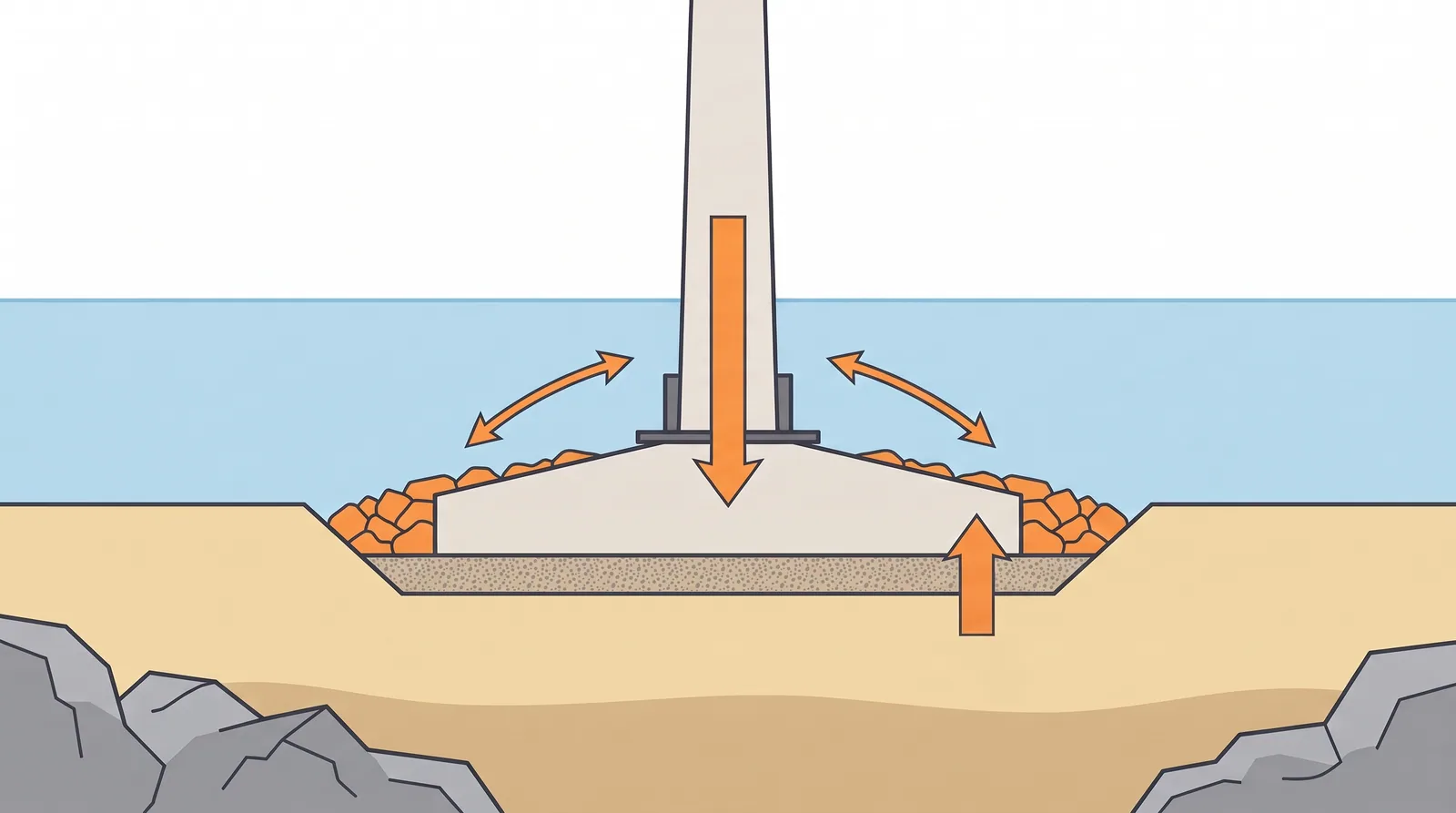
How it is done
- Investigate the founding stratum in detail (borings, CPT, geophysics) and design for bearing, sliding, overturning, settlement, waves, ice and earthquake, treating the gravel bed as a design element.
- Dredge to the founding level, removing soft or loose material; improve the ground where needed (steel-pipe inclusions at Rion–Antirion).
- Place a gravel or crushed-rock bed and screed it level with a frame or screeding barge; survey it to tolerance. Hold point.
- Build the base in a dock or casting yard and float it out, or carry it with a heavy-lift crane vessel (Svanen on the Confederation Bridge).
- Lower and seat the base, ballast it, and fill any gap under it with underbase grout where contact is not uniform.
- Place scour protection (filter and armour layers) around the base, then build the pier or pylon.
- Monitor settlement and tilt through construction and check scour after storms.
Key numbers
- Water depthabout 10–65 m (Rion–Antirion up to 65 m)
- Base size20–90 m across depending on load and soil
- Screeded bed tolerancein the order of ±50–100 mm before seating
- Programmebed preparation in weeks; seating in days
Where it fits
- Rock or dense sand seabeds, deep water where piling from platforms is slow, pylons and anchorages of suspension bridges.
Where it does not
- Soft clay and silt beds, sites with heavy scour, earthquake sites without sliding checks.
Choosing it
- Choose a gravity base over piles where the seabed is rock or dense soil within dredging reach and the water is too deep for efficient piling from platforms.
- Choose it when prefabrication in a dock and placement by heavy-lift vessel suit a long, repetitive crossing, as on the Confederation Bridge.
- Prefer piled or caisson foundations on soft clay or silt or where scour cannot be controlled; with ground improvement and a sliding-tolerant design, as at Rion–Antirion, a gravity base can still work on weak soils in a seismic zone.
Plant, pace and money
PlantDredgers, screeding frames, tugs, ballast systems, divers or ROVs.
ProductivityBed preparation weeks; seating days.
CostUSD 20-100 million per pylon foundation.
Risks and controls
What goes wrong
- Bed unevenness giving point contact, sliding under wave or ship load, scour.
Quality assurance
Bed survey to tolerance, contact pressure by grout intake, post-seating survey.
Origins
Concrete gravity structures were developed at large scale for North Sea oil platforms in the 1970s (the Ekofisk tank of 1973 and the Condeep platforms), and the idea was taken up for strait crossings in the 1990s (Great Belt, Øresund, Confederation) and for Rion–Antirion in 2004.
Examples
Great Belt East pylons and anchor blocks, Oresund, Confederation Bridge piers.
Case studies
Confederation Bridge, Northumberland StraitCanada · 199712.9 km crossing with 250 m main spans; precast pier bases were placed on a prepared seabed by the heavy-lift vessel Svanen.
Rion–Antirion BridgeGreece · 200490 m diameter bases in up to 65 m of water rest on a gravel layer over soil reinforced with steel-pipe inclusions, and are designed to slide rather than fail in a major earthquake.
Related methods
Further reading
Gimsing and Georgakis · Confederation Bridge construction papers · ISO 19903 Fixed concrete offshore structures · Gerwick, Construction of Marine and Offshore Structures