How bridges get built · Caissons and marine foundations · Temporary trestles and access bridges
Also called: work trestle, temporary access bridge, piled trestle
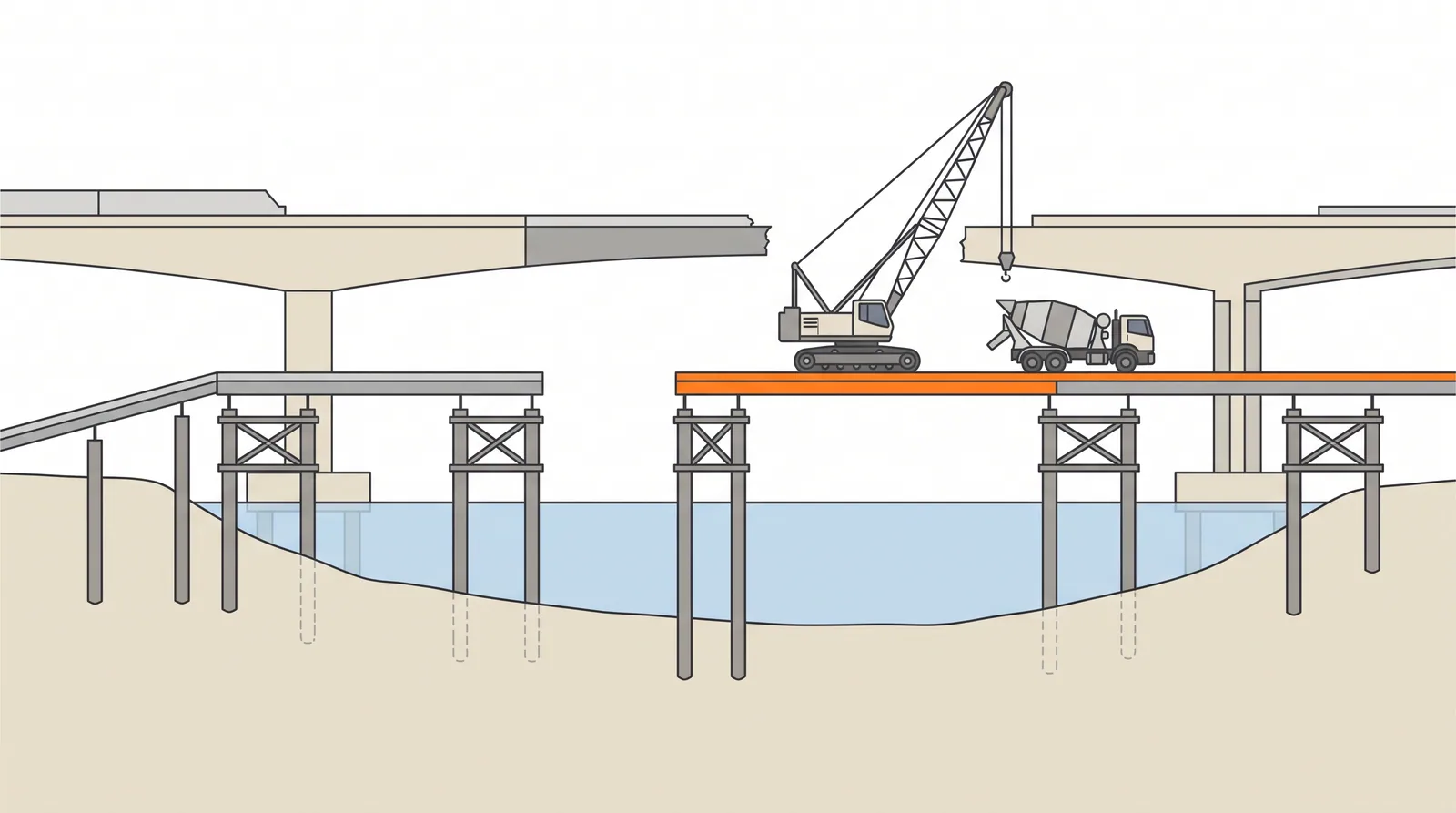
How it is done
- Design the trestle for the heaviest crane and crawler loads, flood and current, scour, debris, ice and vessel impact, and post a load rating.
- Drive the steel pipe piles of the first bents from the shore, then advance from the trestle's own head with a crawler crane, vibratory hammer and a cantilevered pile-guide frame.
- Weld or bolt bracing and capping beams, set the main beams (steel sections or modular panels) and lay a deck of steel plates, precast panels or timber.
- Advance bent by bent and add working platforms at each pier for drilling rigs, cranes and concrete trucks.
- Inspect regularly and after floods, checking pile scour and bracing, and enforce traffic and load controls.
- Remove in reverse once the permanent works are complete, extracting the piles by vibration or cutting them below the bed where permitted.
Key numbers
- Bent spacingabout 10–15 m, more with heavier girders
- Pilessteel pipes of about 600–1,000 mm, two to four per bent
- Water deptheconomic to about 5–6 m
- Rate20–40 m of trestle per day
Where it fits
- Rivers, wetlands, estuaries and coasts with water to about 5-6 m, viaducts with many piers, sites where barges cannot operate at low tide.
Where it does not
- Deep water, navigable channels, flood seasons that would carry the trestle away, environmentally protected wetlands (use top-down instead).
Choosing it
- Choose a trestle over barges for long viaducts in shallow water, tidal flats and wetlands, where barges ground at low tide and land plant can work continuously.
- Choose a piled working platform over a jack-up for long campaigns at one large pier; at Sutong the platform was carried on the permanent casings.
- Prefer jack-ups or floating plant in water deeper than about 6–10 m, in navigable channels, or where floods would load a trestle heavily.
- Prefer top-down construction from the permanent deck in protected wetlands where temporary piles are not permitted.
Plant, pace and money
PlantCrawler crane with vibro-hammer working from the trestle head, pipe piles, steel girders, deck panels.
Productivity20-40 m of trestle per day.
CostUSD 8,000-20,000 per metre; the game charges this as the access line.
Risks and controls
What goes wrong
- Flood damage, pile scour, overloading by unplanned plant, collision from vessels.
Quality assurance
Load rating posted, pile driving records, inspection after floods.
Origins
Piled timber and later steel trestles have served bridge and harbour construction since the 19th century; steel-pipe trestles built from their own advancing head became routine on Asian river and estuary bridges.
Examples
Sea viaducts in the Gulf, wetland viaducts in Florida, most Korean river bridges during construction.
Case studies
Sutong BridgeChina · 2008A 117 × 55 m drilling platform; the first temporary 60 m support pipes vibrated in the current, so the platform was carried on the 120 m permanent casings instead, saving steel and time.
Cypress Avenue Bridge, Sacramento River, ReddingUSA · 2007 (load test)Most of the river shafts were drilled from a temporary steel trestle, with rock pads near the banks.
Related methods
Jack-up platformsFloating barges and spud bargesTop-down construction over wetlandsSteel pipe piles (open- and closed-ended)Artificial islands for marine foundations (sand, rock-bund and cellular islands)Modular temporary and emergency bridges (Bailey, Acrow, Mabey)
Further reading
BS 5975 temporary works · FHWA temporary works guidance · EN 1991-1-6 Actions during execution