Also called: prestressed high-strength concrete pile, spun pile, PHC pile
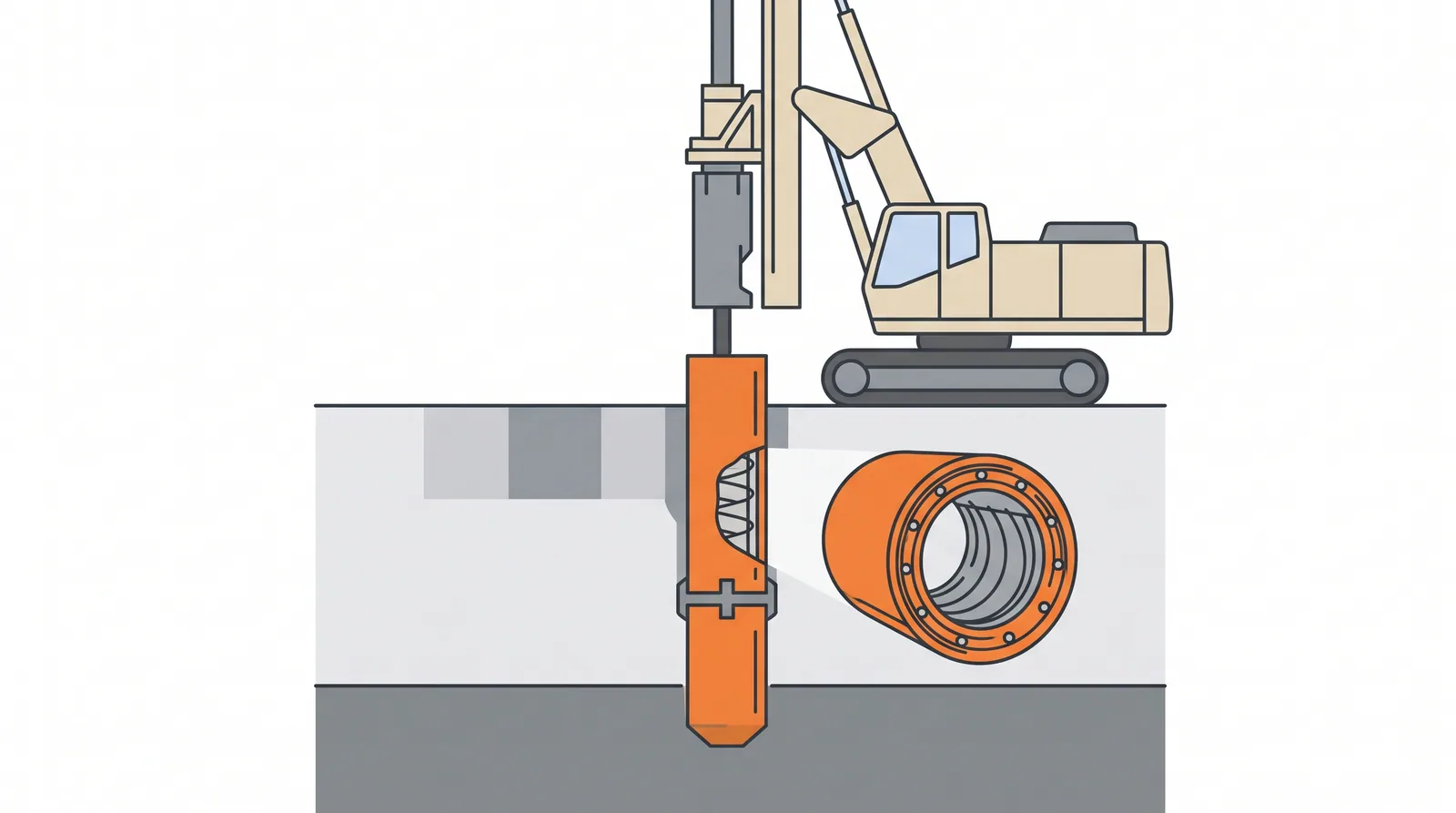
How it is done
- Before driving, run a wave equation analysis to choose the hammer and cushion and to set limits on driving stress in compression and, through soft layers, in tension.
- Check delivered segments for cracks, end-plate squareness and length; set out the positions and pitch the first segment in the leader with a plywood or timber cushion on the head.
- Drive with a hydraulic hammer, reducing the stroke in soft layers to avoid tension cracking; record blows per 250 mm and hammer energy for the full length.
- Splice by welding the end plates with a circumferential groove weld (or with a mechanical joint); let the weld cool before driving resumes and inspect it.
- Drive to the set at or below the minimum toe level in the bearing layer; stop and refer to the engineer if refusal comes well above the expected level or the resistance suddenly drops (a possible break).
- Restrike selected piles after setup and test them dynamically with signal matching; run low-strain integrity tests on a sample to find cracked piles or failed joints.
- Cut the head with a saw rather than a breaker, fill the hollow with a reinforced concrete plug or weld on a head plate with anchor bars, and embed in the cap.
Key numbers
- Diameter300-1,200 mm; concrete strength 80 MPa or more (over 100 MPa now common in Japan).
- Effective prestress classes (JIS)about 4, 8 and 10 MPa for types A, B and C.
- Segment length5-15 m; spliced piles of 50-60 m are routine and 70-80 m possible.
- Working loadabout 1-4 MN per pile.
- Driving stress limits (AASHTO)compression 0.85 f'c minus effective prestress; tension about 0.25 sqrt(f'c) plus effective prestress (MPa).
- Verticalitywithin about 1:75-1:100.
Where it fits
- Alluvial and coastal sites with a bearing layer of dense sand or gravel; viaduct approaches, low piers, wetland viaducts on trestles.
- Loads of 1-4 MN per pile; groups of 4-20 under a cap.
Where it does not
- Boulders, cobbles and shallow rock: the pile refuses, cracks or breaks (the game's boulder event).
- Very stiff clay over the full length: hard driving damages the joints.
- Urban sites with noise and vibration limits.
Choosing it
- Choose PHC over bored piles when a dense sand or gravel bearing layer lies within about 40 m and loads are moderate (1-4 MN per pile): much cheaper and faster per unit of capacity.
- Prefer steel pipe piles where ship impact, large lateral loads, liquefaction or hard driving demand bending capacity and ductility, or where piles must be spliced to great length.
- Prefer SIP or another pre-bored method near housing, or where dense upper layers would cause hard driving.
- Prefer bored piles or rock sockets where boulders, cobbles or rock are expected above the bearing level.
Plant, pace and money
Risks and controls
What goes wrong
- Tension cracking during easy driving in soft clay, joint failure, pile running off line, heave of neighbouring piles in clay.
Quality assurance
Driving records (blows per 250 mm), PDA on 5-10 % of piles, integrity tests after driving, verticality within 1:75.
Origins
Spun reinforced concrete piles were made in Japan from 1934 and prestressed spun piles from 1962; high-strength PHC piles (80 MPa and above) came into use in the 1970s, were standardised in JIS in 1982, and since the late 1980s have made up over 90 % of Japanese precast pile production, spreading to Korea, China and Southeast Asia.
Examples
Most Korean expressway viaducts on alluvium; the reference optimiser picks PHC where a dense layer is reachable.
Case studies
Related methods
Further reading
KS F 4306 · JIS A 5373 · PCI Bridge Design Manual · Japan Road Association, Specifications for Highway Bridges, Part IV Substructures · FHWA GEC 12 Design and Construction of Driven Pile Foundations