How bridges get built · Driven piles · Vibratory driving
Also called: vibro-hammer, vibratory pile driver
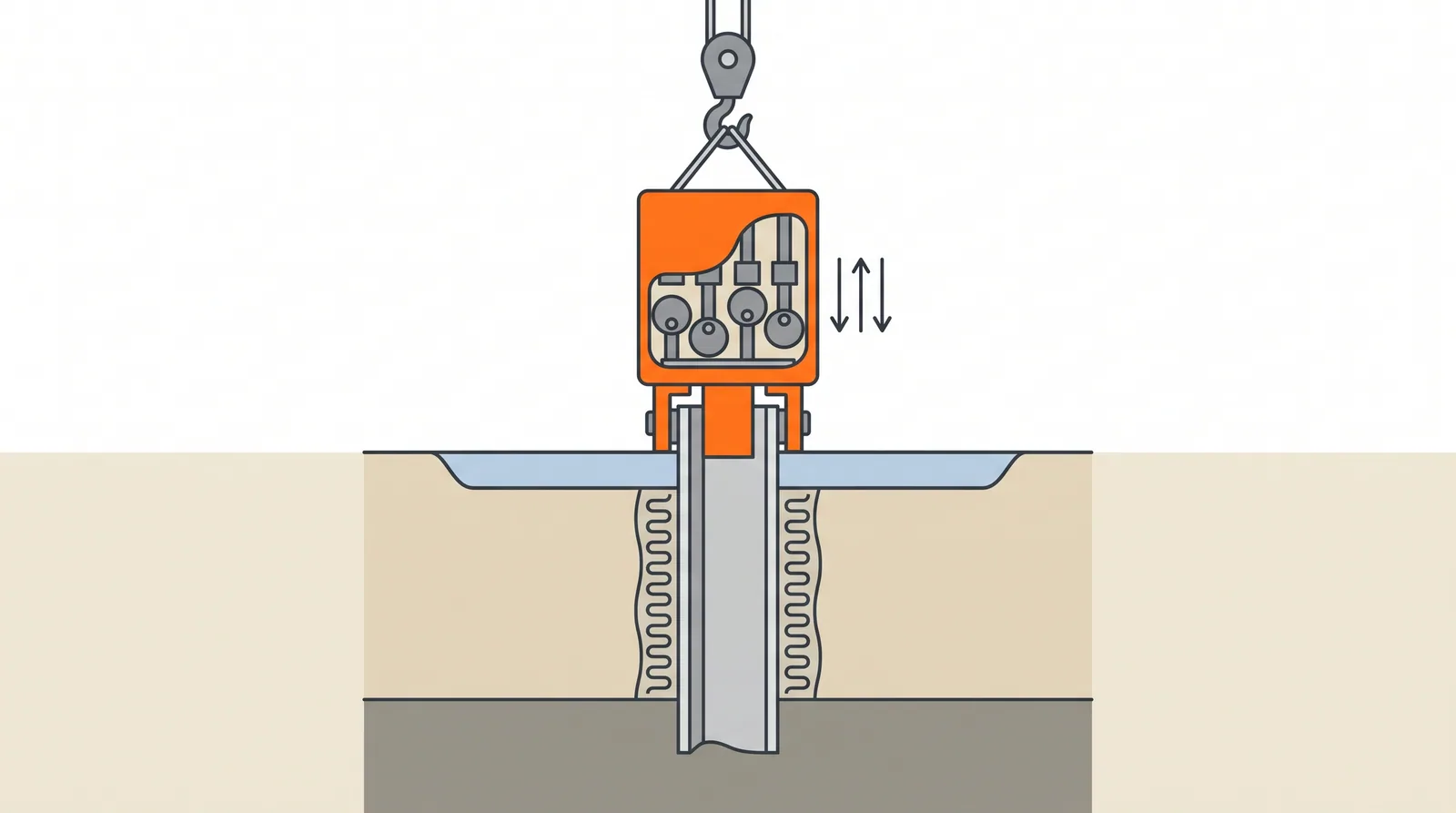
How it is done
- Check driveability and vibration risk: sands and soft soils suit; stiff clay and dense gravel resist; estimate the eccentric moment and centrifugal force needed and the vibration at neighbours.
- Choose a variable-moment (resonance-free) vibrator near structures, so the machine starts and stops with zero eccentric moment and passes through the soil's resonance without shaking it.
- Clamp the vibrator to the pile with hydraulic jaws (twin clamps for pipes and casings), hang it from a crane rated for the dynamic loads, and pitch the pile in a guide.
- Vibrate down at full frequency, recording penetration rate, frequency and power; stop if penetration slows to the specified minimum rate, to avoid overheating and densifying the soil around the pile.
- For bearing piles, finish the last metres with an impact hammer and record the set: vibratory penetration does not prove capacity.
- Monitor peak particle velocity at sensitive structures and settlement of nearby ground; change frequency or method if limits are approached.
- Use the same unit to extract sheet piles and temporary casings, withdrawing slowly so soil fills the void.
Key numbers
- Frequencyabout 20-30 Hz for standard units, 30-40 Hz for high-frequency units.
- Eccentric momentabout 10-300 kg·m for bridge work, over 1,000 kg·m for very large tubulars; centrifugal force about 300-4,000 kN per unit.
- Typical vibration limits at neighbouring buildings: about 2-20 mm/s peak particle velocity depending on sensitivity (DIN 4150-3, BS 7385-2).
- Sheet pilesabout 20-60 per shift in suitable soils.
Where it fits
- Sheet piles, temporary casings, steel pipe piles through sand and silt, extraction of temporary works.
Where it does not
- Stiff clay and dense gravel (the pile stops); final bearing without an impact hammer; near structures sensitive to vibration and settlement.
Choosing it
- Choose vibro over impact for sheet piles, casings and the upper length of steel piles in sand and soft soil: several times faster, quieter, and it extracts as well as drives.
- Prefer impact driving for the final set of bearing piles and in stiff clay or dense gravel where vibration stalls.
- Prefer press-in next to settlement-sensitive structures or where loose saturated sand could densify and settle under vibration.
Plant, pace and money
PlantCrane-hung vibro-hammer with eccentric moment of about 10-300 kg·m (centrifugal force about 300-4,000 kN) and power pack; variable-moment, resonance-free units near buildings.
ProductivitySheet piles at 20-60 per shift, casings in minutes.
CostCheaper per pile than impact driving where it works.
Risks and controls
What goes wrong
- Settlement of adjacent ground by vibration, liquefaction of loose sand around existing foundations.
Quality assurance
Vibration monitoring at neighbours, penetration rate records.
Origins
Vibratory pile driving was developed in the Soviet Union from the 1930s (D. D. Barkan) and spread to Europe, Japan and the United States in the 1950s and 1960s; variable-moment, resonance-free machines later made it acceptable close to buildings.
Examples
Sheet-pile cofferdams everywhere; casing installation for bored piles.
Case studies
Hong Kong-Zhuhai-Macau Bridge (tunnel-portal islands)China · 2011120 steel cylinders about 22 m in diameter and 40 m long were installed by eight synchronised vibratory hammers working as one unit, completing the island walls in under seven months.
Jupiter Federal Bascule BridgeUSA · 2025Variable-moment vibratory hammers were used in vibration-sensitive areas next to the historic Jupiter Inlet Lighthouse, with vibration monitoring throughout.
Related methods
Impact hammers: hydraulic, diesel and dropSheet-pile cofferdamSteel pipe piles (open- and closed-ended)
Further reading
Viking, Vibro-driveability (KTH) · ArcelorMittal Piling Handbook · DIN 4150-3 Vibrations in buildings: effects on structures · BS 7385-2 Evaluation and measurement for vibration in buildings