Also called: cantilever steel erection, creeper crane, derrick crane erection, traveller erection of steel
How it is done
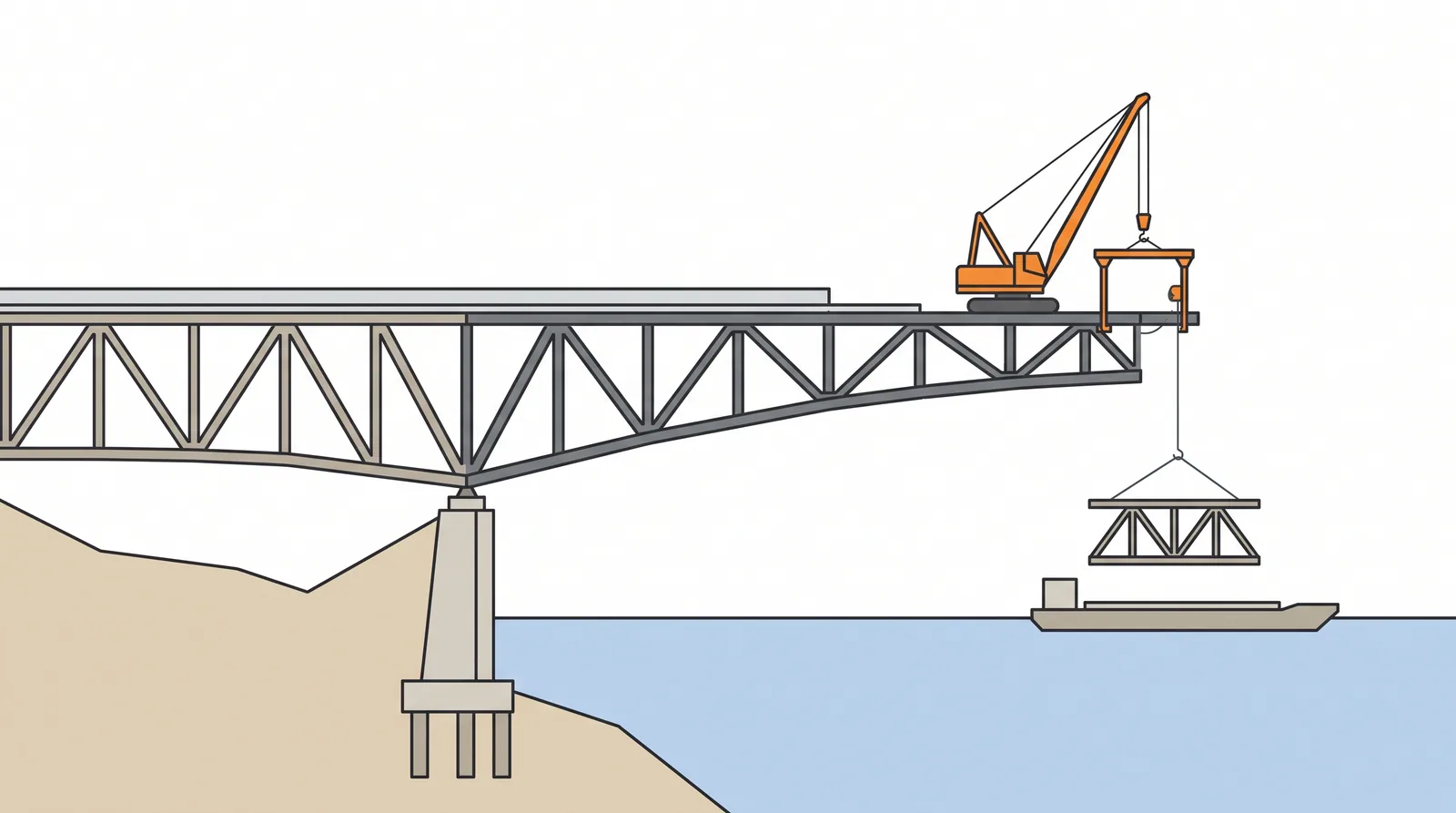
- Erect the pier-head unit (or the anchor span on falsework) and fix it to the pier with temporary ties or stability towers so it can resist the out-of-balance moment of the cantilever.
- Install the creeper crane, derrick or deck crane on the erected steel and set up delivery: barges moored below, or trolleys along the completed deck.
- Cycle: lift the next member or segment, pin and bolt it (or weld, for boxes) with enough fasteners to carry the next stage before release, then advance the crane by one panel.
- Keep the two cantilevers within the allowed out-of-balance load, or tie the cantilever back to an anchor span or temporary backstays; add temporary stays or a king post where the free cantilever would be too long.
- Survey tip level and line after every panel at a reference temperature and correct camber at the joints or with temporary jacks.
- Close at midspan by jacking the tips (or adjusting backstays) to match the closure gap at the planned temperature, or by lowering a suspended span between the tips.
- Remove cranes, temporary ties and jacks, convert the structure to its final support system and survey the as-built profile.
Key numbers
- Span rangeabout 150–550 m for cantilever trusses (Quebec 549 m); about 100–300 m for steel box girders
- Lifted piecestruss members of about 10–80 t; box girder segments of about 100–400 t
- Creeper or derrick crane capacityabout 100–500 t
- Cycleone panel (10–20 m) per 2–5 days per cantilever
- Erection costUSD 800–1,500 per tonne (indicative)
Where it fits
- Steel trusses of 150-500 m, box girder main spans over navigation routes, steel arches erected as cantilevers with tie-backs, cable-stayed steel decks.
Where it does not
- Sites where a floating crane can lift the whole span in one go; short spans.
Choosing it
- Choose it over floating-crane or strand-jack lifting of whole spans when the span is too long or heavy for one lift, or the navigation channel cannot be closed.
- Choose it over temporary towers when the water is deep, the channel must stay open or the valley is high.
- Prefer launching for multi-span viaducts of moderate span; prefer a cable-stayed scheme, where the stays act as permanent falsework, for girder spans beyond about 300 m.
- Prefer a truss over a box girder when the pieces must be light (small cranes, remote sites, limited transport).
Plant, pace and money
Risks and controls
What goes wrong
- Overturning of the cantilever, connection slip, closure misfit from temperature, crane derailment (the 1907 Quebec Bridge collapse remains the lesson).
Quality assurance
Stage-by-stage analysis with temporary conditions, daily survey of the tip, bolt inspection, closure at the planned temperature.
Origins
Cantilever erection of steel trusses was established on the Forth Bridge (1890), whose double cantilevers were built out from the towers without falsework. The Quebec Bridge collapses of 1907 (during cantilever erection) and 1916 (when the suspended span fell while being lifted) made erection-stage analysis a discipline in its own right.
Examples
Forth Bridge, Quebec Bridge (completed 1917), Japanese Minato Bridge, Chinese Yangtze truss bridges.
Case studies
In the bridge game
What Bridge Master applies when you pick it
Deck types: Steel truss, Steel box girder, Orthotropic steel box, Steel arch, Cable-stayed, Extradosed, Steel plate girder. Spans 100-300 m, up to 550 m.
- +30: Long steel truss or arch: cantilever erection.
- +15: Keeps the channel open.
- -30: Simpler methods.
- +10: Tall piers: no falsework or bents, everything comes from the finished deck.
- -10: Long free cantilevers in strong wind: temporary stays and a wind study of the stages.
Related methods
Further reading
Troitsky, Cable-stayed Bridges · Japanese steel bridge erection standards · Durkee, Steel Bridge Construction (chapter in Chen and Duan, Bridge Engineering Handbook) · Merrison Committee, Inquiry into the Basis of Design and Method of Erection of Steel Box Girder Bridges (1973)