Also called: bolted splice, welded splice, high-strength bolting, site welding
How it is done
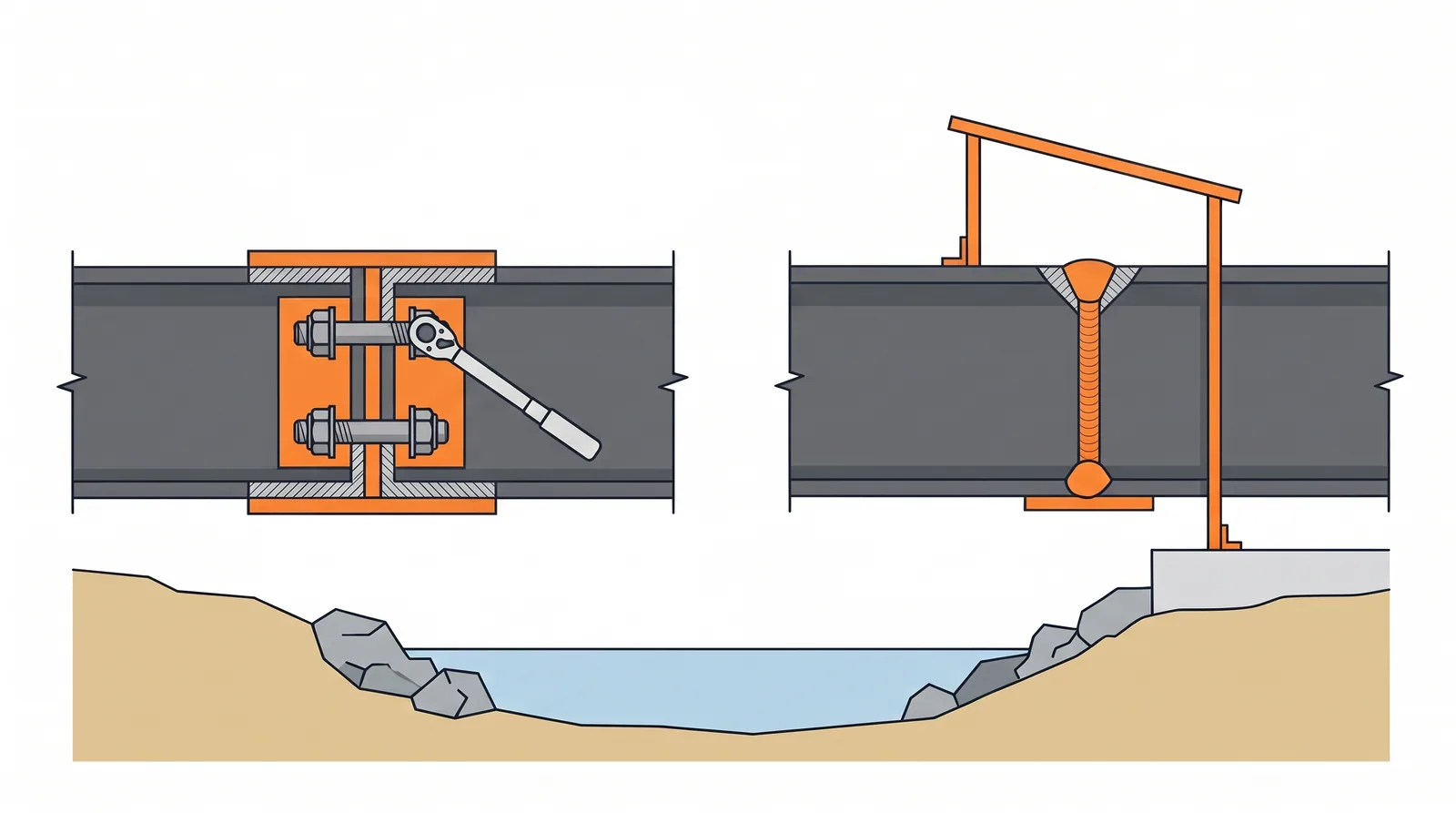
- Detail and fabricate splices with matched holes: drill or ream splice plates with the girders in shop assembly, or CNC-drill from a checked 3D geometry, so field pieces line up without forcing.
- Prepare faying surfaces to the specified slip class (blast-cleaned, or coated with a primer qualified for that class) and keep them free of overspray, oil and loose rust.
- Pre-installation verification: test samples of each bolt, nut and washer lot in a tension calibrator (Skidmore-Wilhelm type) to prove the chosen installation method reaches the minimum pretension; keep lots separate and lubricated.
- Fit up the splice with drift pins and erection bolts in about half the holes before the crane is released, fill the remaining holes and snug-tighten the whole joint, working from the stiffest part outward.
- Pretension by turn-of-nut, calibrated wrench, twist-off (tension-control) bolts or direct tension indicators, then replace the drift pins with bolts and tension them; inspect by the method's own check (match marks, indicator gaps, sheared splines, arbitration torque).
- Welded splices: fit up with backing bars and run-on and run-off tabs, preheat to the qualified procedure, weld flanges and webs in a balanced sequence that controls distortion, under shelter in wind or rain.
- Test butt welds by UT (or phased-array UT) and fillet welds by MT, grind tabs flush, then restore the corrosion protection over the splice.
Key numbers
- Minimum bolt pretension70 % of the specified tensile strength (22 mm A325/F3125: about 173 kN; M24 grade 10.9: about 247 kN)
- Turn-of-nut1/3 to 2/3 of a turn beyond snug, depending on bolt length/diameter
- Slip coefficientAASHTO/RCSC Class A 0.30, Class B 0.50
- Standard holesbolt diameter plus 1.6 mm (AASHTO, d + 1/16 in) to 2–3 mm (EN 1090-2)
- Outputabout 200–400 bolts per crew per shift; a welded box splice in one to three days
- CostUSD 20–40 per installed bolt; USD 2,000–6,000 per welded flange splice (indicative)
Where it fits
- All steel bridges; welded splices for orthotropic boxes and aesthetics, bolted for everything else.
Where it does not
- Welding in wind or rain without shelters; mixing bolt lots without tests.
Choosing it
- Choose bolted slip-critical splices by default: faster, less weather-dependent and easier to inspect; nearly all bridge girder splices see stress reversal or fatigue and need slip-critical design.
- Prefer welded splices for orthotropic deck plates and box girders where bolt heads would interfere with surfacing, aerodynamics or appearance; budget shelters, preheat and 100 % UT.
- Prefer bolting on cold, wet or windy sites and where welders qualified for the procedure are scarce.
- On orthotropic decks a hybrid is common: deck plate butt-welded, ribs and webs bolted.
Plant, pace and money
Risks and controls
What goes wrong
- Under-tensioned bolts, hydrogen cracking in thick welds, distortion pulling the geometry.
Quality assurance
Bolt tension verification tests each lot, weld procedure qualification, UT and MT records.
Origins
Field connections were riveted until the 1950s. The first specification allowing high-strength bolts in place of rivets was issued by the Research Council on Riveted and Bolted Structural Joints in 1951, and by the 1960s bolting had replaced field riveting on bridges.
Examples
Every steel splice in the game's steel erection animations is assumed bolted.
Case studies
Related methods
Further reading
RCSC Specification for Structural Joints · AWS D1.5 Bridge Welding Code · EN 1090-2 · AASHTO LRFD Bridge Construction Specifications, Section 11 (Steel Structures) · ASTM F3125 High-strength structural bolts · EN 14399 High-strength structural bolting assemblies for preloading