Also called: cantilever arch erection, stayed cantilever arch, tie-back arch erection
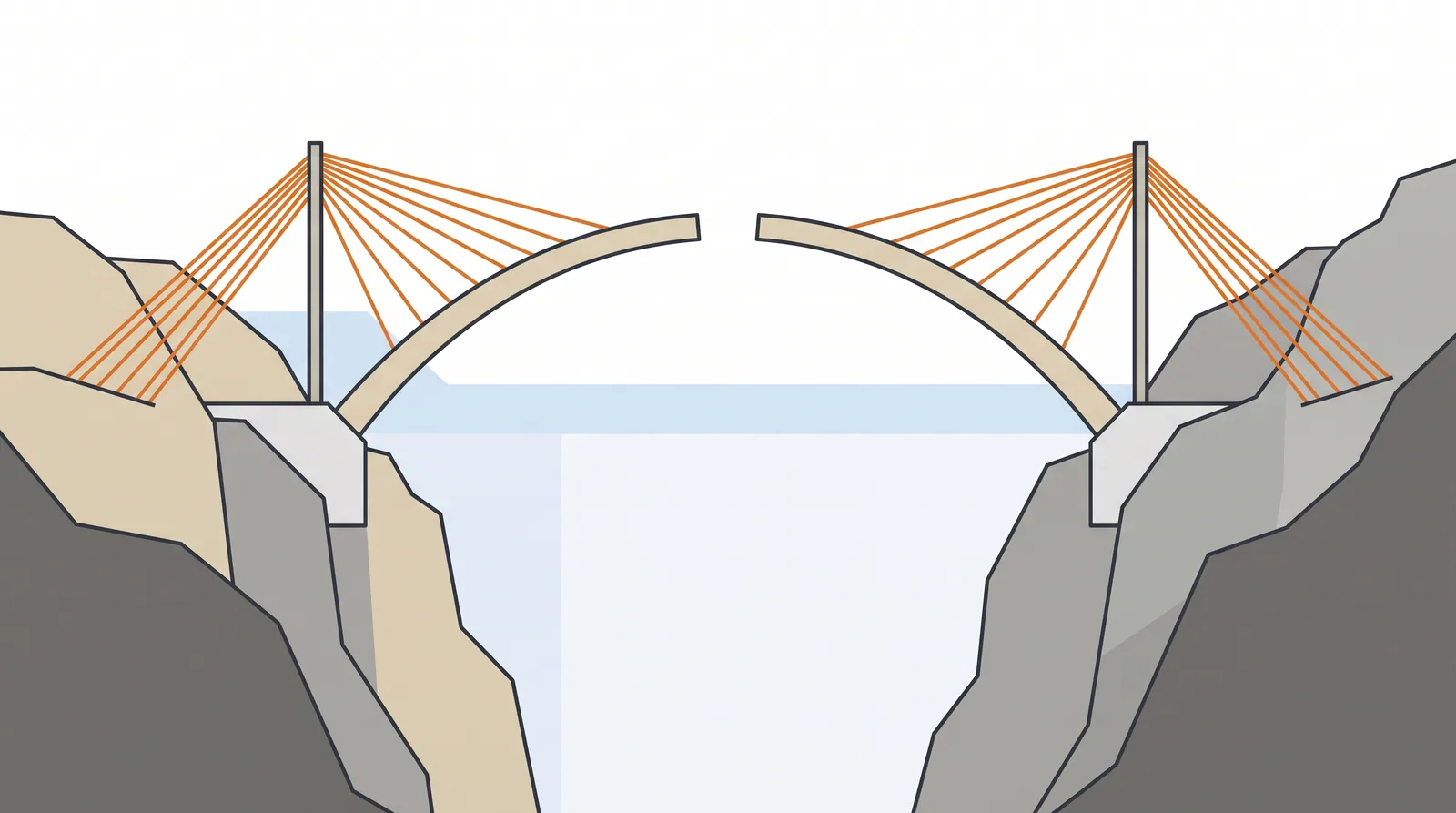
How it is done
- Build the springing foundations and abutments; build temporary towers (or extend the end piers upward) and the backstay anchorages, in rock or as gravity blocks, behind each springing.
- Build the first arch segments at the springings on short falsework or brackets, with temporary hinges or fixity as the design requires.
- Advance each half-arch segment by segment: cast in a form traveller (concrete) or lift a steel segment by cable crane, derrick or creeper crane, then connect the temporary stay pair to that segment.
- Stress each stay to the force from the construction control analysis, re-tensioning earlier stays where required, so the arch follows its theoretical line and the backstays balance the tower.
- Survey arch geometry, tower tilt and stay forces after each segment at a reference temperature and correct the next segment.
- Close at the crown: align the two tips by stay adjustment or jacking, then fit or cast the key segment at the planned temperature, sometimes with crown jacks to set the thrust.
- Release the stays in the analysed sequence so the arch carries itself, then build the spandrel columns or hangers and the deck, and dismantle towers and stays.
Key numbers
- Span rangeconcrete arches about 150–450 m, steel arches about 200–550 m by this method
- Rise-to-span ratioabout 1/4 to 1/8 for deck arches
- Segment lengthabout 4–8 m cast in place; 10–20 m for steel segments
- Cycleabout one segment per week per half-arch for cast-in-place concrete
- Arch and temporary worksUSD 3,000–6,000 per m² of deck (indicative)
Where it fits
- Concrete arches of 150-450 m and steel arches of 200-550 m over deep valleys and rivers; sites where a cable crane or float-in is not possible.
Where it does not
- Spans small enough for falsework or a whole-lift; sites without room for the tie-back anchorages.
Choosing it
- Choose it over falsework (centering) when the valley is deep, the river is navigable or flood risk makes centering unsafe.
- Choose it over a cable crane alone when segments are cast in place; combine the two where steel or precast segments must be carried across a gorge.
- Prefer float-in or a whole-span lift for tied arches over navigable water with an assembly site nearby.
- Prefer vertical or horizontal rotation of half-arches (bridge_rotation) where each half can be assembled at low level near the bank.
Plant, pace and money
Risks and controls
What goes wrong
- Stay force errors distorting the arch, tower instability, crown misfit, wind on the cantilevers.
Quality assurance
Construction control with stage analysis, daily survey, stay force measurement, closure at the planned temperature.
Origins
James Eads cantilevered the steel tubular arches of the St. Louis bridge (1874) from the piers with tie-backs because the Mississippi could not take falsework; the method was revived for long concrete arches with Krk (1980) and is now standard for long arches in China and Spain.
Examples
Krk (390 m, 1980), Hoover Dam bypass (323 m, 2010), Almonte (384 m, 2016), Chaotianmen (552 m, steel, 2009). Wanxian (420 m, 1997) used the related stiff-skeleton method: a steel tube truss arch cantilevered with tie-backs and then encased in concrete.
Case studies
In the bridge game
What Bridge Master applies when you pick it
Deck types: Concrete arch, Steel arch, Steel truss, Network tied arch. Spans 100-400 m, up to 450 m.
- +30: Gorge arch: cantilever with stays.
- -10: Long stayed cantilevers in wind need extra ties.
- +10: The channel stays open while the halves grow out from the banks.
Related methods
Further reading
fib Bulletin on arch bridges · Chen and Duan, Bridge Engineering Handbook (arch chapter) · Troyano, Bridge Engineering: A Global Perspective (arch erection chapter)