Also called: steel sheet piling, braced cofferdam, single-wall cofferdam
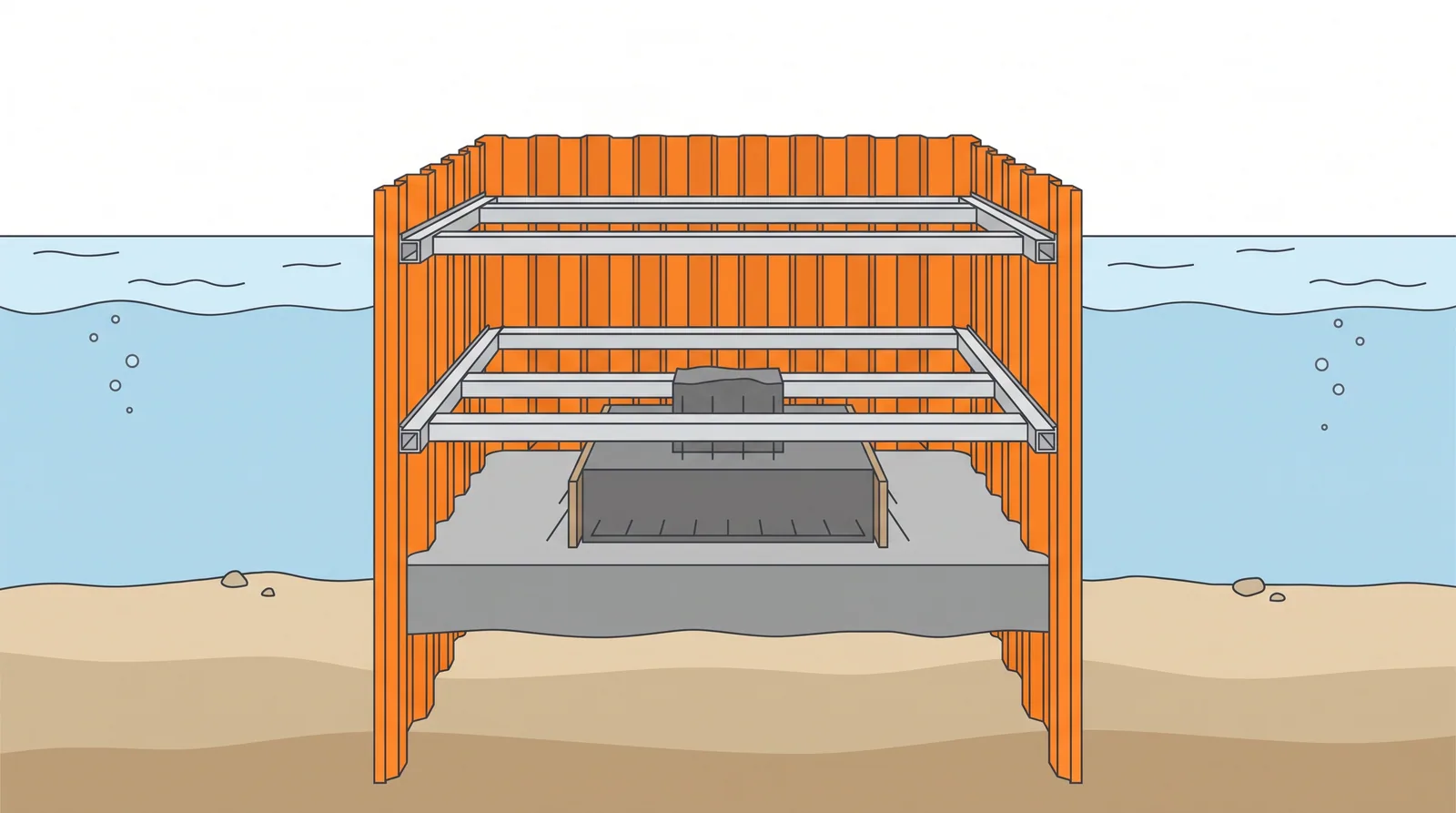
How it is done
- Design for the design flood level, current, waves and debris; set embedment by toe stability, base heave and piping checks rather than a fixed ratio, and decide at this stage whether a tremie seal is needed.
- Clear riprap, debris and old foundations along the wall line (probe or pre-dredge), then set a guide frame on spud piles or on the foundation piles so the sheets go in plumb and on line.
- Pitch the sheets in panels and drive them in stages with a vibro-hammer (impact or press-in where hard layers or vibration limits demand), checking interlocks and verticality; close the ring with a fabricated or tapered closure pile if needed.
- Install the top waling and struts. In open sand, assemble the lower bracing frames at the top and lower them on hangers as dredging proceeds, dredge to grade in the wet, then seal; in clay that will not heave or boil, pump down in stages and fix each waling before going lower.
- Place the tremie seal where required; after it has gained strength, pump down in stages while monitoring strut loads, wall deflection, base and interlock leakage.
- Keep a flood plan: when the river is forecast to overtop, open flood gates or valves and let the cofferdam fill under control rather than allow it to be overtopped or burst.
- After the footing is cast and backfilled, remove the frames from the bottom up as the backfill reaches each level, then extract the sheets by vibro-hammer or cut them off at bed level.
Key numbers
- Retained headcommonly 3-12 m; beyond about 15 m, double-wall, cellular or caisson solutions are usually safer.
- Sheet sectionsU or Z profiles, typically 12-25 m long, section modulus about 1,000-5,000 cm3/m.
- Bracing levelsabout 3-5 m apart vertically.
- Plumbnesstypically within about 1 %; a leaning ring will not close.
- Programmea 15 x 25 m pier cofferdam is driven in 5-10 days, then excavated, sealed and pumped out in another 2-4 weeks.
Where it fits
- River and estuary piers in water to 8-10 m, alluvial beds, temporary works that must be removed.
- Single-wall for narrow footprints; braced frames for depths over 4 m.
Where it does not
- Boulders and hard rock heads that refuse the piles or split the interlocks.
- Fast rivers in the flood season: the cofferdam narrows the channel and raises the flood level.
- Deep water beyond about 10 m, where a double-wall cofferdam or caisson is safer.
Choosing it
- Choose a braced sheet-pile cofferdam over a double-wall or cellular cofferdam for pier footprints up to roughly 30 x 40 m in moderate depths, where internal struts do not obstruct the work.
- Prefer a precast or steel box, or a high cap, when the bed holds riprap, boulders or shallow rock that the sheets cannot penetrate, or when the cap can sit above the bed.
- Prefer secant piles or a diaphragm wall on land or a river bank when the excavation is deeper than about 10 m, close to structures, or must cut off water in gravel or weak rock.
- Prefer press-in installation over vibro-driving next to sensitive structures, under low headroom or beside live railways.
Plant, pace and money
Risks and controls
What goes wrong
- Flooding in a flash flood (the game's cofferdam flood event), interlock declutching, base heave or piping, strut failure during excavation. Cofferdam failure is the most common temporary works accident on river bridges.
Quality assurance
Interlock and plumbness checks, strut loads monitored, base inspected by divers before the seal, flood watch procedure with pumps on standby.
Origins
Timber cofferdams were built by the Romans and described by Vitruvius; rolled steel sheet piling, such as Larssen's U-profile of 1902, made deep, reusable cofferdams routine, and by the 1930s steel sheet-pile cofferdams were building the Mississippi locks and dams in deeper water.
Examples
Nearly all river bridges in Korea, Japan and Europe with piers in shallow water.
Case studies
Related methods
Further reading
USACE EM 1110-2-2503 (cofferdams) · BS EN 12063 (sheet piling) · ArcelorMittal Piling Handbook · CIRIA C760 Guidance on embedded retaining wall design · USS Steel Sheet Piling Design Manual