How bridges get built · Ground improvement · Vibro-compaction
Also called: vibroflotation, deep vibratory compaction
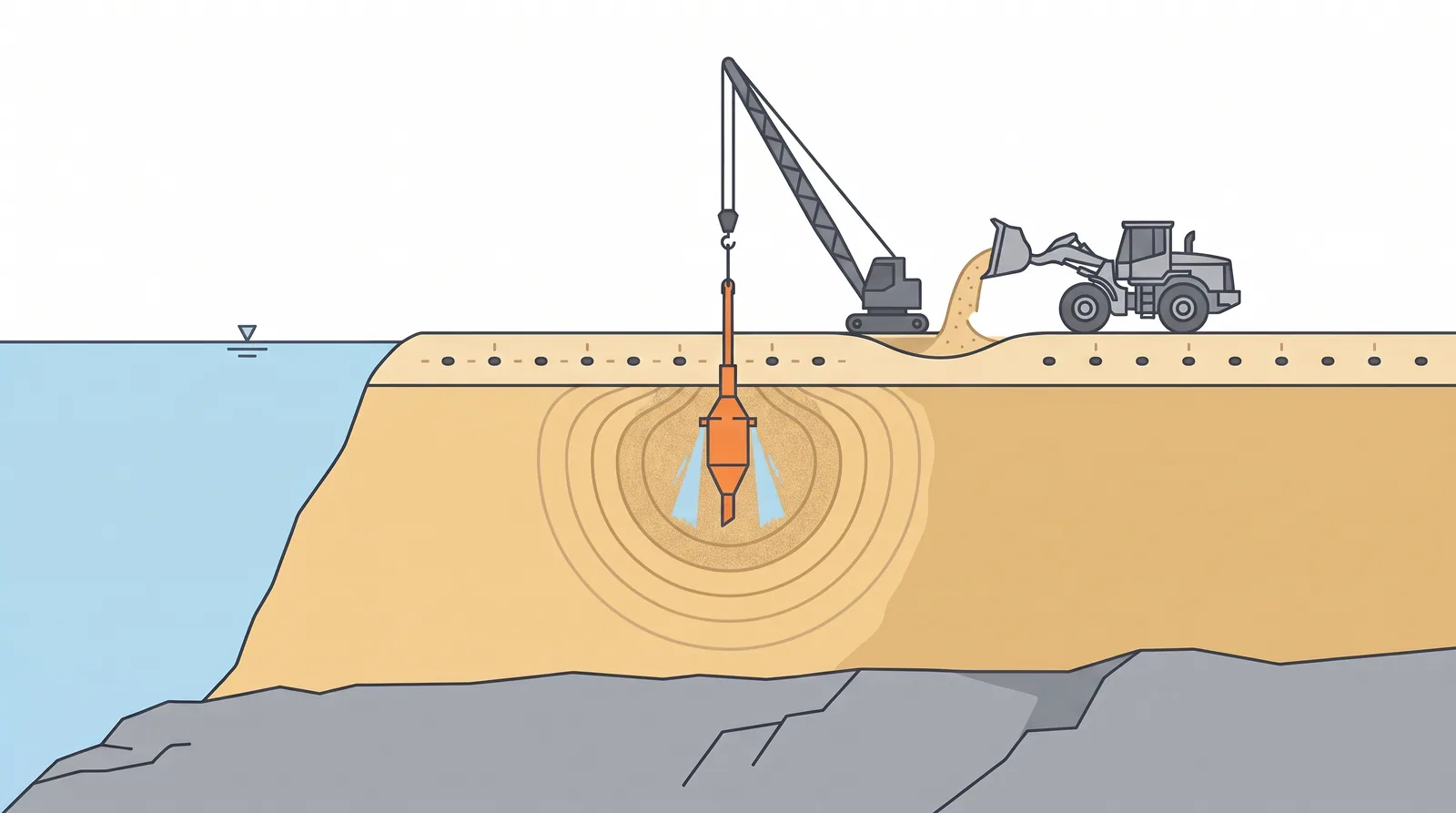
How it is done
- Confirm suitability from gradings and CPTs: clean sand with fines below about 10–15 % and clay below about 2 %; run a trial area with CPTs before and after to fix spacing and holding times.
- Set out a triangular grid, typically 2.5–4.0 m, and prepare access for the crane and the sand feed.
- Penetrate with the vibroflot under its own weight, vibration and water jets to the treatment depth.
- Compact upward in steps of about 0.3–1.0 m, holding at each step until the amperage reaches the set value, while sand fed at the surface fills the crater.
- Log every point (depth, amperage, time, sand volume) and level the area, measuring the settlement the treatment has produced.
- Test with CPTs at grid centroids after a waiting period of one to four weeks, since resistance keeps rising with time; re-treat zones that fall short of the target.
- Recompact the loosened top 0.5–1 m with a vibratory roller before building.
Key numbers
- Suitable soilfines below about 10–15 %, clay below about 2 %.
- Grid 2.5–4.0 m triangular; depth commonly 10–30 m, deeper with special equipment.
- Surface settlement during treatmenttypically 5–10 % of the treated thickness, made up with imported sand.
- Targetscommonly a relative density of 70–80 % or a CPT resistance profile set from the liquefaction analysis.
- Outputseveral thousand m² per rig per week.
Where it fits
- Clean sands with less than 10-15 % fines, reclaimed fill, hydraulic fill under approaches and abutments.
- Depths to 30 m.
Where it does not
- Silty or clayey sands; fines stop the densification. Use stone columns or dynamic compaction instead.
Choosing it
- Choose vibro-compaction for clean sand fills: it densifies the soil itself without imported stone, and is the cheapest deep treatment for them.
- Prefer stone columns when fines exceed about 10–15 % or silt and clay layers are interbedded.
- Prefer dynamic compaction for shallower, coarse or unsaturated fills on open sites where vibration and noise are acceptable.
- Prefer DCM or jet grouting beside sensitive structures, where the settlement and vibration of the treatment itself cannot be tolerated.
Plant, pace and money
PlantVibroflot on a crane, water supply, loader for sand feed.
ProductivitySeveral thousand square metres per rig per week.
CostUSD 10-25 per square metre for 10-15 m treatment.
Risks and controls
What goes wrong
- Settlement of the surface during treatment affecting nearby structures.
- Fines content higher than the investigation showed.
Quality assurance
Pre- and post-treatment CPT on a fixed grid; amperage records per point.
Origins
Developed in Germany by the Keller company in the mid-1930s around the vibroflot of Steuerman and Degen (1936), and spread internationally after the Second World War.
Examples
Reclaimed islands and coastal approaches in the Gulf, Singapore and Korea.
Case studies
Oosterschelde storm surge barrierNetherlands · 1986The seabed sand beneath the 65 piers was densified with vibrating needles from the purpose-built vessel Mytilus before the foundation mattresses and piers were placed.
Palm JumeirahUnited Arab Emirates · 2001–2006Vibro-compaction densified the dredged sand of the reclaimed island to reduce settlement and liquefaction potential before building.
Related methods
Stone columns (vibro-replacement)Liquefaction assessmentDynamic compactionArtificial islands for marine foundations (sand, rock-bund and cellular islands)
Further reading
Mitchell and Jardine, A Guide to Ground Treatment (CIRIA C573) · Kirsch and Kirsch, Ground Improvement by Deep Vibratory Methods · EN 14731 (ground treatment by deep vibration)