How bridges get built · Driven piles · Driven cast-in-situ piles
Also called: Franki pile, Vibrex pile, displacement cast-in-place pile
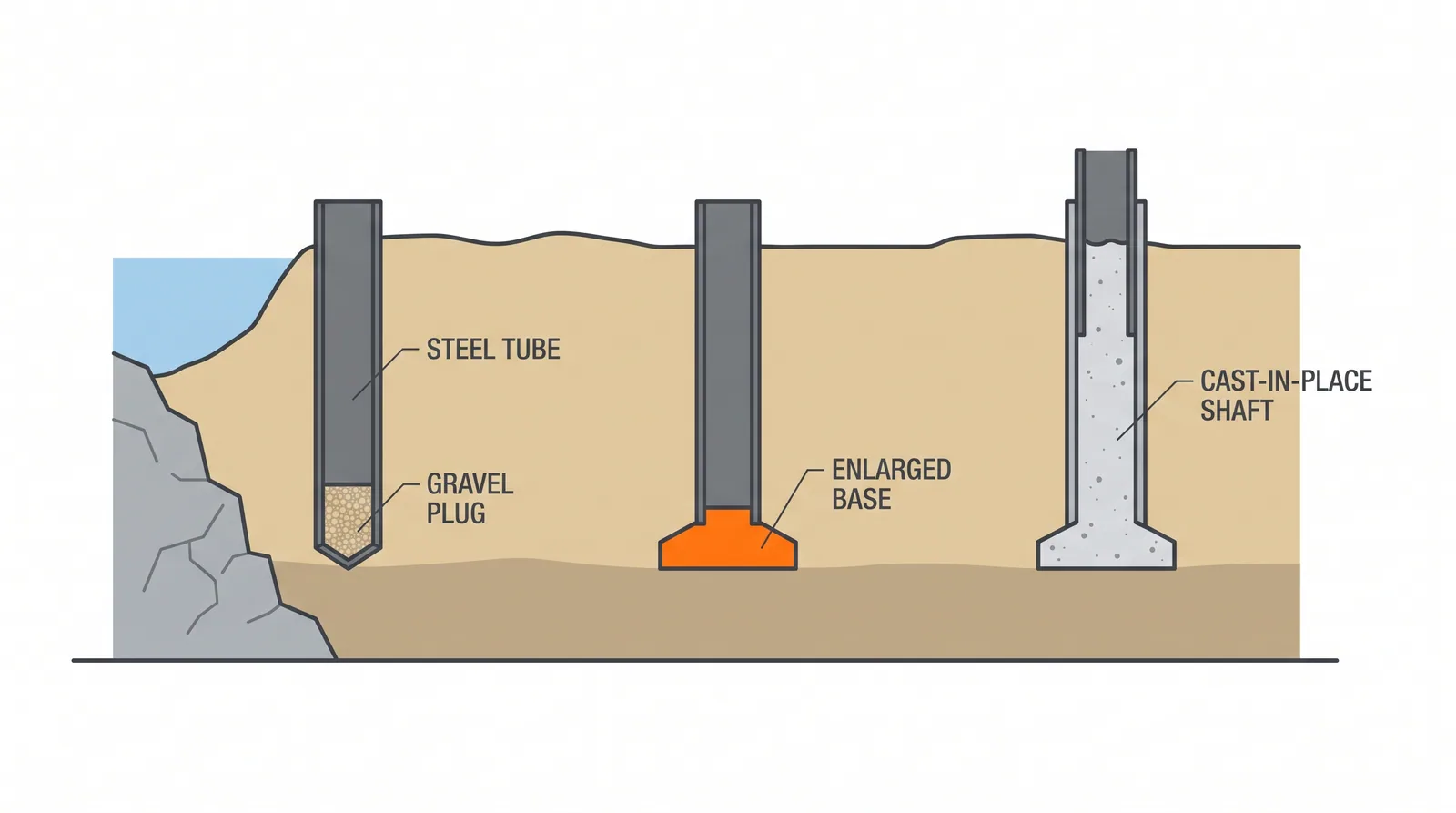
How it is done
- Set the steel tube on the pile position and form a plug of dry (zero-slump) concrete or gravel at its base, or fit a sacrificial shoe.
- Drive the tube by striking the plug with an internal drop hammer (Franki) or by top-driving the tube, recording blows as for any driven pile.
- At founding level, hold the tube on its cables and drive out the plug and further charges of dry concrete to form an enlarged base, recording the volume and the energy needed to expel the last charges.
- Insert the reinforcement cage, then place concrete while withdrawing the tube in stages, compacting by hammer (Franki) or by vibrating the tube, and keeping a head of concrete above the tube toe at all times.
- Record concrete volume per metre against the theoretical: a shortfall signals necking, an excess signals soft zones or voids.
- Check recently cast neighbouring piles for heave or damage and keep the specified time or distance between adjacent installations.
- Test the integrity of every pile, load-test a sample, and trim the head to sound concrete at cut-off.
Key numbers
- Shaft diameterabout 350-600 mm, with an enlarged base roughly twice the shaft diameter in granular soil.
- Working loadabout 0.6-2 MN per pile.
- Lengthtypically 5-30 m, chosen pile by pile to suit the ground.
- Rakeup to about 1:4 (Franki raked piles are always reinforced).
Where it fits
- Variable ground where pile lengths change from pier to pier; medium-load abutments; sites where high base resistance in gravel is wanted.
Where it does not
- Very soft soils where the withdrawal necks the shaft; noise-sensitive sites.
Choosing it
- Choose a driven cast-in-situ pile over a precast pile where lengths vary unpredictably from pile to pile (no cutting or splicing waste) and an enlarged base in granular soil gives high end bearing.
- Prefer CFA or bored piles in soft clay, near sensitive structures, or where vibration is restricted.
- Prefer precast driven piles where flowing groundwater or very soft layers could wash or neck the fresh concrete.
Plant, pace and money
PlantSpecialist rig with drop hammer and tube.
Productivity4-10 piles per shift.
CostUSD 100-200 per metre.
Risks and controls
What goes wrong
- Necking during tube withdrawal, cage lifting, base quality unknown.
Quality assurance
Concrete volumes per pile against theoretical, integrity testing on every pile.
Origins
Edgard Frankignoul patented the Franki pile in Belgium in 1909 and introduced the dry concrete plug in 1926; by 1929 the system had 34 subsidiaries and licensees worldwide. Shell-type driven cast-in-situ piles such as the Raymond pile developed in parallel in the United States.
Examples
Belgian and South African practice; older European motorway bridges.
Case studies
Residence Palace, BrusselsBelgium · 19232,458 Franki piles supported this large building complex, an early demonstration of the system at scale.
Related methods
Further reading
EN 12699 (displacement piles) · Tomlinson and Woodward, Pile Design and Construction Practice