How bridges get built · Bored piles and deep foundations · Barrettes and diaphragm-wall foundations
Also called: barrette pile, rectangular bored pile, diaphragm wall panel foundation
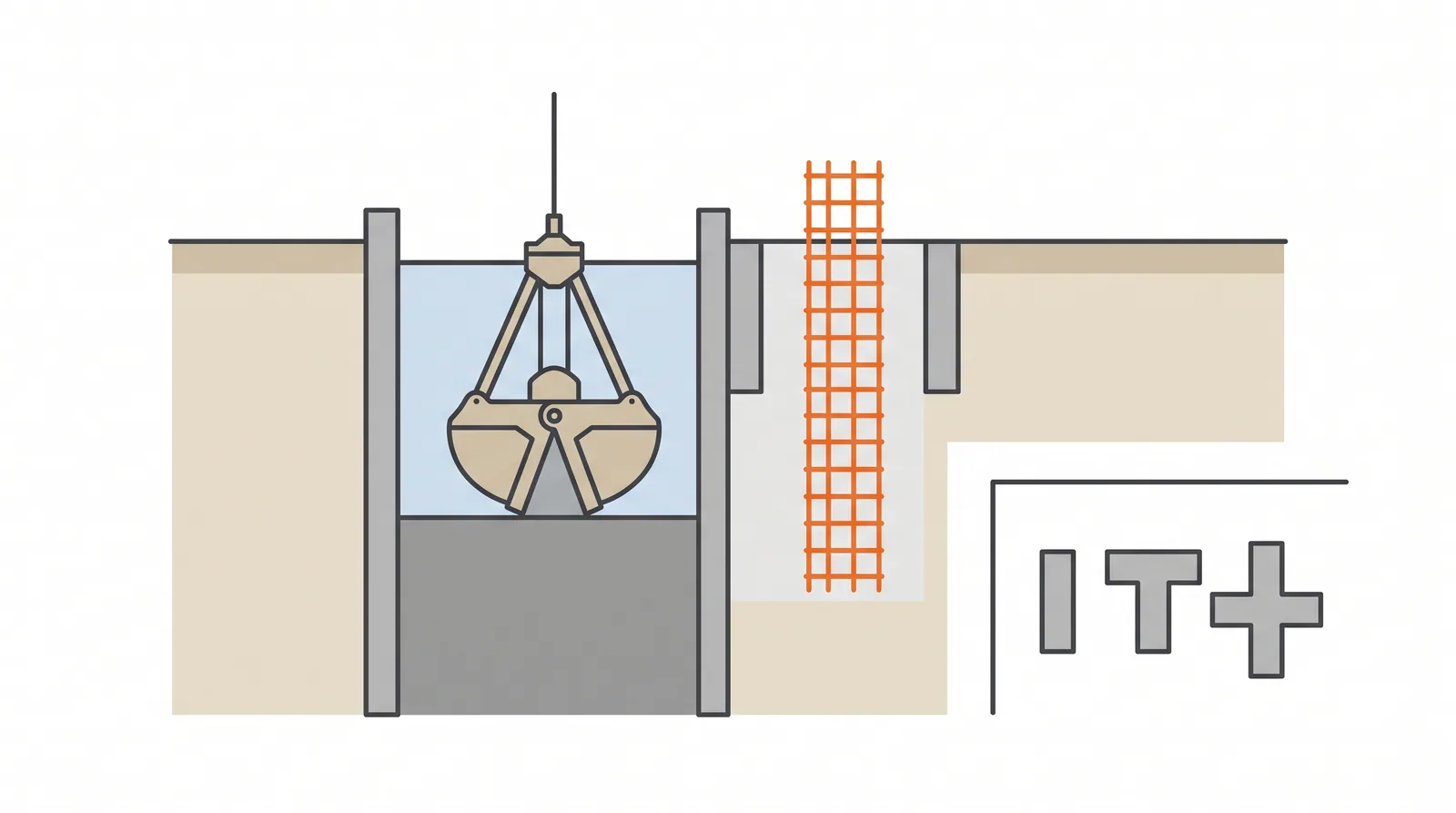
How it is done
- Build reinforced concrete guide walls about 1–1.5 m deep to set out the panel, guide the tool and hold the slurry level.
- Excavate under bentonite or polymer slurry with a cable or hydraulic grab in soil and with a hydromill (cutter) in rock and very dense ground, monitoring tool verticality by its inclinometers.
- Keep the slurry 1–1.5 m above the groundwater; at the base, desand or exchange the fluid until density and sand content meet the limits, and check depth and verticality by sonic profiling. Hold point.
- Lower the cage, usually in two or more sections coupled over the trench, with spacers for cover, CSL tubes and base-grouting circuits where the design relies on base resistance.
- Tremie the concrete, using two pipes in long panels so the concrete rises level, and keep the pipes embedded throughout.
- For T, L or cruciform barrettes, excavate the legs in sequence and keep the concrete in all legs rising together; break down, test and load test as for bored piles.
Key numbers
- Plan0.6–1.5 m thick × 2.2–3.6 m per bite; longer as multi-bite panels
- Depthcommonly 30–80 m; Hong Kong's ICC barrettes were reported at about 125 m
- Verticalityabout 1:200–1:300 with hydromill control; about 1:100 with a grab
- Working loadabout 10–30 MN per single-bite barrette
- Outputone 3 × 1.2 m panel of 40 m in 3–6 days
Where it fits
- Pylon foundations, high piers with large moments, sites with obstructions where the hydromill cuts through, deep foundations to 80 m.
Where it does not
- Small loads, sites where a few round piles would do, ground with cavities that swallow slurry.
Choosing it
- Choose barrettes over round shafts when large moments act mainly in one direction: a 1.2 × 2.8 m panel is much stiffer about its long axis than a round pile of the same area.
- Choose them where a hydromill must cut through boulders, old foundations or strong rock in one tool, as at the Güreşen Bridge on volcanic rock above 100 MPa.
- Prefer them where the same rig also builds diaphragm walls for the excavation around the cap.
- Prefer round bored piles for moderate loads or small numbers of elements; mobilising a diaphragm-wall rig and slurry plant only pays on a sizeable job.
Plant, pace and money
PlantDiaphragm wall grab or hydromill on a crawler crane, slurry plant with desanding, large cranes for cages.
ProductivityOne 3 x 1.2 m panel of 40 m in three to six days.
CostUSD 500-1,000 per m2 of panel face; competitive with 2-3 m shafts for large moments.
Risks and controls
What goes wrong
- Trench collapse with slurry loss, panel joint quality, cage cover in a rectangular section.
Quality assurance
Slurry testing, trench verticality by Koden sonic survey, CSL tubes, O-cell test.
Origins
Barrettes came from the diaphragm-wall technique developed by Christian Veder and ICOS in Italy in the 1950s; single panels used as load-bearing piles followed, and by the 1980s–90s they were common under tall buildings and heavy piers in Hong Kong and Southeast Asia.
Examples
Pylons of several Chinese and Middle Eastern cable-stayed bridges; tall urban viaduct piers in Hong Kong.
Case studies
Güreşen Bridge, Çoruh RiverTürkiye · 2021Main pier of an asymmetric cable-stayed bridge on 1.2 × 2.8 m barrettes socketed into andesite and basalt above 100 MPa, cut with a hydrofraise because the bedrock sloped from 4.5 to 18 m depth; diaphragm walls by the same plant formed the excavation.
International Commerce CentreChina (Hong Kong) · 2010A building rather than a bridge, but the reference case for deep barrettes: a group of about 290 barrettes reported to reach about 125 m below ground in West Kowloon reclamation.
Related methods
Drilled shafts (bored piles) with casing or slurryBentonite and polymer slurry stabilisationBi-directional (Osterberg cell) load testSecant-pile and diaphragm-wall cofferdamsBase and shaft post-grouting of bored piles
Further reading
EN 1538 (diaphragm walls) · Xanthakos, Slurry Walls · EFFC/DFI Guide to Support Fluids for Deep Foundations · Puller, Deep Excavations: A Practical Manual