How bridges get built · Bored piles and deep foundations · Micropiles
Also called: minipiles, root piles, pali radice
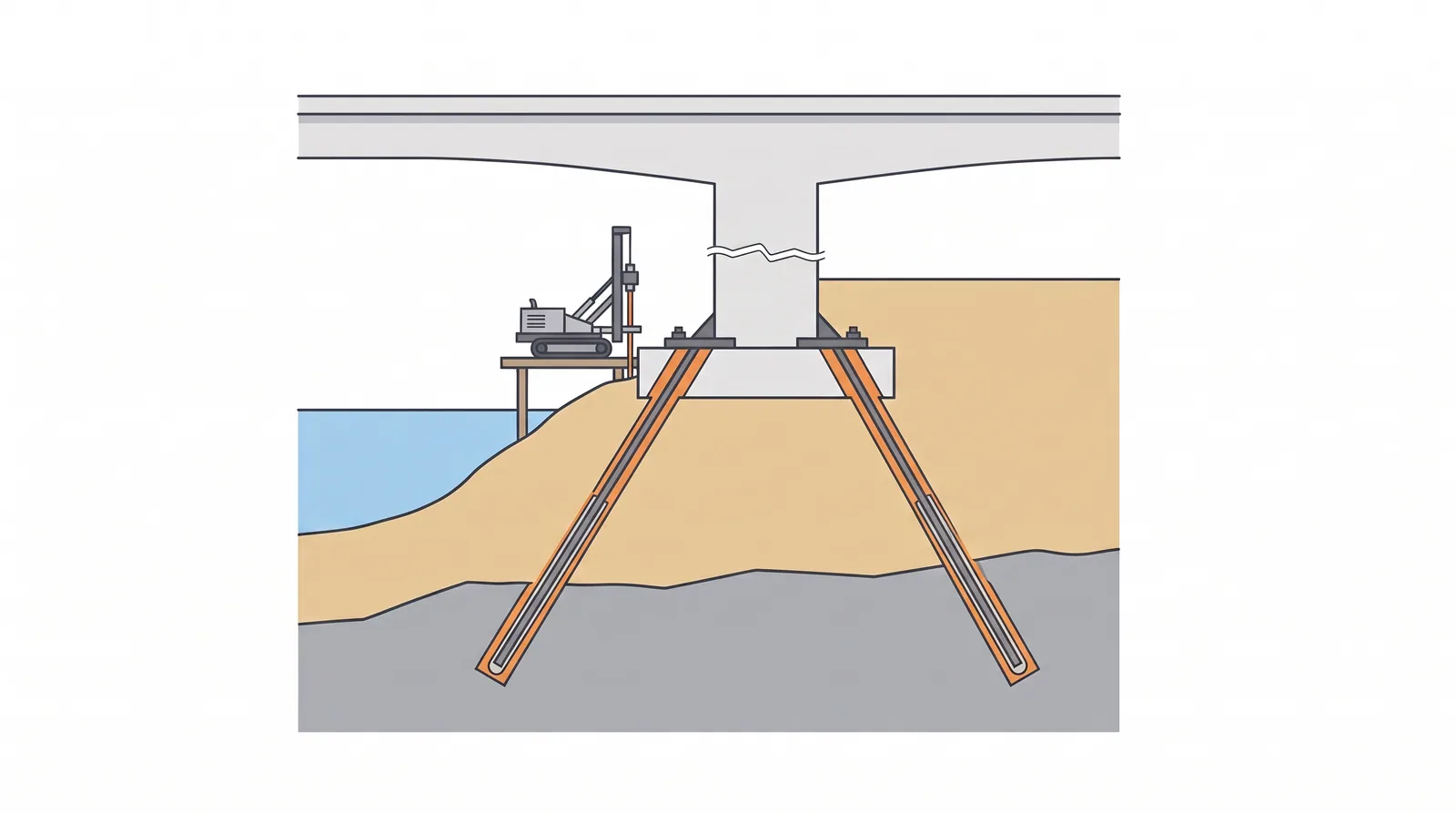
How it is done
- Survey the existing structure, services and headroom; select the micropile type (FHWA Types A–D by grouting method) and the connection to the cap or footing, and agree the test programme.
- Drill a cased hole with a rotary or rotary-percussive (DTH) rig using water, air or polymer flush; core through existing footings first where piles pass through them.
- Clean the hole and insert the reinforcement (threaded bar, often hollow, a steel pipe, or both) with centralisers.
- Tremie grout from the toe with neat cement grout (w/c about 0.45–0.5); for pressure-grouted types, pull the casing over the bond zone while grouting under pressure, or post-grout through sleeve ports.
- Make the connection: grouted sleeve or bearing plate through the existing footing, or embedment in a new cap; preload where the design requires it.
- Load test sacrificial verification piles before production and proof test a share of the production piles, recording creep.
- On retrofits, monitor the existing structure for movement during drilling (in real time where piers are sensitive) and adjust the sequence if it moves.
Key numbers
- Drilled diameter100–300 mm (cased micropiles commonly 178–273 mm casing)
- Capacity300–1,500 kN typical; over 2,000 kN with large casings and rock sockets
- Ultimate grout-ground bond (FHWA)roughly 35–360 kPa in soils, about 200–4,000 kPa in rock, by type and ground
- Testing (FHWA)verification to about 2.5× design load; proof tests to about 1.67× on about 5 % of production piles
- Output5–15 piles per rig per shift
Where it fits
- Retrofit and seismic strengthening of existing piers, scour repairs, foundations under low headroom, sites with boulders or karst where drilling small holes is safer, steep slopes.
Where it does not
- New heavy foundations where a few large shafts are cheaper; soft clay with little bond.
Choosing it
- Choose micropiles over large shafts where headroom, access or existing footings rule out big rigs, as under the Route 92/280 connectors and the 130-year-old Nipigon rail bridge.
- Choose them for underpinning while the structure stays in service; at Nipigon the owner expected about 20 % saving against replacement.
- Prefer drilled shafts for new heavy foundations: per kN micropiles are expensive, and their slender section can buckle in very soft soil or scour.
- Where piers rock in earthquakes, design for tension cycling and keep displacement at the tension design load close to the bar's elastic elongation (a lesson from the Route 92/280 retrofit).
Plant, pace and money
PlantSmall drilling rig, grout mixer and pump.
Productivity5-15 piles per shift.
CostUSD 150-400 per metre; high per kN but low mobilisation.
Risks and controls
What goes wrong
- Grout loss in fissured rock, bar corrosion without encapsulation, buckling in soft soils.
Quality assurance
Grout volume per pile, load tests on 5 % including creep tests, bond zone length verified.
Origins
Fernando Lizzi of Fondedile developed the 'pali radice' (root piles) in Naples in the early 1950s to underpin war-damaged buildings; the method spread worldwide from the 1970s, and FHWA research and manuals of the 1990s–2000s made it standard for US bridge retrofit.
Examples
Seismic retrofit of Californian and Japanese piers; scour repairs under river bridges.
Case studies
CPR Nipigon bridge, OntarioCanada · 2007 (reported)Underpinning of a 130-year-old rail bridge on masonry piers and overstressed timber piles: 273 mm cased micropiles with a 69 mm bar for 1,200 kN service load, tested to 3,000 kN in compression without failure.
Route 92/280 interchange connectors, San Francisco Bay AreaUSA · 2013 (reported)Caltrans seismic retrofit with micropile groups at five bents instead of CIDH piles, because of poor rock, high groundwater and low headroom.
Liberty Bridge, Greenville, South CarolinaUSA · 2004Curved cable-stayed footbridge whose drilled-pier design was replaced by micropiles for compression and anchor piles for tension, because of difficult access and ground.
King and Queen Street bridges, West Don Lands, TorontoCanada · 2012–15Remedial rock-socketed micropiles battered at about 1H:5V under existing piers; drilling-induced movement of the bridge forced stoppages, and the work was completed under real-time monitoring with a revised sequence.
Related methods
Drilled shafts (bored piles) with casing or slurryPercussion rotary drilled (PRD) steel pipe pilesBearing replacementPermeation, compaction and compensation groutingSeismic retrofit: jacketing, restrainers, seat extensions and isolation
Further reading
FHWA Micropile Design and Construction Guidelines · EN 14199 · FHWA NHI-05-039 Micropile Design and Construction Reference Manual · Bruce and Juran, Drilled and Grouted Micropiles: State-of-Practice Review (FHWA)