How bridges get built · Piers, pylons and abutments · Steel and composite pylons
Also called: steel tower, composite pylon, stainless-clad pylon
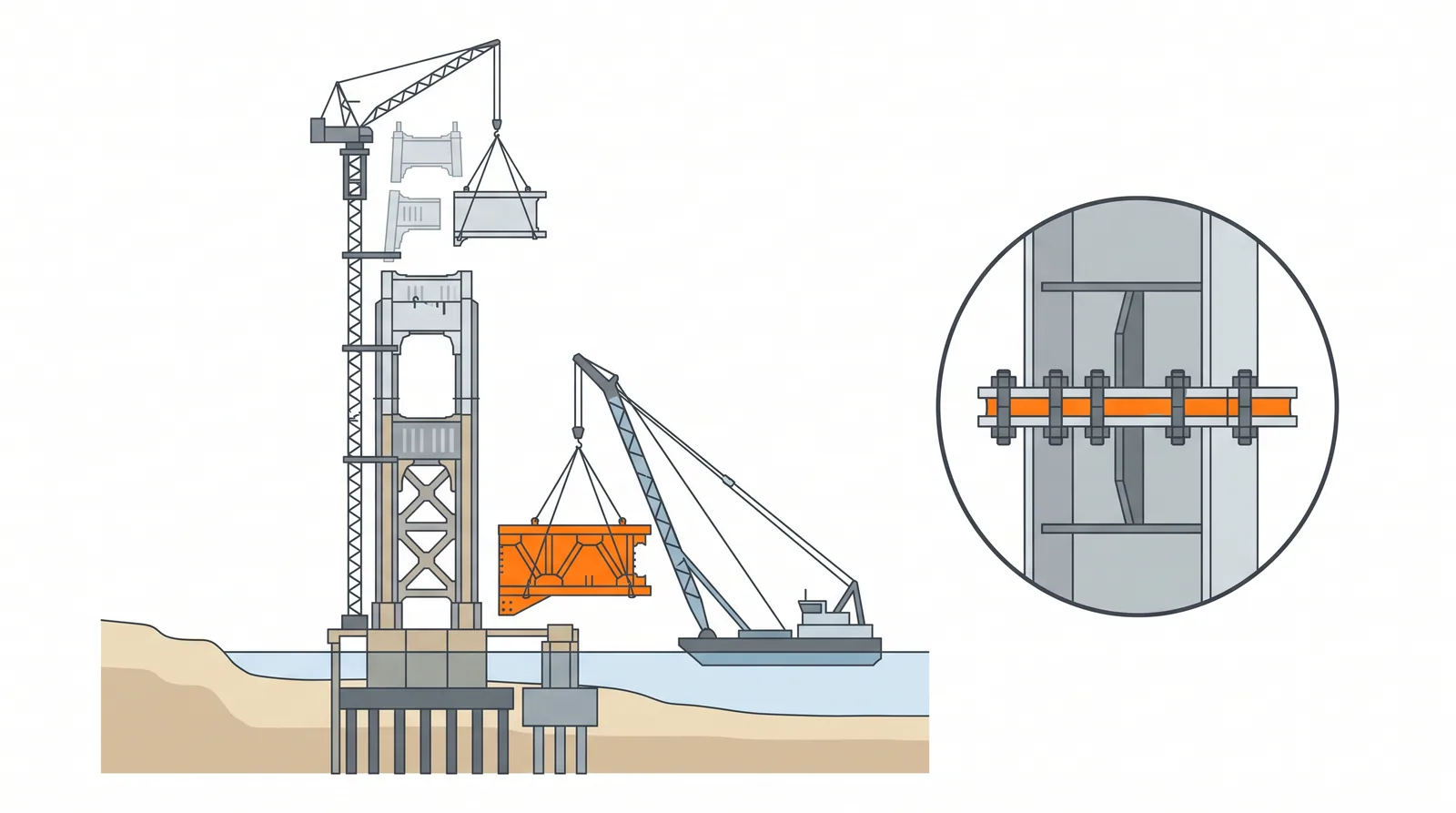
How it is done
- Fabricate the tower in blocks with machined end faces and trial-assemble adjacent blocks in the shop to check straightness, twist and splice fit.
- Set the base: anchor bolts or an anchor frame cast into the pier, a grouted base plate and a survey of base level and position, since every block above follows it.
- Lift the lower blocks with a floating or crawler crane and the upper blocks with a climbing crane attached to the tower; make the field splices with pretensioned high-strength bolts or site welds.
- Survey each block for verticality and twist, correct only within the limits of the splice details, and track the cumulative tilt against the erection analysis.
- Fit temporary dampers or tuned mass dampers to control vortex-induced vibration of the free-standing tower until cables or stays restrain it.
- Erect cross beams and integral stay anchor boxes with the shafts, inspecting welds and bolt tension at each level.
- Commission dehumidification of the closed cells, touch up coatings, install lifts and access, and dismantle the climbing crane from the top.
Key numbers
- Height100–300 m (Akashi Kaikyo 298 m)
- Block weighttens of tonnes up to about 150 t with a climbing crane; far heavier with floating cranes
- Erection pacea block every 1–3 days; a 200 m tower in 4–8 months
- Splicesmachined ends bearing in compression, with high-strength friction-grip bolts or site welds
- Closed cellsdehumidified to below about 50 % relative humidity
- CostUSD 8,000–15,000 per tonne erected
Where it fits
- Suspension bridge towers, cable-stayed pylons where speed or foundation load matters, seismic regions (ductile steel), sites with a fabrication yard and heavy lift.
Where it does not
- Sites without heavy lift access; budgets sensitive to steel prices; humid marine sites without a maintenance plan for coatings.
Choosing it
- Choose steel over concrete when foundation load is critical (soft ground, deep water), in high seismicity, or when speed above the deck matters and fabrication and heavy lift are available.
- Prefer concrete where fabrication capacity is distant, steel prices are volatile or marine corrosion maintenance is a concern; concrete also adds damping.
- Choose a composite pylon (steel anchorage head on a concrete shaft) when anchorage congestion or speed governs only in the upper part.
Plant, pace and money
PlantFabrication yard, tower crane 30-100 t or floating crane 1,000-3,000 t, welding and bolting crews.
ProductivityA segment every one to three days; a 200 m tower in 4-8 months.
CostUSD 8,000-15,000 per tonne erected.
Risks and controls
What goes wrong
- Fit-up errors between segments, weld defects, wind during lifts, corrosion inside closed boxes.
Quality assurance
Machined end inspection, survey per segment, weld NDT, dehumidification of closed cells.
Origins
Steel towers were the norm for suspension bridges from the riveted cellular towers of the Golden Gate (1937) to the welded towers of Akashi Kaikyo (1998); outside Japan, concrete took over most long-span towers from the 1980s.
Examples
Akashi Kaikyo, Golden Gate and most suspension towers; Stonecutters top sections; Japanese cable-stayed bridges with steel pylons.
Case studies
Golden Gate BridgeUSA · 1937Riveted cellular steel towers 227 m high, the classic American suspension-tower construction.
Akashi Kaikyo BridgeJapan · 1998298 m welded steel towers erected block by block with a climbing crane; tuned mass dampers controlled wind-induced vibration of the free-standing towers.
Tatara BridgeJapan · 1999Steel pylons over 200 m high for an 890 m span, the longest cable-stayed span when opened.
Related methods
Pylon construction: concrete, anchorage zones and geometryFloating crane erectionField splices: bolted and welded connections
Further reading
AASHTO LRFD 6 · Japanese Honshu-Shikoku Bridge Authority standards