Also called: floating sheerleg, crane vessel, whole-span lift
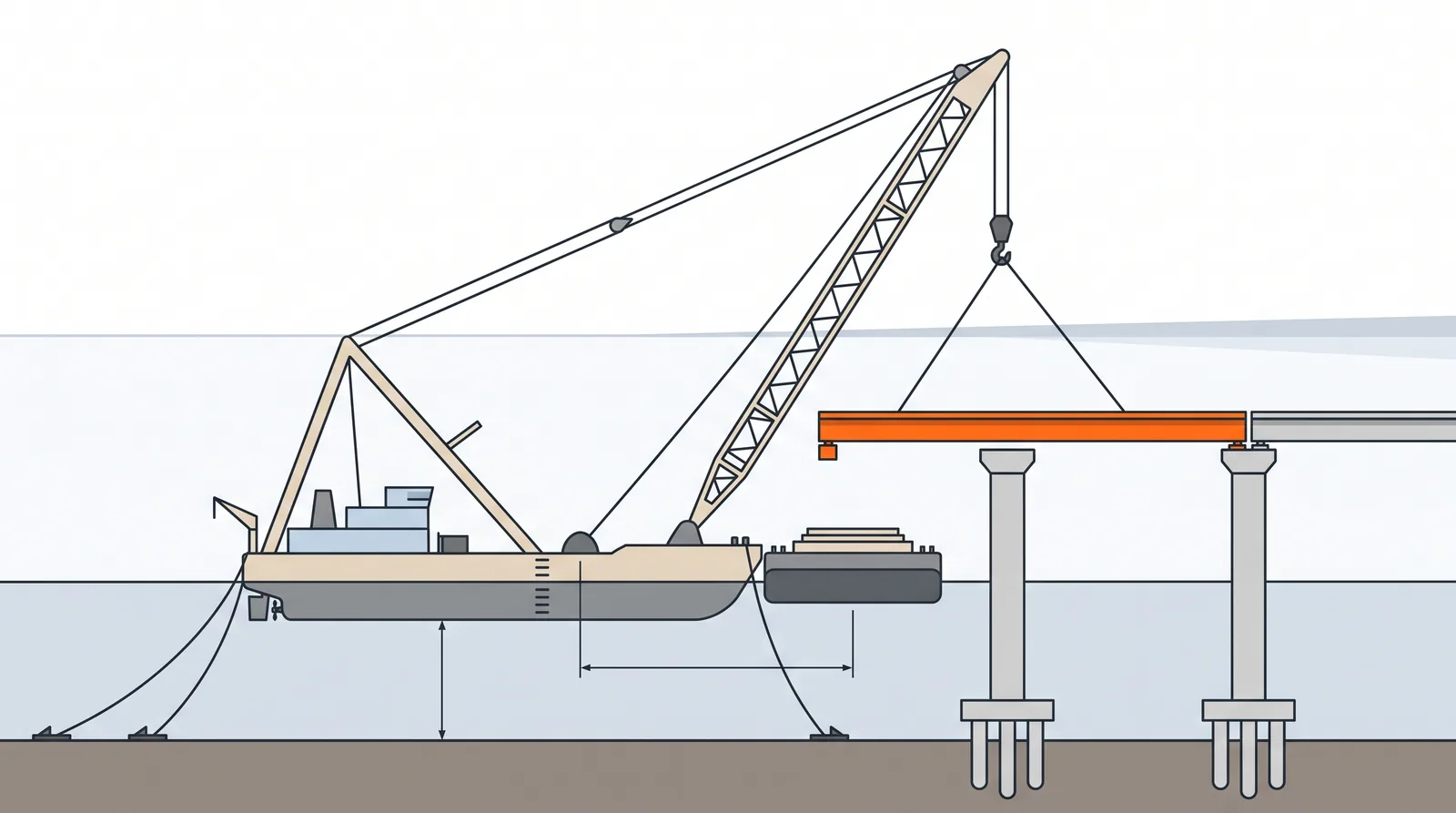
How it is done
- Plan the marine operation: lift weights with contingency, rigging design, crane capacity at the required outreach, water depth along the route and at the piers, moorings or dynamic positioning, and wind, wave and current limits with go/no-go points.
- Prepare the piers with bearings or temporary seats, guides or bumpers, and survey the landing positions.
- Fabricate the units in a yard on the water, load them out onto a delivery barge (skidding, SPMT or by the crane itself) and sea-fasten them.
- Mobilise the crane vessel, moor it at the lift position, check vessel stability and ballast for the lift, and trial the rigging.
- Lift within the agreed window, allowing for dynamic amplification; slew or move the vessel to the pier and lower the unit onto its guides under tag-line or winch control.
- Set the unit on its bearings, make temporary fixings, release the rigging and survey; connect units (stitch pours, splices, wet joints) before the next weather event.
- Reposition for the next lift or demobilise, keeping a record of each lift against the plan.
Key numbers
- Crane vessels for bridge worktypically 1,000–4,000 t capacity; purpose-built catamaran vessels have set girders of about 7,500 t (Confederation Bridge)
- Water depthusually 6 m or more along the route and at the piers
- Dynamic amplification factor in lift designabout 1.1–1.3 depending on load and exposure (DNV-ST-N001)
- Spans lifted wholecommonly 50–200 m
- Rateone to three lifts per day in good weather
- VesselUSD 100,000–400,000 per day (indicative)
Where it fits
- Sea and estuary viaducts with whole precast spans (typically to 3,000 t; purpose-built catamaran cranes have set 7,500 t girders), steel box girder main span sections, pylon tops, arches assembled on shore; water deep enough for the vessel (usually 6 m or more).
Where it does not
- Shallow rivers, strong currents, exposed sites without weather windows, lifts beyond the crane class (the game's marine_lift check), long spans beyond about 200 m in one piece.
Choosing it
- Choose it over piece-by-piece erection for long marine viaducts with many identical spans: whole-span lifts move the work into a yard.
- Prefer strand jacks from the structure above (suspension decks) or from the piers when the unit is too heavy or the water too shallow for a crane vessel.
- Prefer float-in with ballasted barges when the span is heavier than any available crane but can be floated under the piers at a suitable tide.
- Avoid it where weather windows are short and unpredictable; downtime on a vessel costing hundreds of thousands of dollars a day decides the economics.
Plant, pace and money
Risks and controls
What goes wrong
- Vessel motion during the lift, rigging failure, collision with the pier, weather downtime.
Quality assurance
Lift plan with dynamic amplification, rigging certificates, weather and tide limits with go/no-go criteria.
Origins
Sheerleg crane barges were used for bridge spans through the 20th century; purpose-built heavy-lift vessels for whole precast spans arrived with the Great Belt West Bridge in the early 1990s, whose 110 m spans were set by the catamaran crane Svanen, later used for Confederation Bridge.
Examples
Great Belt West and Confederation Bridge (whole concrete spans set by Svanen), Øresund approach spans, Gateshead Millennium Bridge, Hong Kong–Zhuhai–Macao Bridge, Incheon Bridge approaches, the Tappan Zee replacement.
Case studies
In the bridge game
What Bridge Master applies when you pick it
Deck types: PSC I-girder, PSC U-girder, Precast segmental box, Steel box girder, Orthotropic steel box, Steel truss, Steel arch, Spliced PSC girder, Steel plate girder, Voided slab, Extradosed, Cable-stayed, Network tied arch. Spans 40-120 m, up to 200 m.
- +30: Deep water viaduct: lift whole spans by floating crane.
- +15: Navigable river with barge access.
- -45: Crane barge cannot float.
- -25: Fast current makes barge positioning dangerous.
- +10: Floating plant is the way in when trestles and cofferdams are banned.
- not allowed: Floating crane on dry land.
- not allowed: A floating crane needs water under the span.
Related methods
Further reading
DNV-ST-N001 Marine operations · IMCA lifting guidance · DNV-ST-N001 Marine operations and marine warranty