How bridges get built · Driven piles · SIP and pre-bored driven piles
Also called: soil-cement injected precast pile, pre-bored PHC, SIP method
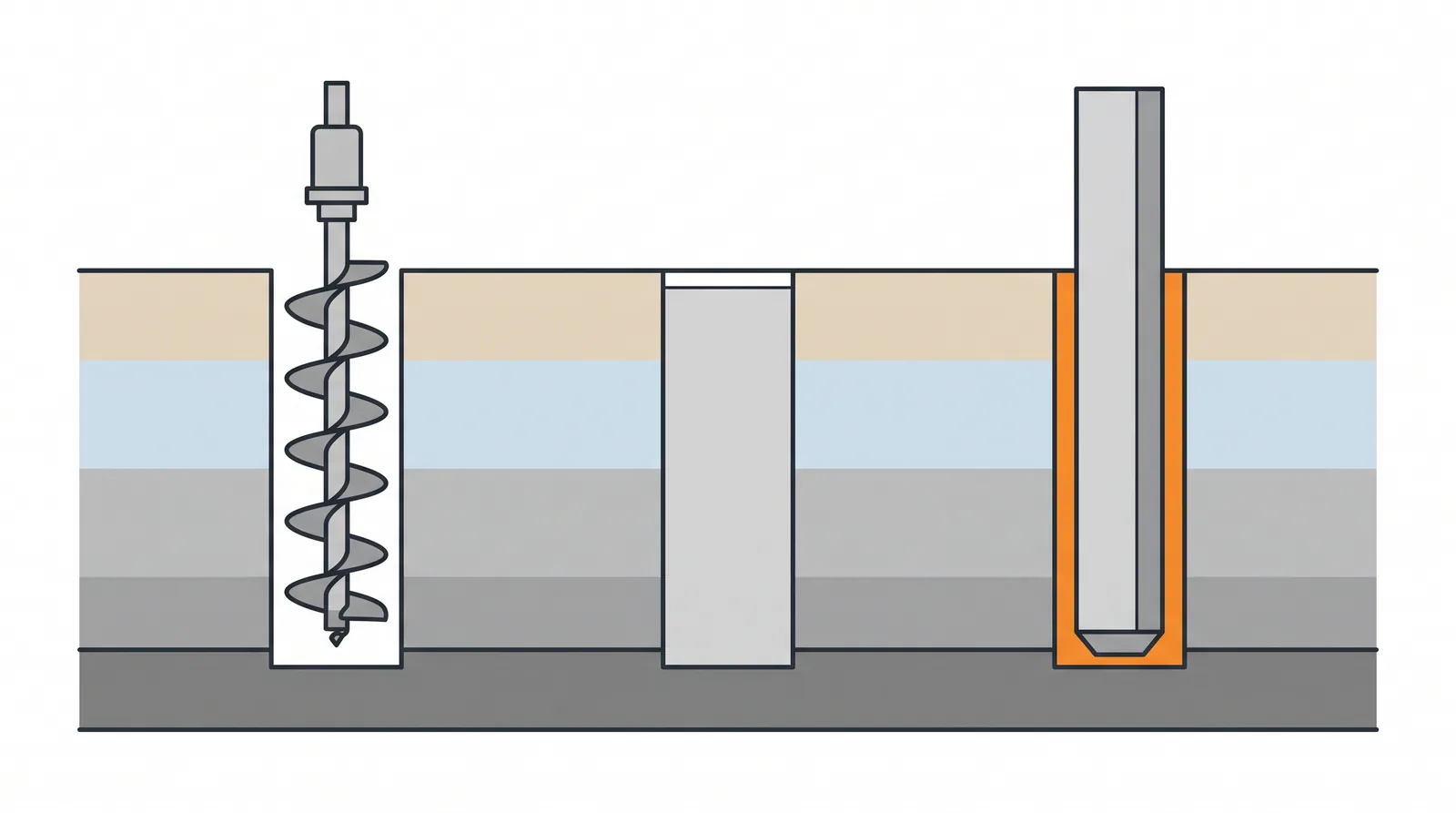
How it is done
- Set out and auger the hole to the bearing layer with a rotary auger rig, using depth and auger current or torque readings to confirm arrival in the bearing stratum.
- Inject cement milk at the toe (root fixing) and along the shaft as the auger is withdrawn, so the hole is stabilised and filled.
- Lower the PHC pile into the slurry-filled hole under its own weight or with light pressing, splicing segments as needed.
- Seat the toe by a short final drive with a light hammer to the set derived from test piles, or by pressing.
- Hold the pile on line and level until the slurry stiffens; record head level and verticality.
- After curing, verify capacity on a sample by dynamic restrike and static load tests.
- Cut the head and connect to the cap as for driven PHC piles.
Key numbers
- Hole diameterusually about 100 mm larger than the pile.
- PilesPHC 400-600 mm most common; lengths 10-40 m.
- Curing before load testingabout 7-28 days.
- Productivityabout 4-8 piles per rig per shift.
Where it fits
- Urban sites in Korea and Japan with noise and vibration limits; approach viaducts near houses; dense upper layers over a bearing layer.
Where it does not
- Where full driven shaft friction is needed; loose sands where the hole collapses.
Choosing it
- Choose SIP over impact-driven PHC within noise or vibration limits, or where dense upper layers or obstructions would cause hard driving.
- Prefer plain driving where the site allows it: higher shaft friction, a visible driving record for every pile and lower cost.
- Prefer bored piles or barrettes when the load per pile exceeds what a PHC pile can carry or the bearing layer is deep rock.
- Prefer CFA piles where standard PHC lengths do not reach the bearing stratum or precast supply is the constraint.
Plant, pace and money
PlantAuger rig, slurry plant, light hammer.
Productivity4-8 piles per shift.
CostUSD 120-220 per metre, above plain driving.
Risks and controls
What goes wrong
- Poor slurry quality giving low friction; seating blows damaging the head.
Quality assurance
Slurry density and volume, seating blow counts, load tests.
Origins
Pre-boring and inner-excavation (embedded) methods for precast piles developed in Japan from the 1970s, as noise and vibration laws (1968 and 1976) restricted impact driving in cities; by the 2010s they accounted for about 95 % of precast concrete pile work in Japan. Korea adopted the soil-cement injected precast (SIP) method as its standard urban pile.
Examples
The default urban pile in Korea; the game offers it for urban viaducts.
Related methods
PHC spun concrete pilesPress-in (silent) pilingContinuous flight auger (CFA) pilesJetting and predrilling to aid driving
Further reading
Korean Design Standard KDS 11 50 · JGS standards · Tsuda, Prestressed concrete piles: development and construction methods (Prestressed Concrete, JPCI, 2016)