How bridges get built · Ground improvement · Sand compaction piles
Also called: SCP, compacted sand piles
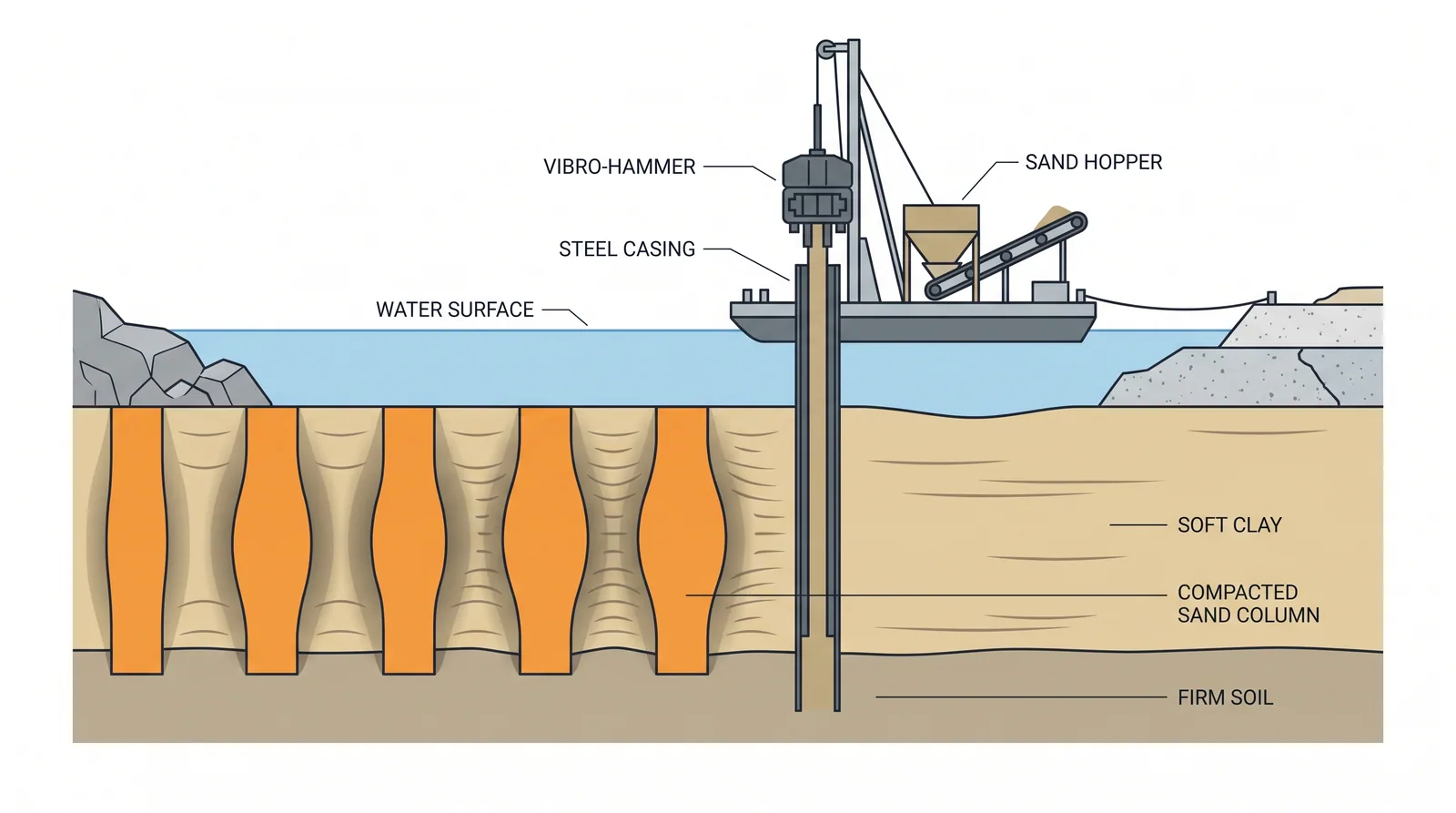
How it is done
- Investigate the soft clay or loose sand and set the replacement ratio and pattern for the purpose: high ratios for stability under seawalls and caisson bases, lower ratios for settlement reduction and sand densification.
- Prepare a working platform on land; offshore, position the SCP barge by GNSS, typically with two or three casings working together.
- Drive the casing to the design depth with a vibro-hammer, with sand inside it held by compressed air.
- Withdraw the casing in increments while discharging sand, then re-drive each increment to compact and enlarge the pile; repeat to the surface.
- Record casing tip depth, sand level and sand discharged per stroke automatically, and compute the pile diameter achieved at each level.
- Allow for heave of the surrounding clay or seabed, trimming or dredging the heaved material where it matters.
- Verify with boreholes, CPT or SPT in the piles and between them, and monitor settlement and pore pressure under the structure as it is built.
Key numbers
- Pile diameter about 0.7 m on land; offshore, 1.0–1.2 m casings form piles of about 2 m.
- Replacement ratio about 10–30 % for densifying loose sand; about 30–80 % for soft clay under seawalls.
- Depthto about 50 m below sea level offshore.
- Outputabout 350 m of pile per day for a three-casing marine barge (published manufacturer data).
Where it fits
- Soft marine clay under quay walls, approach embankments and small abutments; liquefaction mitigation in loose sand.
Where it does not
- Sites where the vibration is unacceptable; very deep soft layers beyond 30-35 m.
Choosing it
- Choose SCP over PVD and surcharge under marine structures (seawalls, breakwaters, caisson bases) where stability is needed at once, since the sand both reinforces and drains.
- Prefer DCM offshore when sand is scarce, seabed heave is unacceptable, or higher strength is needed.
- Prefer vibro-compaction for clean sand on land; SCP adds sand where the existing sand is too silty to densify on its own.
- Near vibration-sensitive structures, use the non-vibratory SCP variants developed in Japan or another method.
Plant, pace and money
PlantMarine or land SCP rig with vibro-hammer, sand barge or hopper.
ProductivityAbout 350 m of pile per day for a three-casing marine barge (published manufacturer data); single-casing land rigs are slower.
CostUSD 50-100 per metre of pile.
Risks and controls
What goes wrong
- Heave of the adjacent seabed or ground; sand supply logistics.
Quality assurance
Sand consumption per pile, post-treatment CPT and SPT.
Origins
Developed in Japan in the 1950s (the vibro-compozer method associated with Murayama), it moved offshore on multi-casing barges and remains a standard method in Japanese and Korean port works.
Examples
Kansai and Incheon airport reclamations, Korean west-coast port bridges.
Case studies
Kansai International AirportJapan · 1987–1994Sand compaction piles improved the soft clay beneath the island's seawalls, with sand drains under the reclamation itself.
Hyogo-ken Nanbu (Kobe) earthquakeJapan · 1995On the reclaimed waterfront, ground densified by sand compaction piles and similar methods showed little liquefaction while untreated fill nearby liquefied widely.
Related methods
Further reading
JSCE and Japanese port design standards on SCP · Kitazume, The Sand Compaction Pile Method · Ports and Harbours Bureau, Technical Standards and Commentaries for Port and Harbour Facilities in Japan