How bridges get built · Ground improvement · Lightweight fill (EPS geofoam, foamed concrete, LWA)
Also called: EPS blocks, foamed concrete, lightweight aggregate fill
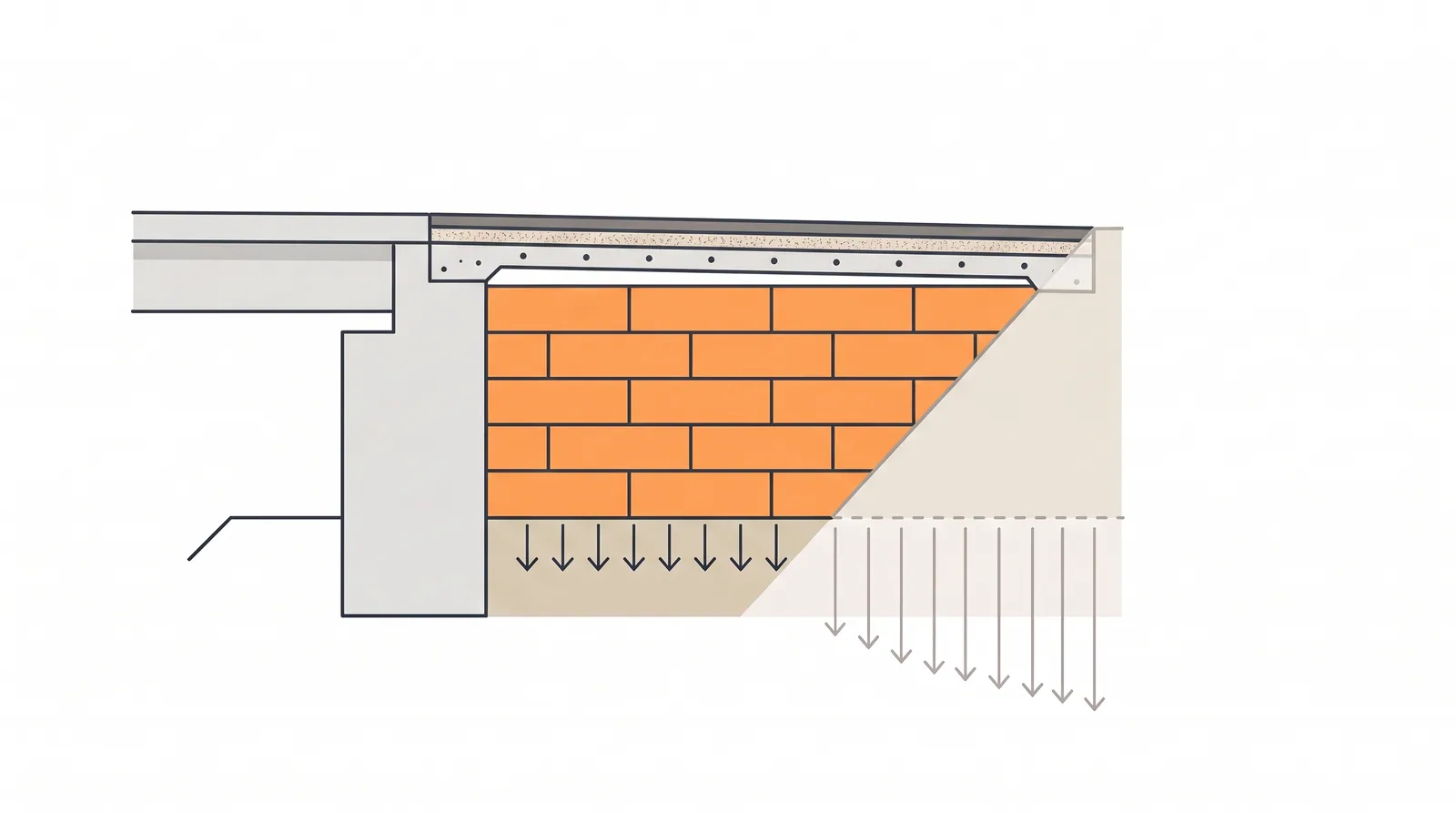
How it is done
- Design for buoyancy at the design flood or groundwater level, bearing and settlement of the subgrade, load spread under the pavement, and lateral pressure on the abutment; choose the EPS grade or foamed concrete density to suit.
- Excavate to a level base, install drainage that keeps water below the fill, and lay a thin sand levelling bed.
- Place EPS blocks in staggered layers, turning the joint direction in each layer, with barbed connector plates between layers so the mass acts as one.
- Protect the fill: a hydrocarbon-resistant membrane over the top and sides where fuel spills are possible, soil cover on the side slopes, and a ban on hot work near exposed blocks.
- Cast a reinforced concrete load-distribution slab over the EPS and build the pavement on it.
- For foamed concrete, pump in lifts of about 0.3–1.0 m, letting each lift set before the next, and check wet density on every pour.
- Taper the lightweight zone into ordinary fill in steps to avoid a settlement step at the transition, and monitor levels after opening.
Key numbers
- EPS density about 15–30 kg/m³ (ASTM D6817 EPS15 to EPS29) with compressive resistance at 1 % strain of about 25–75 kPa.
- Foamed concrete for fillsabout 400–800 kg/m³, 28-day strength roughly 0.5–3 MPa.
- Lightweight aggregate (expanded clay, shale, pumice): about 300–1,000 kg/m³ in place, depending on material.
- An EPS fill weighs about 1–2 % of the same volume of soil fill.
- Factor of safety against uplift at the design water level commonly at least 1.2.
Where it fits
- Approaches over soft clay where PVD time is unavailable, behind abutments to cut lateral earth pressure, widening next to old embankments.
Where it does not
- Below the groundwater table without proper buoyancy design; EPS floats.
Choosing it
- Choose lightweight fill over PVD and surcharge when there is no time to consolidate and the approach must not settle against a fixed abutment, especially in widenings beside old embankments.
- Prefer piled embankments for high fills on deep soft clay: lightweight fill reduces the load, it does not remove it.
- Choose EPS where the lowest weight is needed and the water table stays below the base; choose foamed concrete where buoyancy, fire or fuel are concerns, or where it must fill irregular space behind walls.
- Use a compensated design, removing soil equal in weight to the new load, to approach zero net load on very soft clay.
Plant, pace and money
PlantLight: trucks, a small crane, a foamed concrete unit.
Productivity500-1,500 m3 of EPS per day.
CostEPS USD 60-120 per m3 installed; foamed concrete USD 80-150 per m3. Several times ordinary fill, but the settlement and the abutment savings usually pay for it.
Risks and controls
What goes wrong
- Fire during construction, chemical attack from fuel spills, differential settlement at the transition to ordinary fill.
Quality assurance
Block density certificates, level survey of each layer, membrane inspection.
Origins
EPS was first used as road fill in Norway in 1972 at the approach to the Flom bridge, where it halted the settlement of an embankment on soft clay; Japan developed the method from the mid-1980s and NCHRP Report 529 (2004) set US design guidance.
Examples
Norwegian and Dutch approaches since the 1970s; increasingly common in Japan and Korea for approach widening.
Case studies
Flom bridge approachNorway · 1972First use of EPS blocks as road fill, replacing part of a settling approach embankment on soft clay.
I-15 Reconstruction, Salt Lake CityUSA · 1997–2001EPS geofoam was used extensively at bridge approaches over soft lake clays so that the embankments could be built on a compressed programme without waiting for consolidation.
Related methods
Prefabricated vertical drains with surchargePiled embankment with load-transfer platformMSE (reinforced soil) abutmentsVacuum consolidation (vacuum preloading)
Further reading
EPS Geofoam Applications and Technical Data (EPS Industry Alliance) · BS 8006 · NCHRP Report 529 Guideline and Recommended Standard for Geofoam Applications in Highway Embankments · ASTM D6817 (rigid cellular polystyrene geofoam)