How bridges get built · Heavy lift, moving and accelerated construction · Working over live railways: possessions and blockades
Also called: railway possession, track blockade, working within possessions
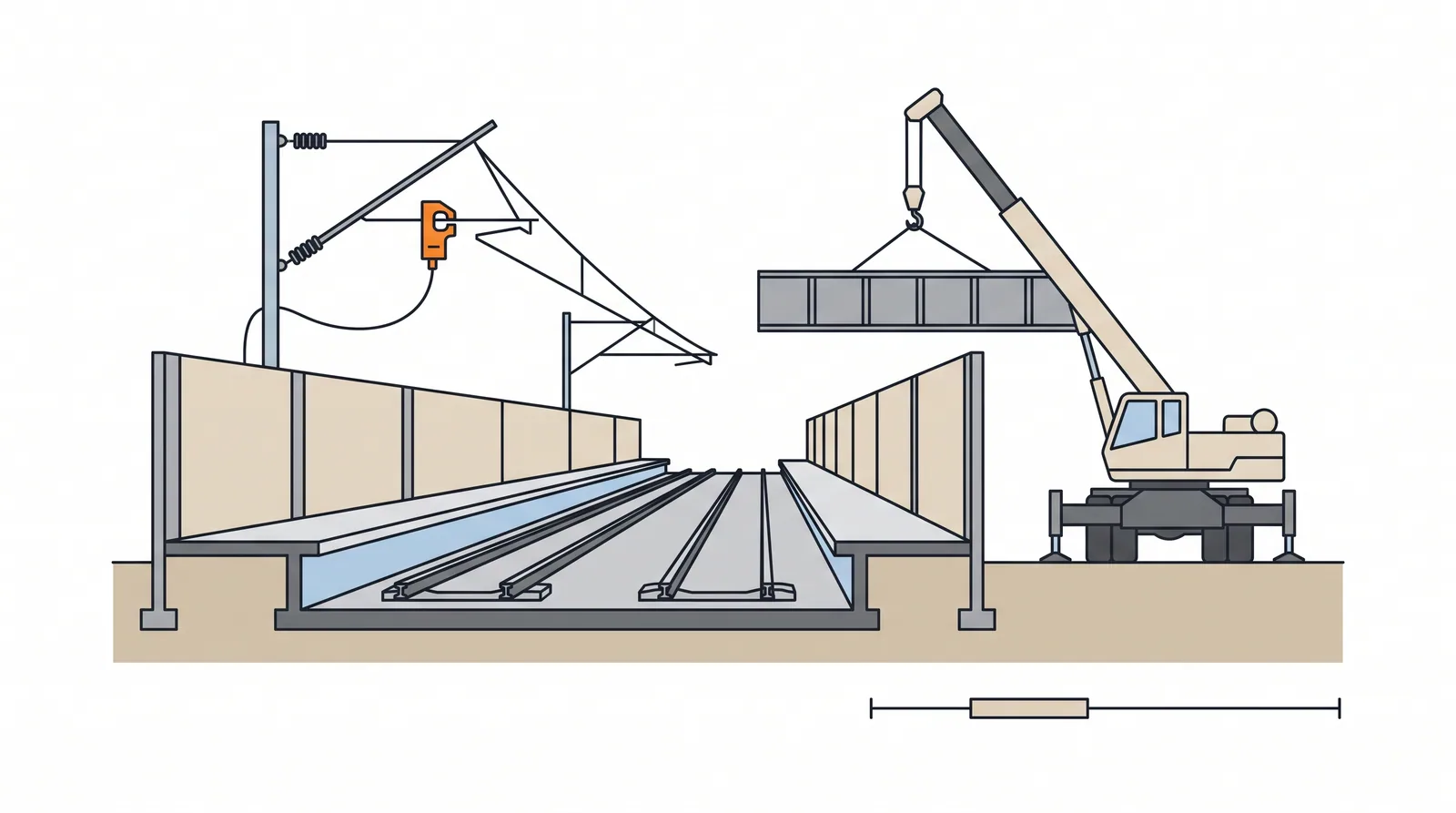
How it is done
- Engage the railway early: agree access windows (overnight possessions, weekend or holiday blockades) a year or more ahead, the isolation of overhead lines, and the asset protection requirements.
- Design the bridge and its erection so that only the minimum needs a possession (lifts over the tracks, demolition, formwork over the line), with piers and abutments set clear of the track and its maintenance zone.
- Prepare everything outside the possession: substructure, staging of girders, crane pads and outrigger checks, lift plans, protection decks and screens; trial-assemble critical elements.
- Rehearse the possession with an hour-by-hour plan carrying float, contingency equipment, continue-or-abort decision points, and defined roles for railway and contractor.
- In the possession, take the isolation, lift and fix the elements, and install protection (permanent formwork, protection decks or screens) so later work can continue with trains running.
- Hand back on time after inspection of the track and overhead line, and record any overrun and its cause.
- Between possessions, work only behind protection, with exclusion zones and crane slew limits whenever trains run.
Key numbers
- Overnight possessionsoften 4–8 hours, of which 1–2 hours go to isolation and hand-back
- Weekend blockadesabout 27–54 hours; holiday blockades of several days
- Planning lead timea year or more for blockades
- Lifts in one possessioncomplete spans of about 100–1,000 t by mobile cranes of 500–1,200 t
- Overhead line clearancekeep cranes and loads at least 2.75 m from live 25 kV equipment (UK practice)
Where it fits
- All bridges over operating railways; overhead line electrified routes need extra isolation time.
Where it does not
- Any method that needs falsework or work over the track outside possessions; crane operations that could foul the track.
Choosing it
- Choose methods that minimise possession time (slide, SPMT, rotation, whole-span lifts) over piece-by-piece erection when access is scarce or penalties are high.
- Prefer one longer blockade over many short possessions when the work needs continuous curing or complex sequences, if the railway can divert services.
- Install permanent formwork or protection decks in the first possession so the remaining work can continue with trains running.
- Avoid cast-in-place falsework over the tracks unless a long blockade or full protection is available.
Plant, pace and money
PlantCranes positioned outside the boundary, protection screens, isolation equipment.
ProductivitySet by the possession calendar, not the crane.
CostPossession charges and penalties dominate; the game's railway sites carry a possession factor in the schedule.
Risks and controls
What goes wrong
- Overrun of the possession, crane collapse onto the track, dropped objects, electrocution.
Quality assurance
Possession planning with method statements and rehearsals, safe systems of work with the railway, exclusion zones.
Origins
Working inside possessions has always governed bridge work over railways; overruns such as the Christmas 2014 works at King's Cross and Paddington, investigated by the UK rail regulator, show how costly losing control of a blockade can be.
Examples
UK Network Rail Christmas blockades, Korean KORAIL night possessions, Japanese Shinkansen overbridges (rotation and slide methods).
Case studies
King's Cross and Paddington Christmas engineering worksUK · 2014Engineering works overran on 27 December 2014, closing two major London terminals and leading to an investigation by the rail regulator into possession planning.
Gerrards Cross tunnel collapseUK · 2005A cut-and-cover tunnel being built over the operating Chiltern line for a supermarket development collapsed onto the tracks, closing the line for several weeks; a lesson on temporary works over live railways.
Baoding cable-stayed overpassChina · 2019About 46,000 t rotated over the Beijing–Guangzhou Railway in 68 minutes, so the line needed only a short window.
Related methods
Lateral slide (slide-in bridge construction)SPMT move (self-propelled modular transporters)Rotation (swing) constructionCrane erection of steel girdersBox jacking and pipe-roof jacking under railways and roads
Further reading
Network Rail standards NR/L2 · AREMA Manual