How bridges get built · Heavy lift, moving and accelerated construction · Prefabricated bridge elements and systems (PBES)
Also called: PBES, prefabricated bridge units, modular bridge elements
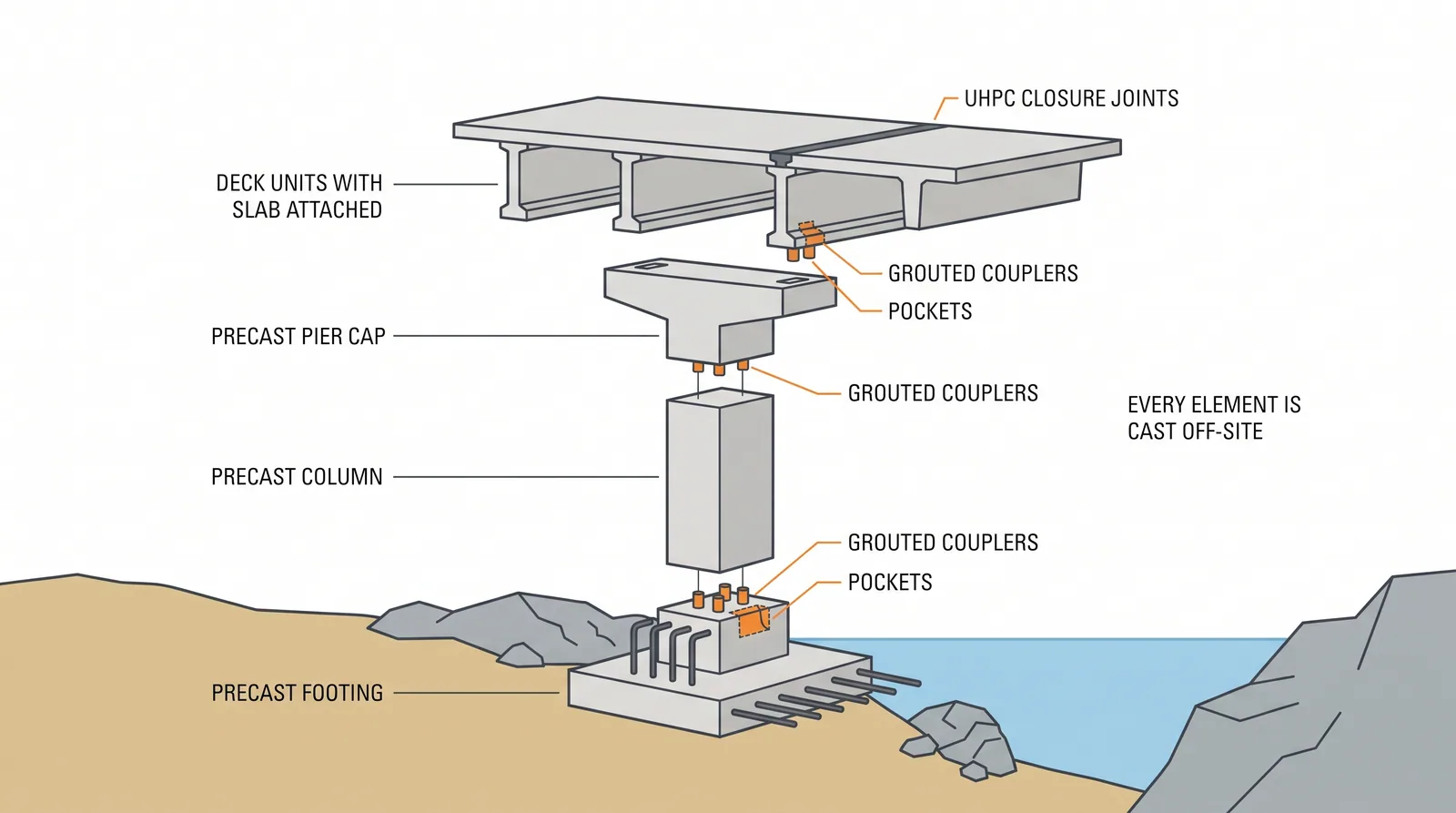
How it is done
- Set the prefabrication scope from the closure the owner can accept: elements (footings, columns, caps, deck panels, girders with deck) or complete spans; standardise element types within transport and crane limits.
- Detail the connections first: grouted splice couplers or grouted ducts for columns and caps, UHPC or closure-pour joints for deck panels and deck girders, post-tensioning where continuity is needed; prove them with mock-ups.
- Survey the existing site and build any new foundations ahead of the closure, beside or beneath the old bridge, so elements can be set to tight tolerances.
- Fabricate elements in the precast plant in parallel with site work, checking geometry (templates for coupler and duct positions) before shipping.
- In the closure, remove the old structure and set elements by crane (or SPMT for large units) in the planned order, holding alignment with shims and temporary bracing.
- Grout couplers and ducts, cast UHPC or rapid-set joints, stress any post-tensioning, protect curing from cold or heat, and confirm strength before loading.
- Place the overlay or grind the deck, finish joints and barriers, reopen, and hand the connection QA records to the owner.
Key numbers
- Closureone night to about two weeks for a full replacement, instead of months
- UHPC jointscompressive strength of about 150 MPa or more; joints about 150–200 mm wide with short non-contact bar laps
- Grouted couplersfull-strength (Type 2) splices required in plastic hinge zones in seismic regions
- Element weightcommonly kept under about 40–100 t for road transport and mobile cranes
- Cost premium over cast-in-placecommonly 5–20 % in element cost (indicative), recovered through shorter closures
Where it fits
- Bridge replacements on busy routes, repetitive viaducts, sites with weather windows, seismic regions with tested connections.
Where it does not
- One-off geometries, sites without fabrication capacity, projects where connection performance is unproven.
Choosing it
- Choose PBES over cast-in-place when user delay, detours or possession costs outweigh the element premium, or when weather or traffic windows are short.
- Prefer complete-span moves (SPMT, lateral slide) when the closure must be hours rather than days.
- Prefer cast-in-place for one-off geometries, highly skewed or curved bridges, or remote sites far from a precast plant.
- In seismic regions, use only connection details with test evidence for cyclic loading in plastic hinge zones.
Plant, pace and money
PlantPrecast plant, transport, cranes, grouting and UHPC mixing.
ProductivityDays on site per span.
CostHigher element cost, lower site cost and user delay.
Risks and controls
What goes wrong
- Connection quality, tolerance stacking, transport damage.
Quality assurance
Connection mock-ups, grout and UHPC tests, geometry checks at delivery.
Origins
Precast girders have been standard since the 1950s, but the systems approach to prefabricating whole bridges was promoted by the FHWA through its accelerated bridge construction work in the 2000s and the Every Day Counts initiative in the 2010s; UHPC field joints became common in the same period.
Examples
US FHWA Every Day Counts programme; Korean and Japanese modular overpasses.
Case studies
I-93 Fast 14, MedfordUSA · 2011Fourteen bridge superstructures replaced over ten weekend closures using prefabricated modular units set by crane.
Keg Creek Bridge, US 6USA · 2011Replaced with prefabricated elements joined by UHPC as a SHRP2 accelerated bridge construction demonstration.
Related methods
Precast segmental piers and capsDeck slabs on girders: cast-in-place, precast panels and stay-in-place formsLateral slide (slide-in bridge construction)SPMT move (self-propelled modular transporters)Full-depth precast deck panels with UHPC or grouted jointsModular temporary and emergency bridges (Bailey, Acrow, Mabey)
Further reading
FHWA Connection Details for PBES · AASHTO LRFD Guide Specifications for ABC · FHWA, Accelerated Bridge Construction: Experience in Design, Fabrication and Erection of Prefabricated Bridge Elements and Systems (2011)