Also called: slide-in, lateral launching, bridge slide, SIBC
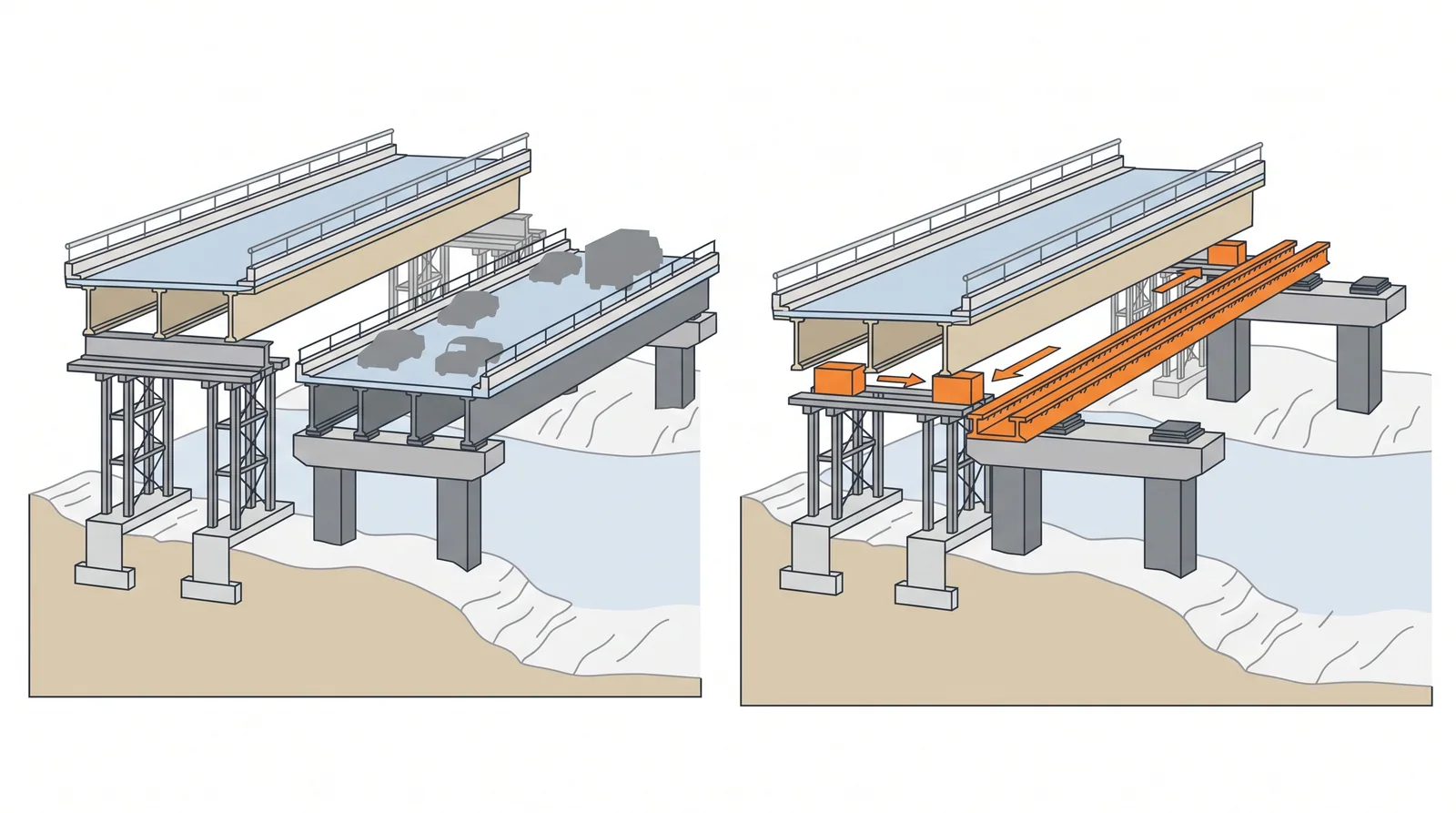
How it is done
- Plan the closure and the slide: slide distance, friction assumptions (PTFE on stainless steel or greased skid beams), push or pull system, deck stresses when supported only at the slide shoes, and contingency for a stuck slide.
- Build temporary supports beside the existing bridge with slide tracks continuous from the temporary to the permanent substructure.
- Build the new superstructure on the temporary supports at final level, complete with deck, barriers and sometimes surfacing; at the same time build or modify the permanent substructure under or beside the old bridge.
- In the closure, demolish the old superstructure or slide it out, sometimes onto temporary supports for later removal.
- Push or pull the new superstructure across with synchronised jacks or strand jacks at a few metres per hour, keeping both ends in step and monitoring skew and drift by survey and stroke counters.
- Jack the deck off the slide shoes, remove the shoes and set it on its bearings; complete approach slabs and joints and reopen.
- Remove the temporary supports and slide tracks after reopening.
Key numbers
- Spansabout 15–120 m; multi-span decks and long trusses have also been slid as one
- Slide distancetypically 10–40 m (one bridge width plus clearance)
- Frictionabout 3–10 % of the vertical reaction (PTFE on stainless or greased skid beams); breakout friction higher
- Closure24–72 hours for slide and tie-in (Skagit River 2013: slide completed in about 19 hours)
- Cost premium10–30 % over conventional construction for the temporary works (indicative)
Where it fits
- Replacements of bridges over live roads, railways and rivers; spans 30-120 m; single or multi-span decks built at the final level.
Where it does not
- Sites without room beside the alignment; decks too flexible to slide without distortion; skewed slides without engineering.
Choosing it
- Choose a lateral slide over SPMT when there is room beside the bridge but no staging area or level route for transporters, or the deck is too long or heavy for SPMT handling.
- Prefer SPMT when the new span can be built in a staging area off the alignment and the route to the crossing is level and firm.
- Choose it over staged half-width construction when road-user or possession costs are high and a single weekend closure is acceptable.
- Prefer it when the temporary supports can double as a detour bridge carrying traffic during construction.
Plant, pace and money
Risks and controls
What goes wrong
- Differential friction racking the deck, track misalignment, jacks out of sync, weather during the closure.
Quality assurance
Trial slide over a short distance, synchronised jack control, survey at intervals during the slide.
Origins
Sliding new spans sideways into position has long been used for railway bridges in Europe (the German 'Querverschub'); in the US the FHWA promoted it as slide-in bridge construction in the 2010s, with the Utah DOT among the first and most frequent users.
Examples
Utah DOT slide-ins (dozens since the late 2000s), I-5 Skagit River (2013), Sellwood (2013), Milton–Madison (2014), UK railway bridge replacements, Korean railway crossings.
Case studies
In the bridge game
What Bridge Master applies when you pick it
Deck types: Steel plate girder, Steel box girder, PSC I-girder, PSC box (cast in place), Steel truss, Orthotropic steel box, Steel arch, PSC U-girder, Spliced PSC girder, Voided slab, Precast segmental box, Network tied arch. Spans 30-100 m, up to 150 m.
- +30: Replace or cross in one possession: slide it in.
- -35: No reason to slide over open ground.
- -20: Sliding a deck over 100 m: huge temporary supports; ILM or cantilever instead.
- -25: A one-off operation for one span: on a multi-span viaduct it is the exception for the main span, not the method for the deck.
Related methods
Further reading
FHWA Slide-In Bridge Construction Implementation Guide · AASHTO ABC Guide Specifications