How bridges get built · Bored piles and deep foundations · Percussion rotary drilled (PRD) steel pipe piles
Also called: PRD pile, rock-socketed steel pipe pile, DTH pile
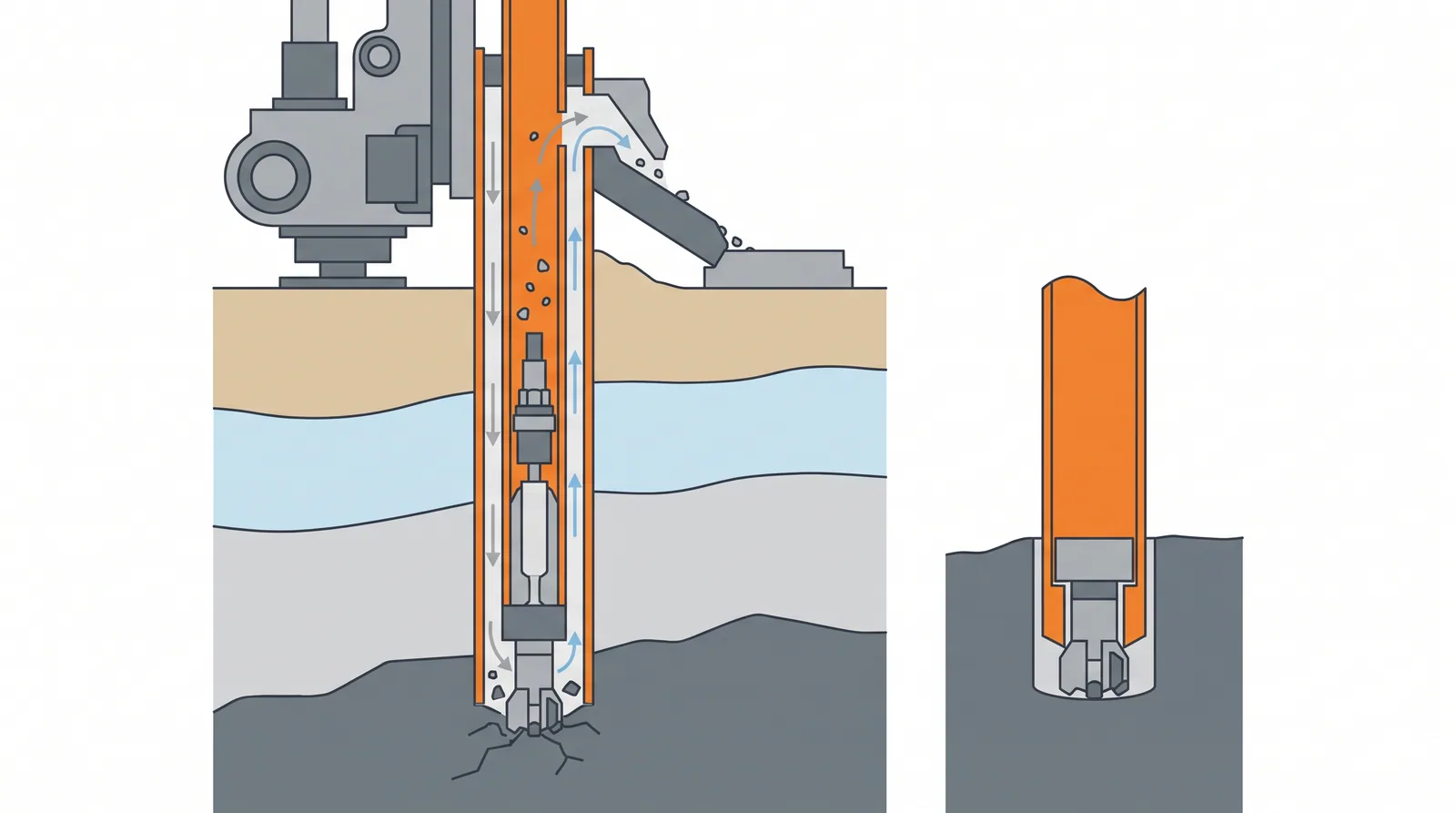
How it is done
- Set out and pitch the steel pipe, fitted with a hardened shoe or ring bit, in a guide frame; check verticality in two directions.
- Lower the DTH hammer and bit inside the pipe; the rotary head turns the pipe while the hammer drills ahead, and an eccentric or concentric reamer cuts clearance so the pipe follows.
- Flush cuttings up the pipe with compressed air (water or foam where air would blow out the ground), controlling air pressure near structures and in loose sands.
- Advance through soil and boulders to rock, then socket to the design depth judged on penetration rate, cuttings and the rock level in the boreholes; keep a drilling log for each pile.
- Clean the socket with air or water and measure depth; check for collapse. Hold point.
- Lower the cage or steel insert into the pipe and socket and concrete by tremie (or in the dry where the socket is sealed).
- Grout the annulus around the pipe where shaft friction or lateral support is relied on, then load test a sample by static or high-strain dynamic test with a drop weight.
Key numbers
- Pipe diameter400–1,200 mm (600–800 mm typical in bridge work)
- Length10–40 m
- Capacityabout 2–6 MN for 600–1,000 mm piles socketed in rock
- Compressed airabout 25–35 m³/min at 1.7–2.4 MPa for large DTH hammers
- Shaft friction on the cased lengthlittle unless the overcut annulus is grouted
Where it fits
- Shallow weathered rock, boulder beds, urban sites, marine trestles with rock close to the bed, small groups under viaduct piers.
Where it does not
- Deep soft soil where shaft friction on the pipe is the main resistance (the pipe is not driven, friction is low).
- Very large diameters.
Choosing it
- Choose it over driven steel piles where weathered rock or boulders lie at shallow depth and a driven pile would refuse short or be damaged.
- Choose it over large bored piles for light to moderate piers on tight or urban sites, where a compact rig and compressor fit.
- Prefer driven piles in deep soft soil where shaft friction carries the load: a drilled-in pipe sits in an overcut hole, and Hong Kong load tests on pre-bored socketed piles showed no measurable side resistance on the cased length.
- Prefer large bored piles (RCD or casing) where loads exceed about 6–8 MN per pile or diameters beyond about 1.2 m are needed.
Plant, pace and money
PlantPRD rig with rotary head and DTH hammer, air compressors, service crane.
Productivity3-8 piles of 20-30 m per rig per shift.
CostUSD 250-500 per metre for 600-800 mm.
Risks and controls
What goes wrong
- Air flush blowing out soil around the pipe, socket cleanliness, dust and noise from the compressor.
Quality assurance
Drilling logs with rock penetration rates, socket depth verification, load tests.
Origins
The method grew out of DTH drilling in mining and water wells. DTH-installed socketed H-piles in pre-bored holes were in common use in Hong Kong by the 1990s, and PRD steel pipe piles became a mainstream bridge and building pile in Korea in the 2000s.
Examples
Korean urban viaducts and coastal trestles; Hong Kong 'socketed H-piles' are the H-section cousin.
Related methods
Steel pipe piles (open- and closed-ended)Drilled shafts (bored piles) with casing or slurryRock sockets and base treatmentMicropiles
Further reading
Korean Design Standard KDS 11 50 · Hong Kong GEO Publication 1/2006 · Hong Kong Buildings Department, Code of Practice for Foundations