How bridges get built · Site investigation and testing · Static pile load test
Also called: maintained load test, kentledge test, reaction pile test
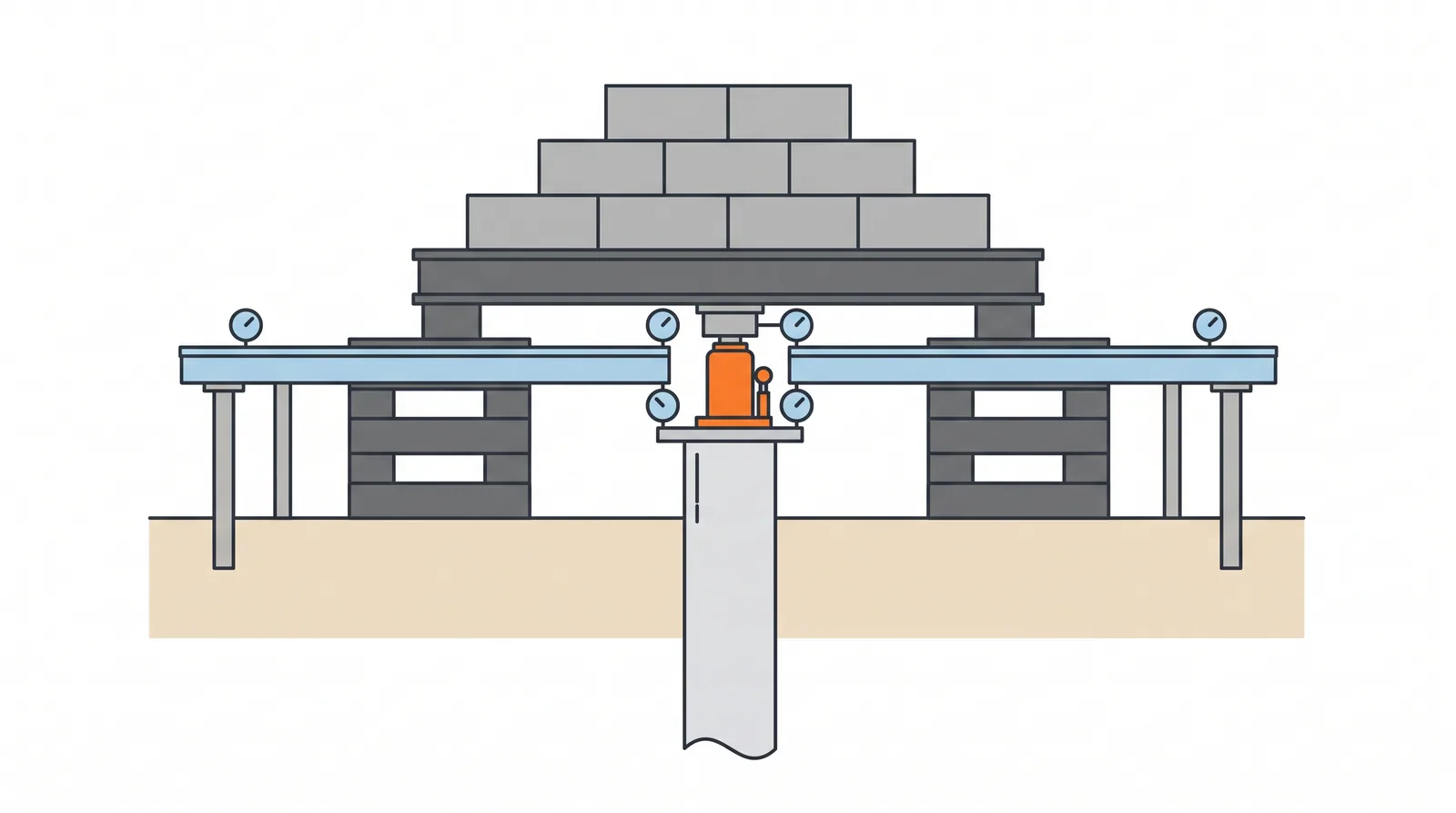
How it is done
- Plan the programme at design stage: preliminary piles tested to failure or to 2–3 times working load before production, and proof tests on working piles at about 1.5 times working load during production.
- Install the test pile with the production rig, method and crew; instrument it with strain gauges at layer boundaries and telltales to the toe, and record the installation in full.
- Allow time for set-up before testing: concrete strength in bored piles, and dissipation of installation pore pressures in clay for driven piles.
- Build the reaction (kentledge on cribbing, or reaction piles or anchors with a crossbeam) clear of the test pile, and support the reference beams independently, shaded from sun and wind.
- Load in maintained increments, holding each until the settlement rate falls below the specified creep criterion, with an unload and reload cycle; measure head movement with gauges or LVDTs and check the reference by levelling.
- Unload in steps and record the rebound; run tension or lateral tests with the reaction reversed where those loads govern.
- Interpret the load-settlement curve (Davisson offset or 10 % of diameter), derive shaft and base resistance from the strain gauges, and revise pile lengths and resistance factors before production.
Key numbers
- Test load2–3 × working load (or to failure) on preliminary piles; about 1.5 × working load on working piles.
- Reactionkentledge of about 1.2–1.3 × the maximum test load; reaction piles and cribbing at least five pile diameters and not less than 2.5 m clear of the test pile (ASTM D1143).
- Failure definitionssettlement of 10 % of pile diameter (EN 1997-1), or Davisson offset of elastic shortening + 4 mm + D/120.
- AASHTO LRFD resistance factors rise to 0.80 for driven piles (0.70 for drilled shafts) with static load testing, against roughly 0.25–0.55 for static analysis alone.
- Duration1–3 days of loading; 1–2 weeks including reaction set-up for large piles.
Where it fits
- Any project with more than a few dozen piles or with uncertain ground; contractual acceptance testing.
- New pile types or ground the contractor has not worked in.
Where it does not
- Testing a pile that is not representative (different length, different installation method).
Choosing it
- Choose a top-down static test where reaction is practical, roughly up to 20–30 MN: it is the reference against which all other tests are calibrated.
- Prefer a bi-directional (O-cell) test for larger loads, over water, or where reaction piles cannot be installed.
- Use dynamic or rapid load tests to cover many piles once they are calibrated against at least one static test per pile type and ground condition.
- Test preliminary piles before production while the result can still change lengths; proof tests on working piles only confirm.
Plant, pace and money
PlantKentledge of 500-3,000 t or reaction piles, hydraulic jacks, load cell, dial gauges or LVDTs on a reference beam.
ProductivityTwo to five days per test including setup; reaction systems for large piles take a week.
CostUSD 60,000-250,000 per test on land; double or more over water. The game charges this in the load-test step and in return converts ground surprises into quiet adjustments.
Risks and controls
What goes wrong
- Kentledge instability, jack misalignment, testing too early after installation (setup effects in clay, relaxation in dense sand).
Quality assurance
Calibrated jacks and load cells, reference beams shaded from sun, test reports with load-settlement and strain distributions.
Origins
Static testing is as old as modern piling; ASTM D1143 and later ISO 22477-1 standardised the procedures, and Davisson's 1972 offset limit and the 10 % of diameter criterion became the most used definitions of failure.
Examples
Sea bridge projects commonly run two or three static tests per foundation type; O-cell tests replace kentledge for very large shafts.
Case studies
Port Mann BridgeCanada · 2012An instrumented 1.83 m open-ended steel pipe pile, 75 m long, was tested statically to about 53 MN in compression (about 36 MN shaft and 17 MN base) and 29 MN in uplift, then restruck dynamically for calibration.
Padma Multipurpose BridgeBangladesh · 2022Load tests on early 3 m raked steel piles showed less capacity than designed where clay replaced the expected dense sand, which led to an extra pile and shaft and tip grouting at 22 piers.
Related methods
Bi-directional (Osterberg cell) load testDynamic load testing (PDA) and signal matchingPile integrity testing (sonic echo and cross-hole sonic logging)Base and shaft post-grouting of bored piles
Further reading
ASTM D1143 · ISO 22477-1 · Eurocode 7-1 Section 7 · ICE Specification for Piling and Embedded Retaining Walls (SPERW) · Davisson (1972) High capacity piles · Fellenius, Basics of Foundation Design