How bridges get built · Shallow foundations, cofferdams and dewatering · Pile caps in water
Also called: high pile cap, low pile cap, cap in cofferdam
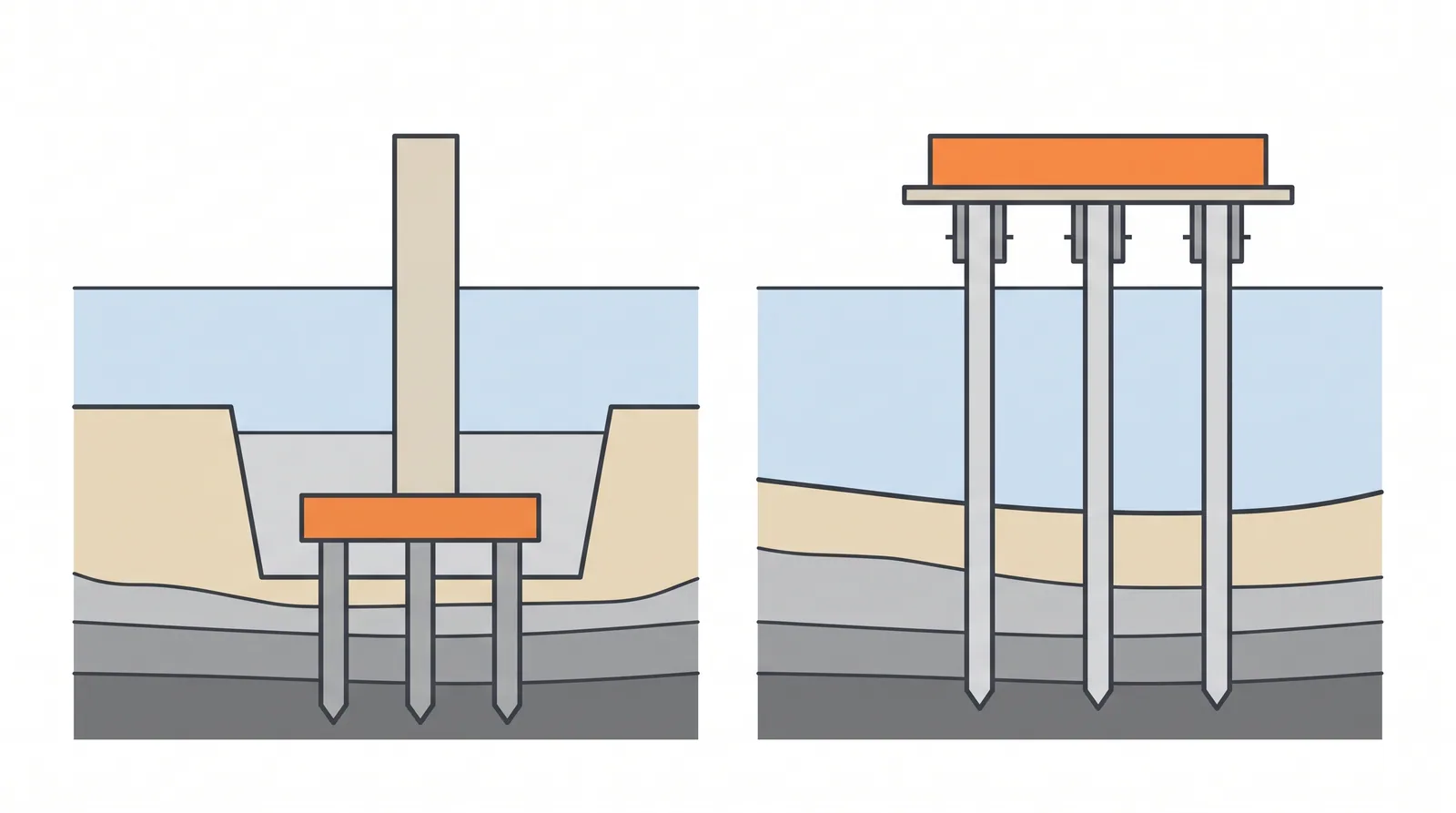
How it is done
- Choose the cap level: a low cap below the bed (protected from scour and ship impact, small flow obstruction) or a high cap near water level (no cofferdam, but exposed, and the piles gain free length and bending).
- Install and test the piles, survey their as-built positions and check the resulting eccentricities and pile loads against the cap design before forming.
- Low cap: build a cofferdam, excavate below the bed, place a tremie seal and dewater. High cap: hang a steel or precast soffit form or box from brackets welded or clamped to the piles.
- Prepare the pile heads: trim bored piles back to sound concrete (removing the overpour), saw-cut concrete piles, cut steel piles square and add shear connectors or plates, and fill hollow piles with a reinforced concrete plug; break back only with methods that do not crack the pile below cut-off.
- Embed the piles in the cap at least 300 mm, or at least 150 mm where the connection is made by anchoring bars or strands (AASHTO LRFD 10.7.1.2), and fix the cap reinforcement around the heads.
- Cast the cap, in two or more lifts with thermal control for thick caps, with the pier starter bars set by survey.
- Reinstate scour protection around low caps; for high caps, provide splash-zone durability (cover, low-permeability concrete, coatings) and fenders where ship impact governs.
Key numbers
- Pile embedment in capat least 300 mm, or 150 mm with anchoring bars or strands (AASHTO LRFD 10.7.1.2).
- Pile spacing at least 2.5 diameters (and not less than 750 mm); pile face at least 225 mm from the cap edge (AASHTO).
- Cap thicknessabout 1.5-3 m for viaduct piers, 5 m or more for pylons.
- Cover for direct exposure to seawater100 mm (AASHTO).
- Programmelow cap 4-8 weeks per pier; high cap 2-3 weeks.
Where it fits
- Low caps: navigable rivers with ship impact, high scour, aesthetics of piers rising from the water. High caps: sea viaducts with many piers, tidal sites where speed matters, no ship impact.
Where it does not
- High caps in the splash zone in aggressive waters without extra cover and coatings.
Choosing it
- Choose a low cap below the bed when ship impact, scour or hydraulic blockage governs, or for appearance on a navigable river.
- Choose a high cap for long marine viaducts with many identical piers, small-craft traffic only and manageable scour: no cofferdam and a much faster cycle.
- A high cap lengthens the free length of the piles, so check pile bending and buckling under ship impact, waves and earthquake, and consider raked piles.
- A partly buried cap is a middle course where limits on flow obstruction are strict.
Plant, pace and money
PlantCofferdam or suspended formwork, cranes or barges, tremie equipment.
ProductivityLow cap 4-8 weeks per pier; high cap 2-3 weeks.
CostLow caps cost 2-3 times high caps because of the cofferdam and seal.
Risks and controls
What goes wrong
- Scour exposing a high cap; ship impact; chloride attack in the tidal zone.
Quality assurance
Pile cut-off survey, cover meter checks, curing of the splash-zone concrete.
Origins
Until the mid-20th century river piers were almost always founded on low caps or footings built inside cofferdams; elevated caps on long piles spread with prestressed concrete and steel pipe piles for long lake and sea crossings such as the Lake Pontchartrain Causeway (1956).
Examples
Sea viaducts in the Gulf and Hong Kong use high caps with precast shells; river bridges in Korea use low caps below the bed.
Case studies
Sutong Yangtze River BridgeChina · 2008Pylon caps of 114 x 48 m on 131 bored piles each were cast in the dry inside steel boxes in the Yangtze estuary.
Hong Kong-Zhuhai-Macau BridgeChina · 2018The non-navigation spans used prefabricated pier and cap units with the caps set partly below the seabed, to keep obstruction of the tidal flow within strict limits.
Lake Pontchartrain CausewayUSA · 1956Each repeating bent is a precast cap on two 1.37 m prestressed cylinder piles, with piles, caps and decks made in one yard and barged out; the first pile was driven in May 1955 and the causeway opened in August 1956.
Related methods
Sheet-pile cofferdamPrecast and floating cofferdam boxesTremie concrete sealRaked (battered) pile groups
Further reading
AASHTO LRFD 10.7 · Tomlinson and Woodward, Pile Design and Construction Practice · CIRIA C674 The use of concrete in maritime engineering: a good practice guide