How bridges get built · Shallow foundations, cofferdams and dewatering · Mass concrete and thermal control
Also called: thick pour, thermal cracking control, cooling pipes
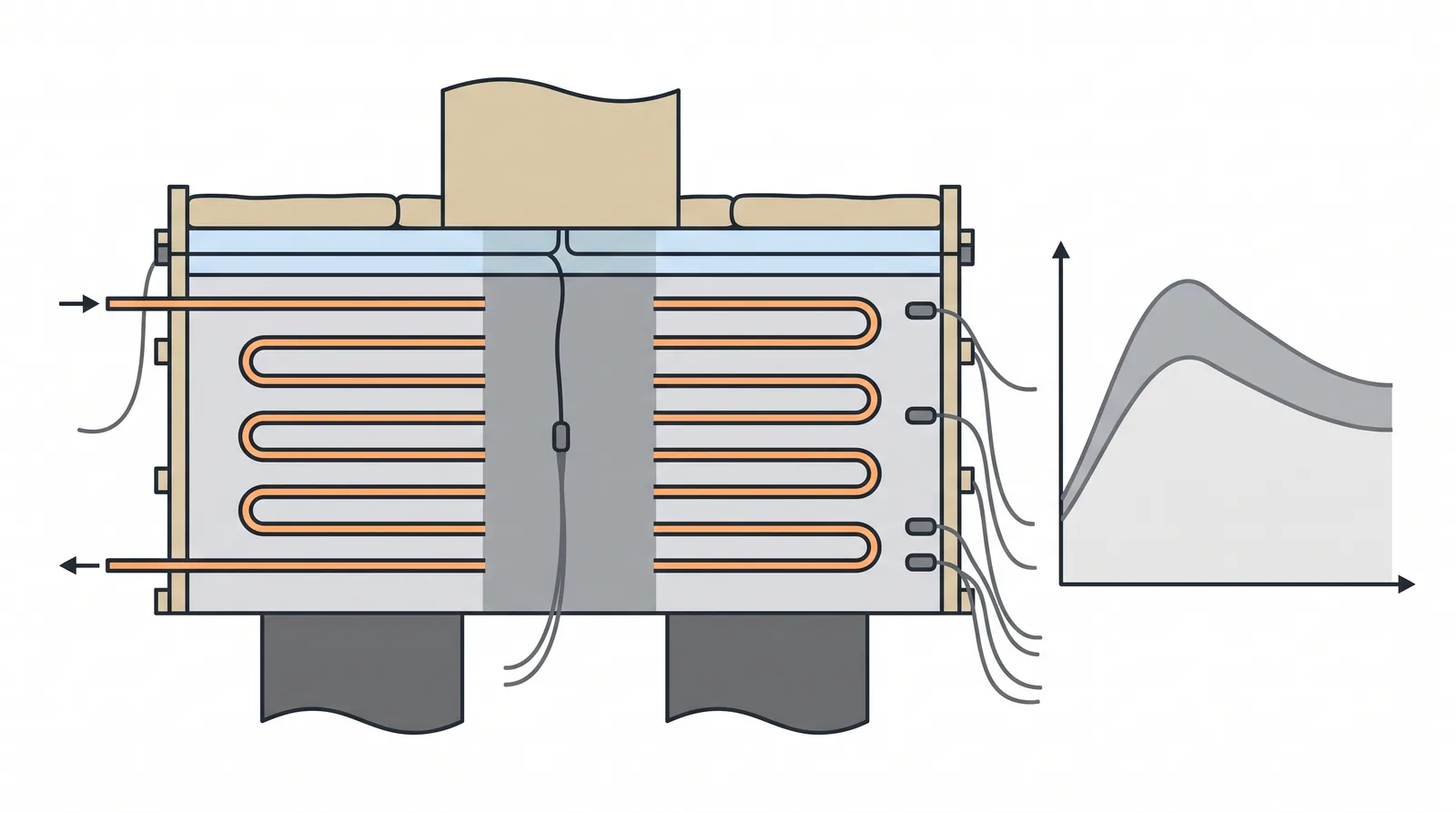
How it is done
- Run a thermal analysis before the pour: predict peak temperature and core-to-surface difference from the mix, pour geometry, placing temperature and ambient conditions, and set the control measures to suit.
- Design a low-heat mix: replace 30-70 % of the cement with slag or 20-35 % with fly ash, keep the binder content as low as strength allows, and use larger aggregate where possible.
- Limit the placing temperature (commonly to about 25-32 C) with chilled water, ice, shaded and sprayed aggregates, liquid nitrogen or night pours.
- For pours thicker than about 1.5-2 m, embed cooling pipes (25-50 mm steel or HDPE) at 1-1.5 m spacing and circulate water for 1-3 weeks, keeping the water close enough to the concrete temperature that the pipes do not crack it.
- Fix thermocouples at the core, mid-depth and surface before the pour; place in layers of about 0.5 m with continuous supply so no cold joints form.
- Insulate the surfaces and delay stripping until the core-to-surface and surface-to-ambient differences are within limits; never cool the surface with cold water.
- Grout the cooling pipes once cooling ends, map cracks after stripping, and seal any that exceed the durability limit.
Key numbers
- Maximum core temperature70 C, to avoid delayed ettringite formation.
- Core-to-surface temperature differenceabout 20 C (35 F in ACI 301), relaxed only on the basis of a cracking analysis.
- Adiabatic temperature riseroughly 12-14 C per 100 kg/m3 of Portland cement.
- Cooling pipes25-50 mm diameter at 1-1.5 m spacing, run for 1-3 weeks.
- Extra costabout USD 10-30 per m3.
Where it fits
- Any pour thicker than about 1 m: pile caps, pylon bases, cofferdam seals, arch springings.
Where it does not
- Pouring a 3 m cap in the desert afternoon without a plan.
Choosing it
- Choose cooling pipes in addition to a low-heat mix when the section exceeds about 2 m, the placing temperature cannot be kept low (hot climates), or early strength is needed for the next stage.
- Prefer splitting the pour into lifts with keyed, roughened joints when supply or thermal limits cannot be met in one pour, accepting a longer programme and joint preparation.
- Prefer slag or fly ash blends over plain Portland cement whenever the specification allows: lower heat and better chloride resistance, at the cost of slower early strength.
Plant, pace and money
PlantChillers or ice plant, cooling pipe network and pumps, thermocouples and loggers.
ProductivityUnchanged for placing; adds 1-3 weeks of monitoring per pour.
CostUSD 10-30 per m3 extra.
Risks and controls
What goes wrong
- Through cracks that let chlorides into the reinforcement; delayed ettringite formation if the core exceeds 70 C.
Quality assurance
Thermal analysis before the pour, thermocouple records, crack mapping after stripping.
Origins
Embedded cooling pipes were first used on a large scale at Hoover Dam (1931-36), where the concrete was cast in interlocking columns and cooled by circulating water; ACI Committee 207 later codified mass-concrete practice.
Examples
Pylon bases of sea bridges in the Gulf are routinely cooled for two to three weeks.
Case studies
Hoover DamUSA · 1936About 2.5 million m3 of concrete cast in columns and cooled through embedded pipes, the first large-scale use of the method; without it the dam would have taken far longer to cool.
Sikorsky Bridge (pier 3 footing)USA · 2003The 61 x 11 x 3 m footing was poured with a horizontal construction joint in its bottom 1.2 m to limit the heat of hydration and the wet-concrete load on the precast tub below.
Akashi Kaikyo Bridge (Kobe-side anchorage)Japan · 1998The 85 m diameter anchorage shaft was filled with roller-compacted concrete, and low-heat cement was used for the massive anchorage and caisson concrete.
Related methods
Further reading
ACI 207.1R and 207.2R · CIRIA C766 Control of cracking caused by restrained deformation · ACI 301 Specifications for Structural Concrete (mass concrete section) · JCI Guidelines for Control of Cracking of Mass Concrete