How bridges get built · Cable-supported and arch bridges · Network tied arch construction
Also called: network arch erection, crossing hanger arch
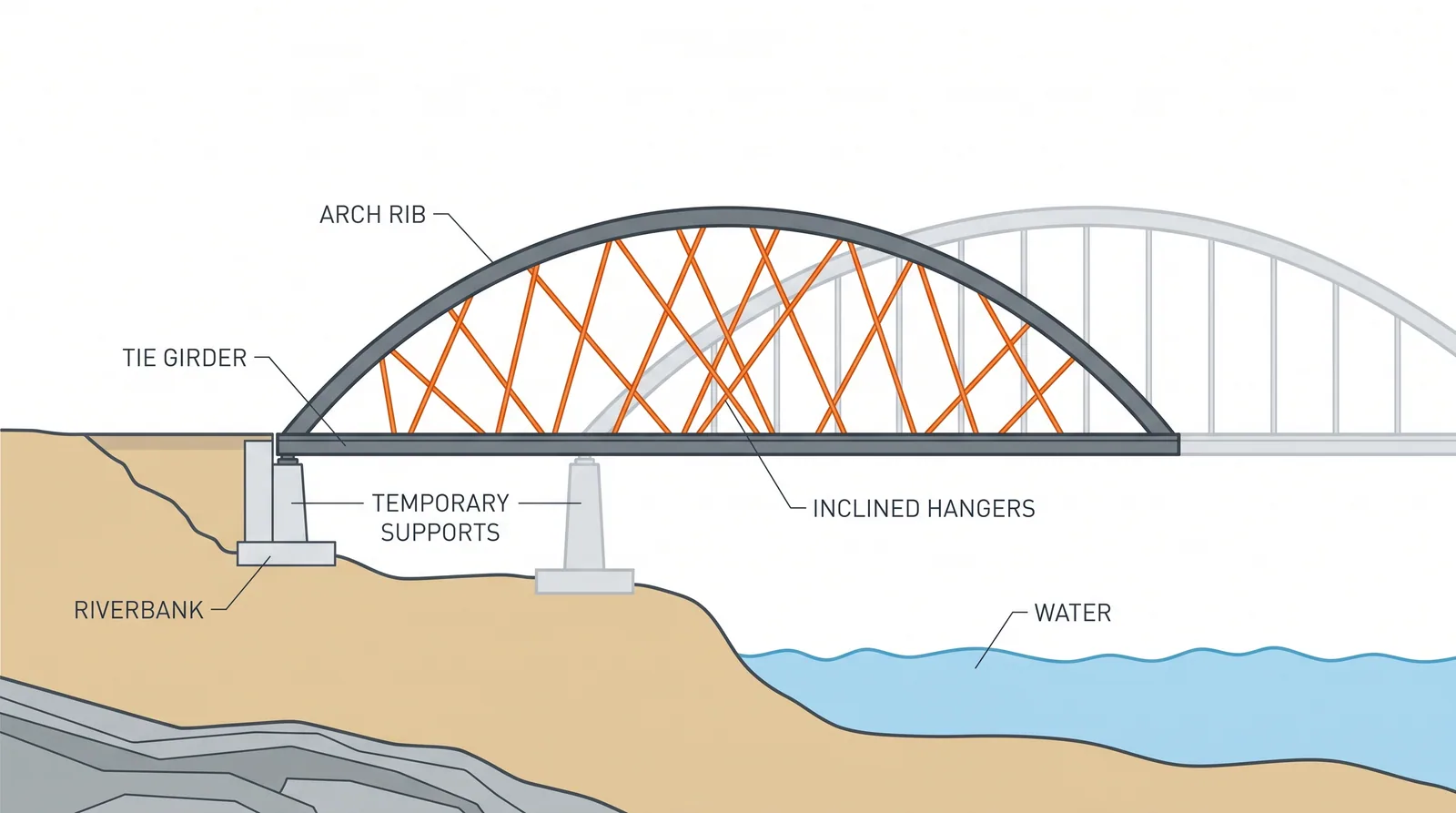
How it is done
- Fix the erection and hanger sequence at design stage: hanger forces are sensitive to the order of deck casting, and a changed sequence can slacken or overload hangers.
- Build the tie: assemble the steel tie or cast the concrete tie on temporary supports, falsework or an assembly yard.
- Erect the arch ribs on temporary towers standing on the tie or the ground, and complete the wind bracing between the ribs.
- Install the inclined hangers (rods or strands) in the planned order and pretension them so each carries a small force before the main loads arrive.
- Cast the deck slab in the analysed sequence (often in strips from midspan outward or in alternating panels), monitoring hanger forces and arch geometry and adjusting hanger lengths where the sequence requires.
- Remove the temporary supports, or move the completed span by float-in, slide or SPMT and set it on its bearings.
- Measure final hanger forces (vibration or lift-off) and arch geometry as the inspection baseline.
Key numbers
- Span rangeabout 80–260 m (economic about 100–200 m)
- Arch riseabout 0.14–0.17 of the span
- Hangersinclined at about 45–65°, each crossing other hangers at least twice
- Installation when moved wholeone night to a few days by float-in, slide or SPMT
- SteelUSD 5,000–8,000 per tonne erected (indicative)
Where it fits
- Single spans of 80-260 m over rivers, canals and railways; replacement spans that must go in during a short closure.
Where it does not
- Sites where the assembly area does not exist; designs without a hanger sequence analysis.
Choosing it
- Choose a network arch over a tied arch with vertical hangers for single spans of about 100–250 m: the crossing hangers make the system act like a truss, so arch and tie are much lighter.
- Choose it where construction depth must be small (navigation or rail clearance) and the span must go in during a short closure by float-in, slide or SPMT.
- Prefer a continuous girder or truss when the crossing is continuous over several piers or the alignment is curved.
- Check that the contractor will follow the hanger and deck sequence; network arches are less forgiving of improvised sequences than conventional arches.
Plant, pace and money
PlantFalsework or assembly yard, cranes, hanger stressing equipment, movers.
ProductivityAssembly in months; installation in a day.
CostSteel USD 5,000-8,000 per tonne erected.
Risks and controls
What goes wrong
- Slack hangers during deck casting, arch buckling before the deck stiffens the system.
Quality assurance
Hanger force records at each stage, arch geometry survey.
Origins
Per Tveit developed the network arch in Norway; the first two, at Steinkjer and Bolstadstraumen, were completed in 1963–64, and the type spread to Germany, the US and elsewhere from the 2000s.
Examples
Brandanger (Norway), Providence River, Blennerhassett, many Norwegian and German road bridges; the game's network tied arch type.
Case studies
Steinkjer BridgeNorway · 1963One of Per Tveit's first two network arches (with Bolstadstraumen, 1964).
Blennerhassett Island BridgeUSA · 2008268 m network tied arch over the Ohio River, assembled on shore and floated into position on barges.
Brandanger BridgeNorway · 2010220 m network arch across a fjord, built to Tveit's principles.
Related methods
Float-in of complete arches and spansLateral slide (slide-in bridge construction)Arch erection by cantilever with temporary staysConcrete-filled steel tube (CFST) arch constructionStay cable and hanger replacement
Further reading
Tveit, network arch publications · NCHRP guidance on tied arches