Also called: heavy lifting by strand jacks, deck section lifting, lifting gantry
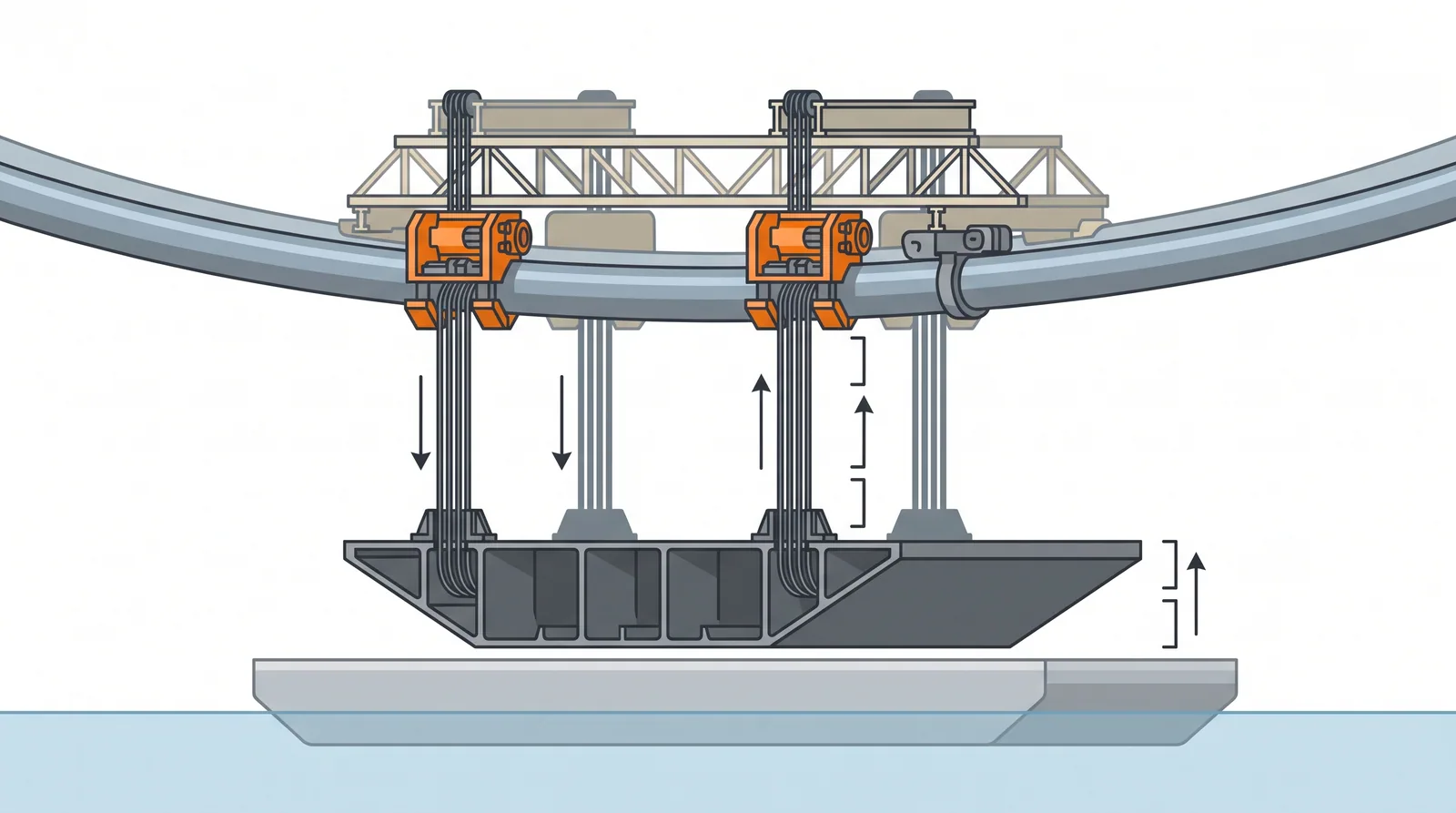
How it is done
- Engineer the lift: load at each lifting point (by weighing or with calculated tolerances), strand jack capacity with margin, gantry and anchorage design, and the load path into the permanent structure.
- Install lifting gantries or frames on the main cables, deck tips, pier heads or temporary towers; mount the strand jacks, power packs and computer control, reeve the strands and fix the bottom anchors to the load's lifting lugs.
- Pre-tension all strands, then trial lift: raise the load 100–200 mm clear of its supports, hold, and check loads, deflections and anchorages.
- Lift in synchronised strokes with the control system holding level within set limits, monitoring the load at each point and stopping on any deviation.
- When lifting from a barge, take the load off quickly at the start so barge motion cannot re-load the strands (snatch loads), and move the barge away once clear.
- At final level, align and connect to the structure (temporary hinges, bolts or welds), transfer the load and release the strands gradually.
- Move the gantries to the next lift, and inspect strands and wedges between lifts, replacing any damaged.
Key numbers
- Strand jack capacityabout 15–1,000 t per jack; systems combine many jacks for loads of several thousand tonnes
- Lifting speedabout 5–20 m per hour
- Strand working loadcommonly 40–50 % of minimum breaking load
- Deck campaign on a suspension bridgeabout one section per day
- CostUSD 50,000–150,000 per section; system hire per campaign (indicative)
Where it fits
- Suspension bridge deck erection, box girder sections for cable-stayed bridges, arch halves, spans up to 5,000 t or more.
Where it does not
- Sites where a crane can do the lift faster; loads without a stable landing structure.
Choosing it
- Choose strand jacks over crane vessels when the lift is heavier than available cranes, the water is too shallow, or the lifting point is high above the water (suspension decks, arches, pier-top lifts).
- Prefer a land or floating crane for repetitive light lifts where speed matters; strand jacks are slow to rig for each lift.
- Use the same system for lowering, sliding and launching; one set of jacks often serves several operations on a project.
- Lifting from barges needs a quick take-off and tidal planning; prefer lifting from a fixed platform or quay when available.
Plant, pace and money
Risks and controls
What goes wrong
- Strand jack synchronisation failure, gantry overload, barge drift under a partially lifted load.
Quality assurance
Lift procedure with load monitoring, strand inspection, synchronisation tests.
Origins
Strand jacks were developed from post-tensioning hardware by the prestressing firms in the 1970s and became the standard tool for very heavy, slow, precise lifts in offshore, power-station and bridge work.
Examples
Deck sections of Great Belt East, Xihoumen, Yi Sun-sin and 1915 Çanakkale; the Lake Champlain arch lift; launching and lowering of many steel decks.
Case studies
In the bridge game
What Bridge Master applies when you pick it
Deck types: Orthotropic steel box, Steel arch, Steel truss, Steel box girder, Cable-stayed, Suspension, Extradosed, Steel plate girder, Precast segmental box, Concrete arch, Network tied arch. Spans 100-300 m, up to 500 m.
- +30: Central span over a shipping channel: float in and jack up.
- -40: Needs barge draft.
- -10: A span hanging on strand jacks in strong wind: tight weather windows.
- -25: A one-off operation for one span: on a multi-span viaduct it is the exception for the main span, not the method for the deck.
Related methods
Further reading
Enerpac and VSL heavy lifting guides · DNV-ST-N001