How bridges get built · Caissons and marine foundations · Floating (box) caisson
Also called: floating caisson, gravity caisson, float-in foundation
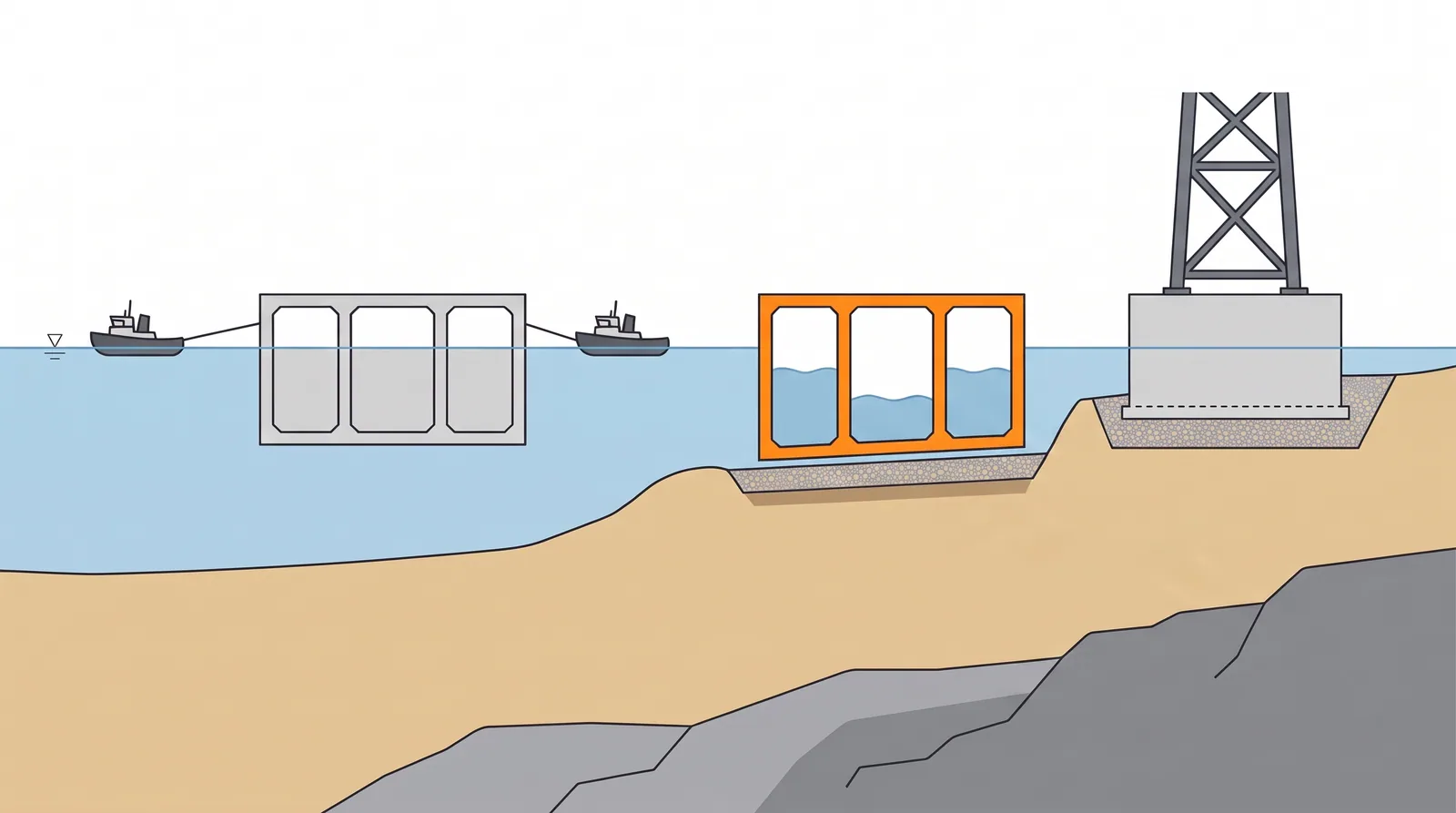
How it is done
- Survey and prepare the seabed: dredge soft material to the founding stratum and place and screed a gravel or rock bed, or improve the ground (steel-pipe inclusions at Rion–Antirion), or pre-install piles through a template.
- Build the caisson in a dry dock, on a slipway or on a submersible barge; for very large units build the base in dock and complete the walls afloat in a wet dock.
- Check floating stability (metacentric height) for every stage of building, towing and immersion, and use compartments to control trim and heel.
- Tow to site with tugs in a forecast window, connect to a pre-laid mooring spread and position with GNSS and winches.
- Immerse by controlled ballasting of compartments, holding position until touchdown, and survey position and level on seating. Hold point before filling.
- Fill with ballast, sand or underwater concrete (anti-washout concrete at Akashi Kaikyo), and grout under the base where contact is incomplete.
- Place scour protection around the base, then build the pier or pylon base on top.
Key numbers
- Water depthabout 15–65 m (Rion–Antirion up to 65 m)
- Footprint30–90 m across (Akashi Kaikyo 80 m, Rion–Antirion 90 m diameter)
- Immersion windowtypically one to three days of low waves and low current
- Programmemonths to a year in the yard; days at sea for immersion
Where it fits
- Straits and estuaries with firm seabeds or rock, pylon foundations, water 15-60 m deep, sites with a yard within towing distance.
Where it does not
- Soft seabeds without piles (settlement and bearing failure), sites with no weather windows for towing.
Choosing it
- Choose it over piling in place when the water is deep (more than about 20–30 m), the seabed can be dredged to a firm layer and a dock lies within towing distance; most of the work then moves to the yard.
- Choose it for pylons and anchorages in straits with short weather windows: offshore work shrinks to bed preparation and a few days of immersion.
- Prefer piles or an open caisson where soft soils extend deep; a floating caisson needs a competent bearing layer or ground improvement.
- Prefer construction in a cofferdam in shallow, sheltered water where a dock and tow are not justified.
Plant, pace and money
PlantDry dock or slipway, tugs, mooring spread, ballasting systems, survey and positioning.
ProductivityMonths in the yard; days at sea for seating.
CostUSD 20-150 million for a large pylon caisson.
Risks and controls
What goes wrong
- Loss during tow, seating out of tolerance, bed scour after seating, ship impact before the pylon is built.
Quality assurance
Bed survey before seating, seating tolerance survey, ballast records.
Origins
Floated and sunk caissons were used in harbour works from the 19th century; for bridges the method grew to its present scale with the Honshu–Shikoku crossings in Japan, culminating in the 80 m steel caissons of the Akashi Kaikyo Bridge (1998), and with European strait crossings of the 1990s and 2000s.
Examples
Akashi Kaikyo, Great Belt East, Oresund, Rion-Antirion (on improved ground), Busan-Geoje.
Case studies
Akashi Kaikyo BridgeJapan · 1998Main tower foundations are steel caissons 80 m and 78 m in diameter, towed out, sunk onto seabed excavated by grab dredger and filled with anti-washout underwater concrete.
Rion–Antirion BridgeGreece · 2004Four 90 m diameter caisson bases in up to 65 m of water, started in a dry dock and completed afloat, then sunk onto a gravel bed over soil reinforced with steel-pipe inclusions.
Changtai Yangtze River Bridge, main pierChina · 2025A 95 × 57.8 m steel-shell caisson prefabricated on shore and floated to site, then sunk as an open caisson by water ballast, concreting and excavation in 36 compartments.
Related methods
Open caisson (well foundation)Gravity base foundationsPrecast and floating cofferdam boxesFloating (pontoon) bridge construction and towing
Further reading
fib Bulletin on marine structures · Gimsing and Georgakis, Cable Supported Bridges · Gerwick, Construction of Marine and Offshore Structures · Combault and Teyssandier, papers on the Rion–Antirion bridge foundations