How bridges get built · Caissons and marine foundations · Pneumatic caisson
Also called: compressed-air caisson, pneumatic well
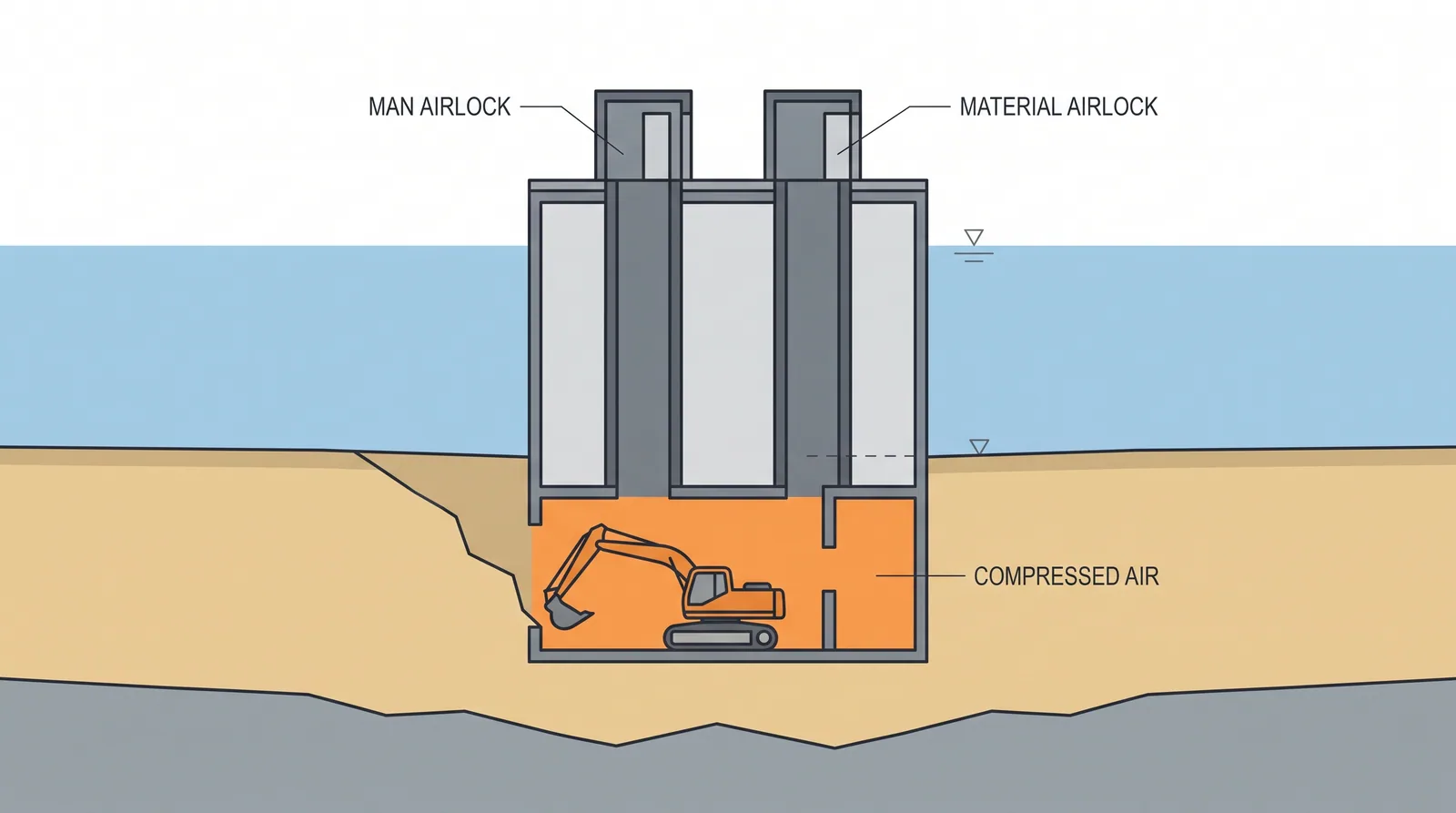
How it is done
- Build the cutting edge and a working chamber with a sealed roof, then the walls in lifts; fit man and material locks on shafts through the roof.
- Pressurise the chamber just enough to balance the water head at the cutting edge, keeping it dry, and adjust the pressure as depth and tide change.
- Excavate the chamber floor evenly (by hand historically, now with ceiling-mounted excavators operated remotely from the surface), removing spoil through the material locks.
- Lower the caisson by controlled excavation under the edge, adding lifts and ballast; survey tilt and position every shift.
- Apply decompression schedules to anyone working under pressure, with a medical lock, hyperbaric staff and gas monitoring; use mixed gas at the higher pressures.
- At founding level, inspect and test the base directly (probing or plate tests), then fill the chamber with concrete under pressure and grout the contact with the roof.
- Release the pressure, fill the shafts, remove the locks and cast the cap.
Key numbers
- Air pressureequal to the water head at the cutting edge, about 0.1 MPa per 10 m
- Manned limitgenerally about 0.35–0.4 MPa (35–40 m of head)
- Sinking rate0.3–1 m per day
- Historic depthBrooklyn Bridge Manhattan caisson stopped at about 24 m
Where it fits
- Founding on rock or in boulder beds under 20-35 m of water and soil, where direct inspection of the base is required; urban sites with tight footprints (Tokyo expressways).
Where it does not
- Depths beyond about 35 m (air pressure over 0.35 MPa), sites without specialist contractors.
Choosing it
- Choose it over an open caisson when boulders, timber or rock outcrops would stop the cutting edge, or when the base must be seen and tested before concreting.
- Choose it next to sensitive structures: the dry chamber prevents the soil inflow and ground loss that open dredging can cause, which is why it suits dense cities such as Tokyo.
- Prefer an open caisson or bored piles beyond about 35–40 m of head, unless an unmanned system and a specialist contractor are available.
- Prefer bored piles or a cofferdam at modest depths; locks, compressors and medical cover are costly to mobilise.
Plant, pace and money
PlantAirlocks, compressors, decompression chambers, remote excavators, medical lock and hyperbaric support.
Productivity0.3-1 m per day.
CostHighest of the caisson family; USD 10-40 million per pier.
Risks and controls
What goes wrong
- Decompression illness, blow-outs, fire in the chamber, base heave when the pressure drops.
Quality assurance
Pressure logs, base inspection records, air quality monitoring.
Origins
Jacques Triger used compressed air to sink a mine shaft in France in 1841; the method reached bridge piers in Britain in the 1850s, including Brunel's Royal Albert Bridge at Saltash, and was taken to record depths by Eads at St Louis and the Roeblings in New York in the 1870s, at a heavy cost in caisson disease.
Examples
Brooklyn and Eads bridges historically; modern Tokyo Metropolitan Expressway piers and some Chinese river bridges.
Case studies
Royal Albert Bridge, SaltashUK · 1859Brunel founded the central river pier through a wrought-iron cylinder about 11 m (37 ft) in diameter with a compressed-air working chamber, one of the first bridge uses of the method.
Eads Bridge, St LouisUSA · 1874Pneumatic caissons took the river piers to rock beneath the Mississippi; caisson disease killed more than a dozen workers and prompted early medical study of decompression.
Brooklyn Bridge, New YorkUSA · 1883Timber pneumatic caissons; the Manhattan caisson was stopped at about 24 m on dense sand rather than taken to rock after decompression sickness had disabled workers, among them chief engineer Washington Roebling.
Forth BridgeUK · 1890Several of the cantilever piers were founded on large iron caissons sunk under compressed air.
Related methods
Further reading
JSCE pneumatic caisson guidelines · McCullough, The Great Bridge · Work in Compressed Air Regulations 1996 (UK) · Japan Road Association, Specifications for Highway Bridges, Part IV (Substructures)