Also called: float-in erection, barge-assembled arch, whole-span float-in
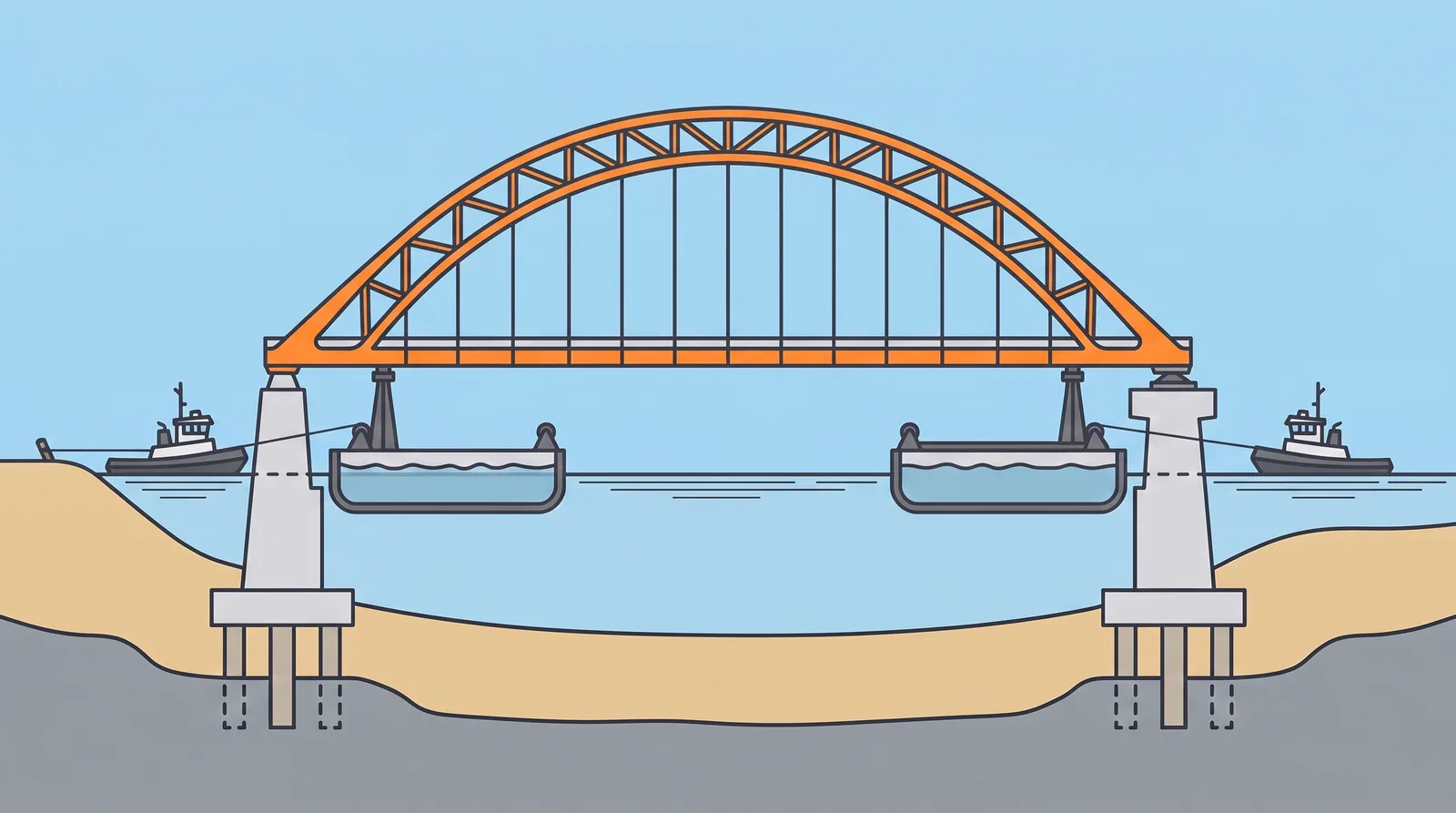
How it is done
- Assemble the span on a quay, slipway or barges near the site, completing as much as the barge capacity allows (bracing, deck plate, sometimes the deck slab).
- Prepare the permanent piers with landing bearings or temporary seats, guides and jacking points, and survey them against the as-built span length at a reference temperature.
- Load out onto barges by SPMT, skidding or floating off; check barge stability, ballast plan, moorings and the span's stresses on its temporary supports.
- Tow at slack water within the forecast window, using tugs and winches to warp the barges between the piers, with abort points along the route.
- Position over the piers and set down by ballasting the barges, lowering with jacks on the barges, or lifting with strand jacks on the piers where the span must rise above barge level.
- Transfer the load to the bearings, release and remove the barges before the tide or current changes, then connect joints and approaches.
Key numbers
- Spans moved wholeabout 80–300 m tied arches and trusses
- Weightsabout 1,000–10,000 t (Fremont centre span about 5,400 t)
- Weather windowweather-restricted operations planned within a reliable forecast of up to about 72 hours (DNV)
- Bargesabout 5,000–20,000 t displacement
- Marine operationUSD 1–5 million (indicative)
Where it fits
- Tied arches and trusses of 100-300 m over navigable water, harbour crossings, replacement spans.
Where it does not
- Rough water, sites without an assembly area, spans too heavy for available barges.
Choosing it
- Choose float-in over piece-by-piece erection when navigation must stay open except for one short closure and an assembly site is within towing distance.
- Prefer SPMT or a lateral slide when the crossing is over land or the water is too shallow for loaded barges.
- Prefer a floating crane when the span is within crane capacity: less ballast engineering and fewer marine days.
- Avoid it where currents are strong or the weather window is unreliable, unless the operation can be held safely partway.
Plant, pace and money
Risks and controls
What goes wrong
- Weather during the tow, barge stability, misalignment on landing.
Quality assurance
Naval architecture check of the tow, float-in procedure with abort criteria, survey on landing.
Origins
Robert Stephenson floated the wrought-iron tubes of the Britannia Bridge (1850) into position on pontoons and raised them with hydraulic presses; floating complete spans became routine for river trusses and arches in the 20th century, the Fremont Bridge lift (1973) being a landmark.
Examples
Fremont Bridge (Portland) centre span, several Dutch and German river arches, Chinese Yangtze tied arches.
Case studies
In the bridge game
What Bridge Master applies when you pick it
Deck types: Steel arch, Steel truss, Steel box girder, Network tied arch. Spans 100-250 m, up to 300 m.
- +30: Tied arch over a channel: float it in.
- -45: No draft for barges.
- -20: Fast current: positioning a floated arch is a day-long gamble.
- -25: A one-off operation for one span: on a multi-span viaduct it is the exception for the main span, not the method for the deck.
Related methods
Further reading
Rosignoli · PIANC guidance on marine operations · DNV-ST-N001 Marine operations and marine warranty