How bridges get built · Cable-supported and arch bridges · Cable crane (cableway) erection
Also called: cableway crane, aerial cableway, cable crane for arches
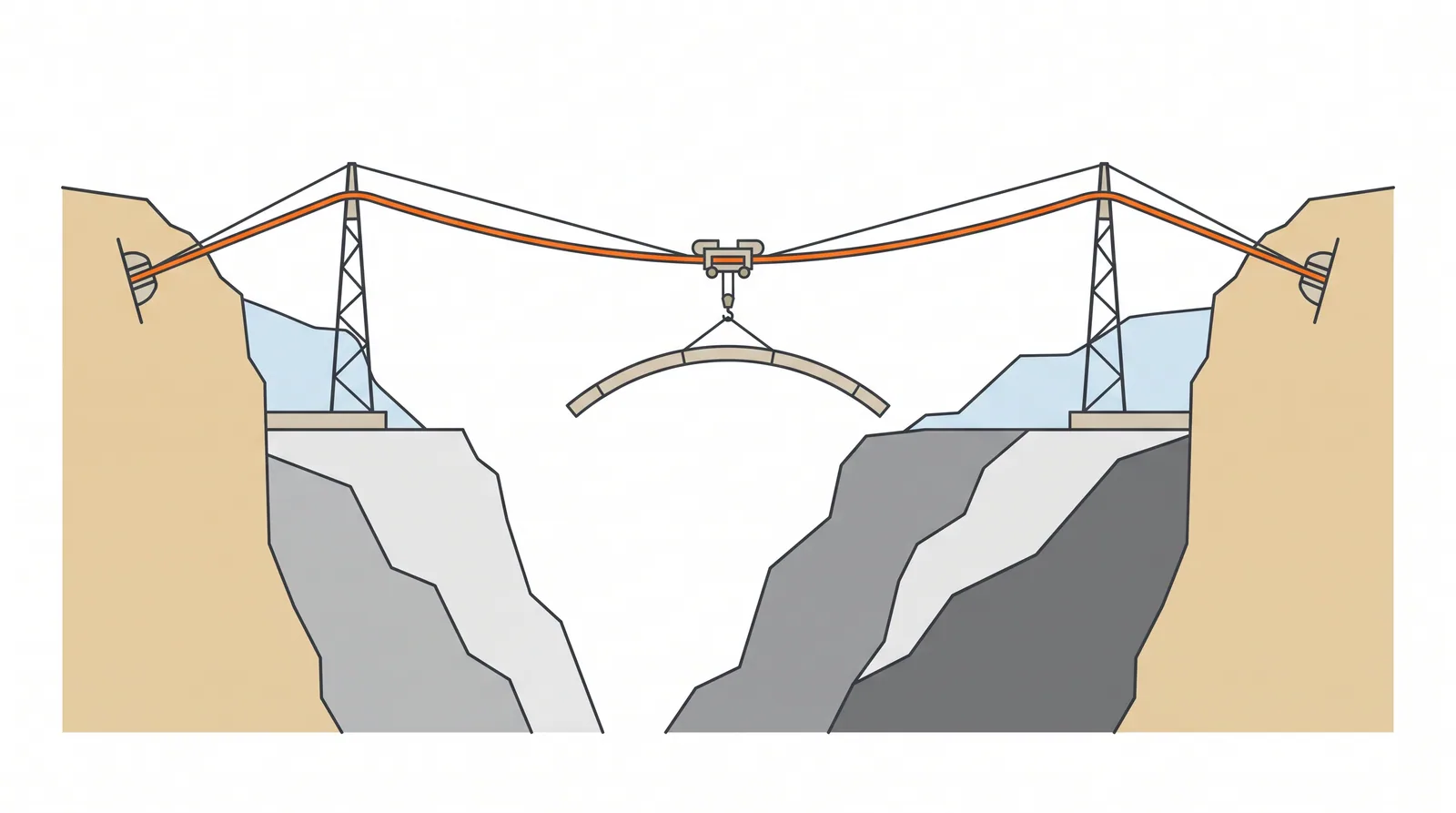
How it is done
- Design the cableway for the heaviest segment with rigging and dynamic effects: span between towers, sag, number of track cables, tower height and backstay anchorages.
- Build the towers (on or behind the abutments, often 50–150 m tall) and their anchorages; string the track cables, hauling and hoisting ropes and the trolleys.
- Load-test the system (static and dynamic overload tests, commonly 1.1–1.25 times the working load) and set wind and operating limits.
- Lift segments from the staging area or a barge, traverse to position and lower them onto the cantilever tip, the falsework or the arch skeleton, coordinating each placement with the tie-back stay installation.
- Monitor tower tilt, anchorage loads and rope wear, and inspect ropes and sheaves on a fixed schedule.
- After arch closure, use the cableway for spandrel columns, cross beams and deck elements, then dismantle the ropes and towers.
Key numbers
- Cableway spantypically 300–900 m between towers
- Capacityabout 50–300 t per lift (Pingnan Third Bridge segments up to about 215 t)
- Towersabout 50–150 m tall, with backstays to rock or gravity anchors
- Load testabout 1.1–1.25 times the working load
- System costUSD 3–15 million (indicative)
Where it fits
- Steel and concrete arch segments of 50-300 t over gorges 200-600 m wide; truss erection; sites with no road access to the span.
Where it does not
- Flat sites where a crane or gantry is cheaper; loads beyond the cableway capacity.
Choosing it
- Choose a cable crane over mobile cranes and gantries when the valley floor is inaccessible or far below, and segments must be delivered anywhere along the span.
- Prefer creeper or derrick cranes riding on the arch when segments arrive by water directly below the span.
- Prefer float-in or strand-jack lifting for tied arches over water when the whole span can be assembled at a quay.
- Size the cableway for the heaviest segment; segment weights and cableway capacity are designed together.
Plant, pace and money
PlantCable crane system 100-400 t, towers, winches, anchorages.
ProductivitySeveral lifts per day.
CostUSD 3-15 million for the system; a large item in the arch budget.
Risks and controls
What goes wrong
- Tower or anchorage failure, rope wear, load swing in wind.
Quality assurance
Rope inspection, load tests, wind limits.
Origins
Cableways were used to build dams and mountain arches from the late 19th century; New River Gorge (1977) used them for a 518 m steel arch, and in China cable cranes combined with tie-back stays became the standard way of building CFST and stiff-skeleton arches from the 1990s.
Examples
New River Gorge (518 m, 1977), Hoover Dam bypass (2010), and Chinese CFST arches such as Wushan (460 m, 2005) and Pingnan Third (575 m, 2020).
Case studies
New River Gorge BridgeUSA · 1977518 m steel arch cantilevered from both rims with tie-backs, the steel delivered by cableways spanning the gorge.
Mike O'Callaghan–Pat Tillman Memorial Bridge (Hoover Dam bypass)USA · 2010High-line cable cranes across Black Canyon served the 323 m arch; one system collapsed in high winds in 2006, delaying the project by about two years.
Pingnan Third BridgeChina · 2020575 m CFST arch; prefabricated sections of up to about 215 t, shipped by water, were placed by a large cable crane on two tall truss towers, with the half-arches anchored back to the towers.
In the bridge game
What Bridge Master applies when you pick it
Deck types: Concrete arch, Steel arch, Steel truss, Precast segmental box. Spans 150-450 m, up to 600 m.
- +30: Very deep gorge: cableway.
- -40: Only for gorges.
Related methods
Arch erection by cantilever with temporary staysCantilever erection of steel (derrick and lifting frames)Truss assembly and erectionConcrete arch on centering and the Melan (stiff skeleton) methodConcrete-filled steel tube (CFST) arch construction
Further reading
Chen and Duan, Bridge Engineering Handbook · Chinese arch bridge construction papers