Also called: piezocone, static cone
How it is done
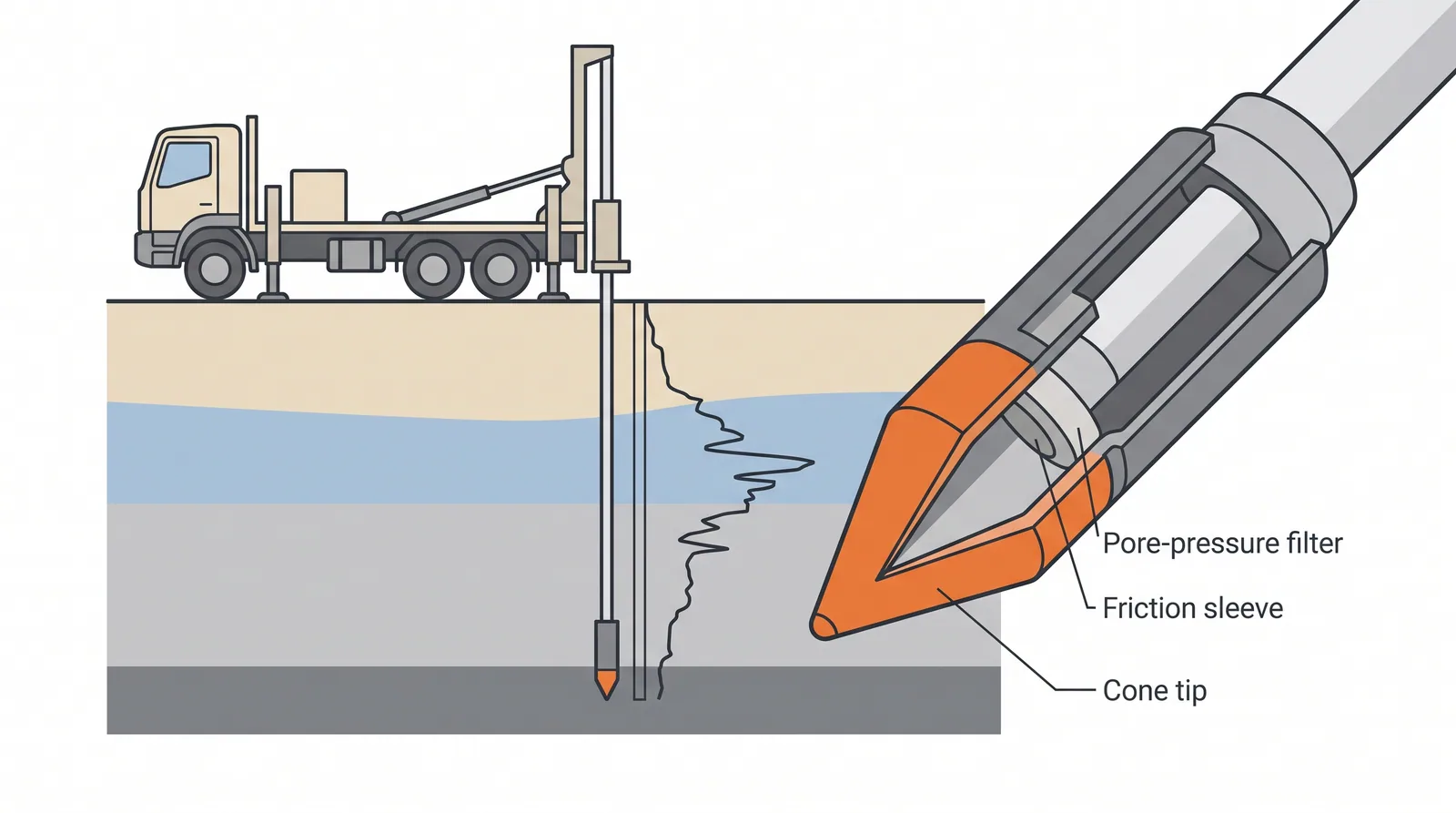
- Choose the cone and push system: a 10 cm² (35.7 mm) or 15 cm² piezocone with u2 filter on a 100–200 kN truck or crawler; on water, a seabed frame or downhole CPT through a drill string.
- Saturate the pore pressure element (glycerine or silicone oil) and record zero readings before each push; set the rods vertical and use the cone's inclinometer.
- Push at 20 mm/s, logging tip resistance, sleeve friction, pore pressure and inclination every 10–20 mm; predrill through fill, crusts or obstructions.
- Stop for dissipation tests in clay and silt layers to obtain consolidation coefficients and equilibrium pore pressure; a seismic CPT adds shear-wave velocity every 0.5–1 m.
- End the sounding at target depth or on refusal (rig thrust, tip capacity or excessive inclination); take zero readings after extraction and reject soundings with excessive drift.
- Correct qc to qt for pore pressure, classify the soil behaviour type, and derive undrained strength, stress history, relative density and pile resistance with CPT-based methods.
- Calibrate the correlations against sampled boreholes and laboratory tests for each soil unit before using them in design.
Key numbers
- Standard cone10 cm² base, 35.7 mm diameter, 60° apex, 150 cm² sleeve; push rate 20 mm/s.
- Typical depth20–40 m in soft to medium soils from a 200 kN rig; refusal in dense sand, gravel or cemented layers.
- Undrained strengthsu = (qt − σv0)/Nkt with Nkt typically 10–20, calibrated per site.
- Outputabout 100–150 m of sounding per day on land.
- Dissipation testsminutes in silts to several hours in plastic clays.
Where it fits
- Soft clays, silts, loose sands, reclaimed fill, liquefaction assessment.
- Long viaducts over alluvium where dozens of profiles are needed cheaply.
Where it does not
- Gravels, cobbles and cemented layers: the cone refuses or breaks.
- Rock, obviously; and depths beyond 30-40 m in stiff ground without predrilling.
Choosing it
- Choose CPTu over boreholes for profiling soft and loose soils, screening liquefaction and designing driven piles in sand: it is continuous, repeatable and cheaper per metre.
- Prefer boreholes where samples, rock proof or groundwater observations are needed, and in gravel, cobbles or cemented layers where the cone refuses.
- Use a seismic CPT instead of a separate geophysical survey when small-strain stiffness or site class is needed at specific piers.
- Prefer CPT-based pile methods (UWA-05, ICP-05, Unified) to SPT correlations for driven piles in silica sand; in carbonate sands calibrate them with load tests first.
Plant, pace and money
Risks and controls
What goes wrong
- Refusal on a thin gravel lens can be mistaken for bedrock.
- Pore pressure element de-saturating if handled carelessly.
Quality assurance
Cone calibration certificates, zero readings before and after every push, saturation procedure recorded.
Origins
Developed in the Netherlands, where Barentsen ran the first mechanical cone soundings in 1932; Begemann added the friction sleeve in the 1950s, Fugro introduced the electric cone in 1965, and the piezocone became standard practice from about 1980.
Examples
Standard in the Netherlands, the Gulf reclamations and Korean west-coast estuaries; used with the LCPC and UWA methods for driven pile design.
Case studies
Related methods
Further reading
ASTM D5778 · ISO 22476-1 · Lunne, Robertson and Powell, Cone Penetration Testing in Geotechnical Practice · Robertson and Cabal, Guide to Cone Penetration Testing for Geotechnical Engineering · ISSMGE International Reference Test Procedure for CPT and CPTU (1999) · Lehane et al. (2005) CPT-based design method for driven piles in sand (UWA-05)