Also called: rotary drilling, cable percussion, standard penetration test
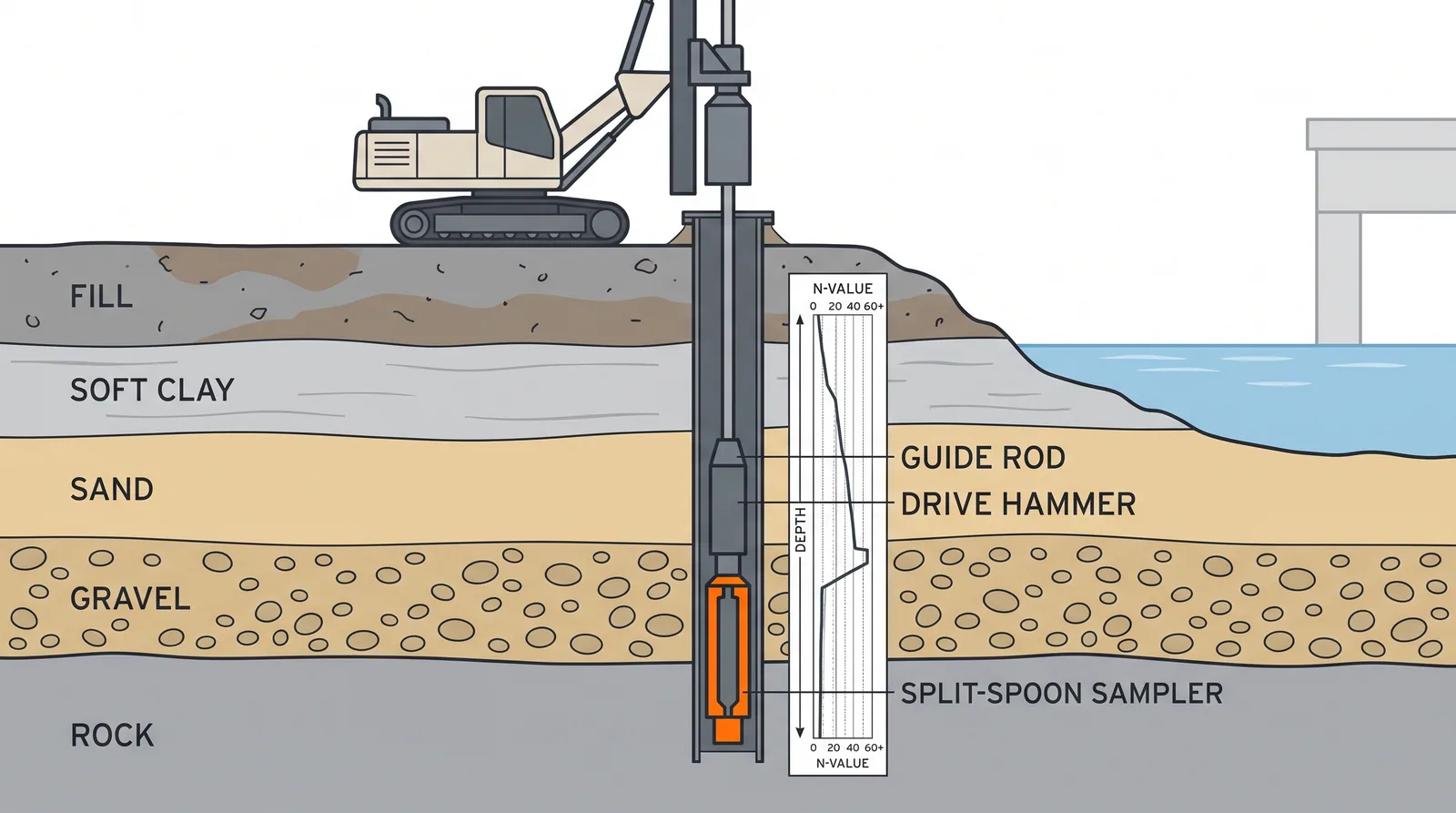
How it is done
- Set out holes from the desk-study ground model: at least one per pier and abutment, more under large pile groups, caissons or variable ground; survey each position and ground or seabed level to the project datum.
- Advance in soil by cable percussion or by rotary wash or mud drilling with casing; keep the hole full of water or drilling fluid below the water table so sand does not heave into the base.
- Run SPTs at 1.0–1.5 m intervals, continuously in critical layers: 63.5 kg hammer, 760 mm free fall, 150 mm seating drive and then the blows for 300 mm (N), recording each 75 mm and stopping at the specified refusal count.
- Take thin-wall or piston samples in soft to firm clays and split-spoon samples elsewhere; seal, label and protect them from drying and vibration on the way to the laboratory.
- At rock, change to double- or triple-tube coring and core at least 3–5 m (or three pile diameters) to prove bedrock rather than a boulder.
- Record water strikes, rises and stable levels; install standpipes or vibrating-wire piezometers in selected holes and grout the rest from the base.
- Measure the hammer energy of each rig and correct N to N60; schedule classification, strength and consolidation tests, then issue factual logs before the interpretive report.
Key numbers
- SPT63.5 kg hammer, 760 mm drop, N = blows for 300 mm after 150 mm seating; tests every 1.0–1.5 m.
- Hammer energy ratioabout 45–95 % of theoretical between hammer types; automatic trip hammers typically 70–90 %; normalise to N60.
- Depth below pile toesEN 1997-2 asks at least 5 m, three pile diameters and the group width; AASHTO asks 6 m or twice the group dimension; core 3–5 m of sound rock.
- Depth below spread footingsEN 1997-2 asks at least three footing widths and 6 m; AASHTO asks two to four widths depending on footing shape.
- Output10–25 m per shift on land in soil; offshore about one 50–70 m hole every 2–4 days including moves.
Where it fits
- All bridge foundations; the minimum is one hole per support, taken at least 5 m and three pile diameters below the deepest pile toe (deeper under wide groups), or about three footing widths below a spread footing.
- Sands and silty sands, where the N-value carries the design; treat N in gravel as an upper bound.
Where it does not
- Relying on SPT alone in soft clays and silts: use CPT and vane tests too.
- Stopping the hole at the first rock: prove it is bedrock, not a boulder, by coring 3-5 m.
Choosing it
- Drill a borehole at every support: only boreholes give samples, groundwater observations and proof of rock.
- Prefer CPTu to profile soft clays, silts and loose sands between boreholes, and calibrate it against the sampled holes.
- Prefer cable percussion for sampling stiff clays and gravels at shallow depth; prefer rotary mud drilling for holes deeper than about 30–40 m or over water.
- Do not let SPT N carry the design in soft clay (use vane and CPTu) or in gravel, where N is inflated by particle size.
Plant, pace and money
Risks and controls
What goes wrong
- Boulders mistaken for rock head.
- Uncorrected hammer energy: N-values from different rigs are not comparable without calibration.
- Artesian water in confined sands blowing the hole.
Quality assurance
Energy-calibrated hammers, continuous logging by an engineering geologist, photographs of every core box, standing water levels on every log.
Origins
Grew out of the drive sampling Charles Gow introduced in Boston about 1902; the split-barrel sampler and the 63.5 kg, 760 mm drop were standardised by the Raymond Concrete Pile Company in the late 1920s, Terzaghi and Peck (1948) made N a design parameter, and ASTM first issued D1586 in 1958.
Examples
Marine investigations for sea bridges typically run 40-70 m holes from jack-ups; the game's borehole cost per hole is scaled from this.
Case studies
Related methods
Further reading
ASTM D1586 (SPT) · ISO 22476-3 · Eurocode 7-2 · ASTM D4633 (SPT energy measurement) · ASTM D1587 (thin-walled tube sampling) · Clayton, The Standard Penetration Test (SPT): Methods and Use (CIRIA Report 143) · ISO 22475-1 (sampling methods and groundwater measurements)