How bridges get built · Cable-supported and arch bridges · Cable wrapping and dehumidification
Also called: main cable dehumidification, cable wrapping, cable corrosion protection
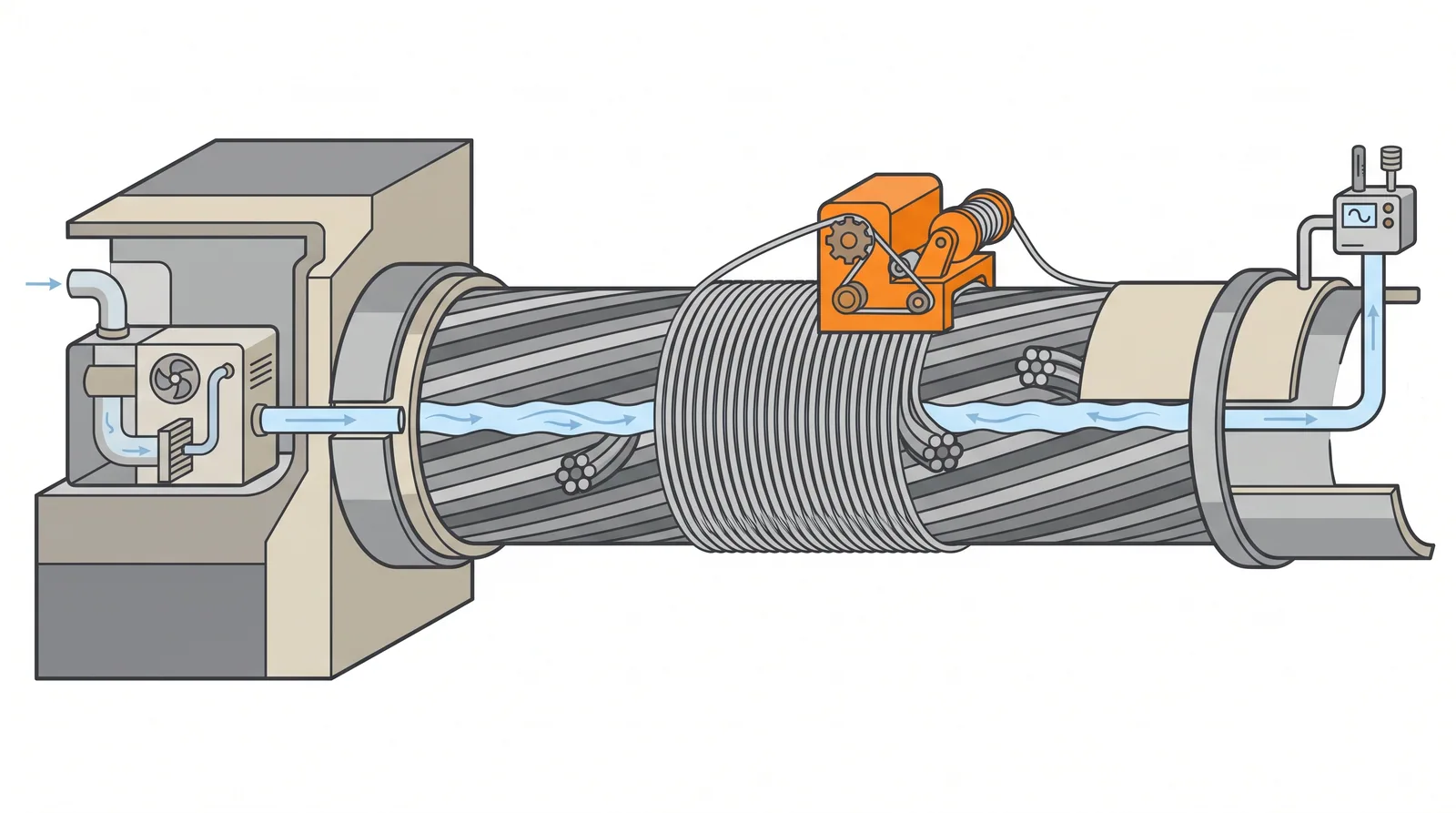
How it is done
- Prepare the cable: on a new bridge after compaction and banding; on an existing cable, open and inspect sample panels and clean or replace corroded and broken wires as needed.
- Wrap the cable airtight with interlocking S-shaped wire and an elastomeric coating, or with an elastomeric wrapping tape, over any specified paste.
- Seal every discontinuity (cable bands, saddle covers, splay chambers, hanger exits) so the cable becomes a sealed duct.
- Install injection sleeves at intervals with exhaust sleeves between them, a dehumidification plant (desiccant dryers and fans) in the tower, anchorage or deck, ducting, and humidity and temperature sensors at the exhausts.
- Pressure-test each wrapped length for airtightness and repair leaks before commissioning.
- Run the plant continuously, injecting dry air at about 40 % relative humidity or lower, and monitor the exhausts until the whole cable has dried.
- Keep monitoring humidity and plant performance, and inspect wraps and seals periodically; combine with internal cable inspections and, on old cables, acoustic monitoring of wire breaks.
Key numbers
- Target inside the cabledry air at 40 % relative humidity or lower
- Corrosion of zinc and steel accelerates above about 60 % relative humidity, so the target leaves a margin
- Closed steel box girders and anchorage chambers: typically held at or below about 50 % relative humidity
- Retrofitwrapping, sleeves and plant typically take one or two working seasons on a major bridge
- Costtypically a few million USD per bridge (indicative), small against cable replacement
Where it fits
- All new suspension bridges; retrofit on cables with wire breaks found in inspections; also stay anchorages and closed box girders.
Where it does not
- Skipping the airtightness test; a leaking wrap wastes the plant.
Choosing it
- Specify it on every new suspension bridge: the plant is cheap relative to the cable, and traditional paste and wrap has a record of trapping moisture.
- Retrofit an existing cable when inspection finds active corrosion or wire breaks, and pair it with acoustic monitoring to confirm that deterioration has stopped.
- Choose S-wire with an elastomeric coating or an elastomeric wrap to suit the owner's maintenance practice; either works only if bands and saddles are sealed.
- Do not treat it as a substitute for inspection: keep humidity records and plan internal cable inspections at intervals.
Plant, pace and money
PlantWrapping machine, dehumidifiers, ducting, sensors.
ProductivityWeeks per cable.
CostUSD 1-5 million per bridge; small against cable replacement.
Risks and controls
What goes wrong
- Wrap leaks at bands, plant failure unnoticed, condensation at cold spots.
Quality assurance
Pressure tests of the wrapped cable, humidity logs, periodic inspection.
Origins
Dry-air systems were first used inside closed steel box girders; Japanese engineers applied them to main cables on the Akashi Kaikyo Bridge (1998), and from the 2000s they were retrofitted to older cables in Europe and the US after inspections found broken and corroded wires.
Examples
Akashi Kaikyo (first), Great Belt, Humber retrofit, Forth Road Bridge retrofit, Yi Sun-sin.
Case studies
Akashi Kaikyo BridgeJapan · 1998First main cables designed with dry-air injection from new.
Forth Road BridgeUK · 2008–2009A 2004 internal inspection found corroded and broken wires and a loss of cable strength; dehumidification and acoustic monitoring were installed to halt the deterioration.
Severn BridgeUK · 2008Main cable dehumidification retrofitted after an inspection found corroded and broken wires.
Related methods
Suspension bridge erection: cables, hangers and deckAerial spinning of main cablesPrefabricated parallel wire strands (PPWS)Stay cable installation and tensioningStay cable and hanger replacement
Further reading
NCHRP Report 534 Guidelines for inspection and strength evaluation of suspension bridge cables · HSBA dehumidification papers