How bridges get built · Site investigation and testing · Scour investigation and hydraulic study
Also called: hydraulic analysis, bed material sampling, flood modelling
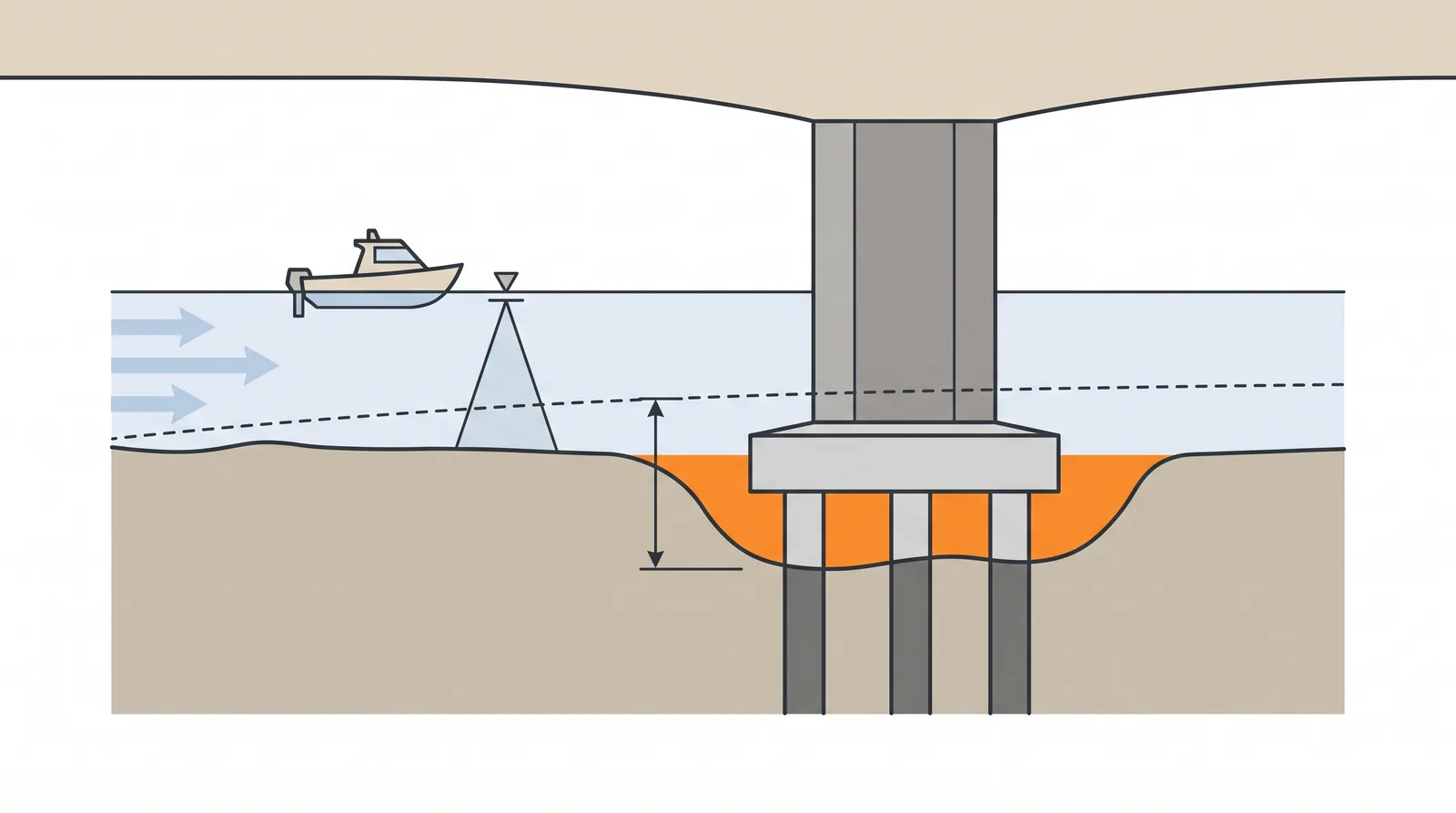
How it is done
- Collect hydrology: gauged discharges or rainfall-runoff estimates, design and check floods, and tide and surge conditions for estuaries.
- Study river morphology from historic maps and imagery: channel migration, braiding, long-term bed lowering or rise, and human effects such as dredging, sand mining and dams.
- Survey the channel: bathymetry, cross-sections upstream and downstream, velocities by ADCP, bed and bank samples (grading, cohesion) and the thickness of erodible sediment above rock.
- Model the hydraulics: 1D for straight reaches, 2D or 3D for bends, skewed crossings, multiple openings and estuaries, with and without the bridge and its temporary works.
- Compute each scour component: long-term degradation, contraction scour, local pier and abutment scour, with debris and skew effects; use erosion-rate methods for cohesive soils and weak rock.
- Combine them into total scour, design the foundations for loss of support at the design flood and for stability at the check flood, and decide on countermeasures.
- Write the scour monitoring and inspection plan: post-flood inspections, sonar or fixed instruments, and trigger levels for closure.
Key numbers
- Design floods (HEC-18)100-year for design (200-year for critical bridges), 500-year for check.
- Local pier scour (HEC-18)up to about 2.4 times the pier width for Froude numbers up to 0.8, and 3.0 times above.
- Hydraulic causes (flood and scour) account for roughly half of recorded US bridge failures (Wardhana and Hadipriono, 2003).
- In large alluvial rivers, contraction scour and degradation can exceed local scour, reaching tens of metres.
Where it fits
- Every river, estuary and tidal crossing; also canals with fast flows.
Where it does not
- Using a single average velocity for a braided or meandering river; the thalweg can move to any pier.
Choosing it
- Design new foundations to survive total design scour without relying on armour; treat countermeasures as a second line.
- Choose 2D modelling over 1D for skewed crossings, bends, estuaries and multiple openings, where velocity and angle of attack differ at each pier.
- Use erosion-rate testing of cohesive and rock-like beds instead of sand-based equations, which can greatly overpredict scour there.
- In migrating or braided rivers design every pier as if it stood in the main channel, or use fewer, longer spans.
Plant, pace and money
PlantSurvey boat with echo sounder, ADCP for velocities, bed samplers.
ProductivityA few days of fieldwork and a few weeks of modelling.
CostA small fraction of the project; the game's scour check is HEC-18 and it is the most common reason a design is marked poor.
Risks and controls
What goes wrong
- Bed changes during construction (cofferdams narrow the channel).
- Debris rafts on piers increasing effective pier width.
Quality assurance
Post-construction bed survey and a monitoring plan with a trigger level.
Origins
Systematic scour evaluation of US bridges followed the 1987 Schoharie Creek collapse: FHWA issued its scour technical advisory in 1988 and the first edition of HEC-18 in 1991.
Examples
Schoharie Creek 1987 (US) and many monsoon-region collapses are scour failures.
Case studies
Schoharie Creek BridgeUSA · 1987Flood scour undermined a pier on spread footings whose riprap had not been maintained; two spans fell and 10 people died. It triggered the national scour evaluation programme.
Hatchie River BridgeUSA · 1989Lateral migration of the channel undermined approach piers that had not been designed for the river; spans collapsed and 8 people died.
Hintze Ribeiro BridgePortugal · 2001A pier failed after the bed of the Douro was lowered, a loss linked to sand extraction; 59 people died.
Padma Multipurpose BridgeBangladesh · 2022Design scour of about 49 m for the 100-year flood plus liquefaction meant about 62 m of each roughly 120 m long, 3 m diameter raked steel pile was discounted for shaft resistance.
Related methods
Boreholes with SPT and samplingSheet-pile cofferdamScour protection: riprap, mattresses and collarsOver-water site investigation from jack-ups, barges and vessels
Further reading
FHWA HEC-18 and HEC-20 · AASHTO LRFD Section 2.6 · FHWA HEC-18 Evaluating Scour at Bridges (5th edition) · Melville and Coleman, Bridge Scour · CIRIA C742 Manual on scour at bridges and other hydraulic structures