How bridges get built · Piers, pylons and abutments · Pier heads, hammerheads and pier caps
Also called: hammerhead cap, pier cap construction, cantilever pier head
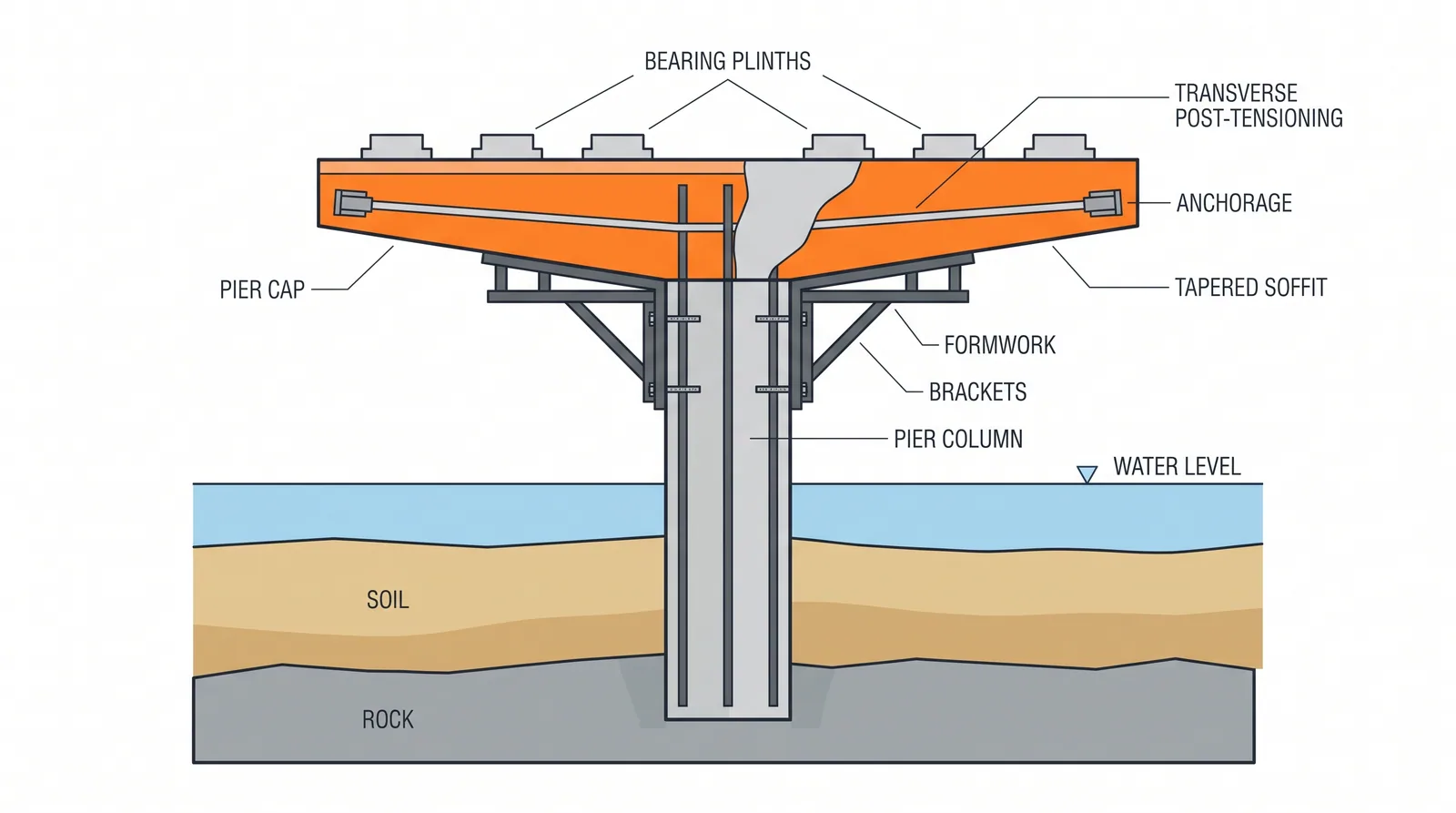
How it is done
- Cast the column to the soffit level of the head with cast-in sockets or through-holes for the bracket system, or plan a ground-founded shoring tower.
- Erect the brackets or shoring and the soffit, designed for the wet concrete and construction loads; inspect and release them for loading (hold point).
- Fix the head reinforcement, which is dense at the column junction, with post-tensioning ducts, anchorages and bursting steel for post-tensioned heads and starter bars for the bearing plinths.
- Pour the head in one operation where possible, applying mass-concrete thermal control in thick heads.
- Cure, then stress the tendons when the concrete reaches transfer strength, in stages if the design matches stressing to the girder loads; grout and seal the anchorages.
- Strike the soffit only after the strength or stressing stage the design requires, and remove the brackets.
- Survey and cast the bearing plinths to level, set shear keys and restrainers, and check support lengths and bearing positions.
Key numbers
- Head widthcommonly 8–20 m on single-column piers
- Depth at the column facetypically 1.5–3 m, often tapering towards the tips
- Thermal controlheads thicker than about 1–1.5 m are treated as mass concrete
- Bearing plinth level tolerancetypically ±3 mm
- Cycle2–3 weeks per head including brackets, stressing and striking
Where it fits
- Every pier with bearings; hammerheads for single columns under 12-25 m wide decks; multi-column caps on wide urban viaducts.
Where it does not
- Over-wide hammerheads without post-tensioning; brackets on slender columns without a check.
Choosing it
- Choose a hammerhead over a multi-column bent when the ground below must stay open (roads, rail, urban streets) or for appearance; it needs more reinforcement or post-tensioning.
- Prefer a multi-column bent with a cap beam on decks wider than about 20–25 m, or where a single column and foundation would be too large.
- Choose brackets fixed to the column over ground shoring when the head is high, over water or over traffic; shoring from firm ground is simpler for low heads.
- Prefer precast caps when closures below the cap are short or work over water is costly.
Plant, pace and money
PlantBracket system or falsework, crane, stressing jacks.
ProductivityTwo to three weeks per head.
CostUSD 600-1,000 per m3, higher than the column.
Risks and controls
What goes wrong
- Bracket collapse during the pour, cracking at the column junction, bearing plinth levels out of tolerance.
Quality assurance
Bracket design check, plinth survey, tendon stressing records.
Origins
Hammerhead piers became the standard single-column pier of the postwar motorway programmes; post-tensioned heads, steel and integral caps, and precast caps (Texas from the 1990s) followed as decks widened and closures shortened.
Examples
Standard on the game's hammerhead piers under I-girder approaches.
Case studies
Lake Ray Hubbard bridges (SH 66), near DallasUSA · from 2000The contractor replaced cast-in-place caps on 43 consecutive bents with caps precast on site, set at about one bent per day; about six months were saved and about 80 % of the bent work moved off the water.
Related methods
Cast-in-place piers with formwork liftsBearing installation and settingPrecast segmental piers and caps
Further reading
PCI Bridge Design Manual · AASHTO LRFD 5